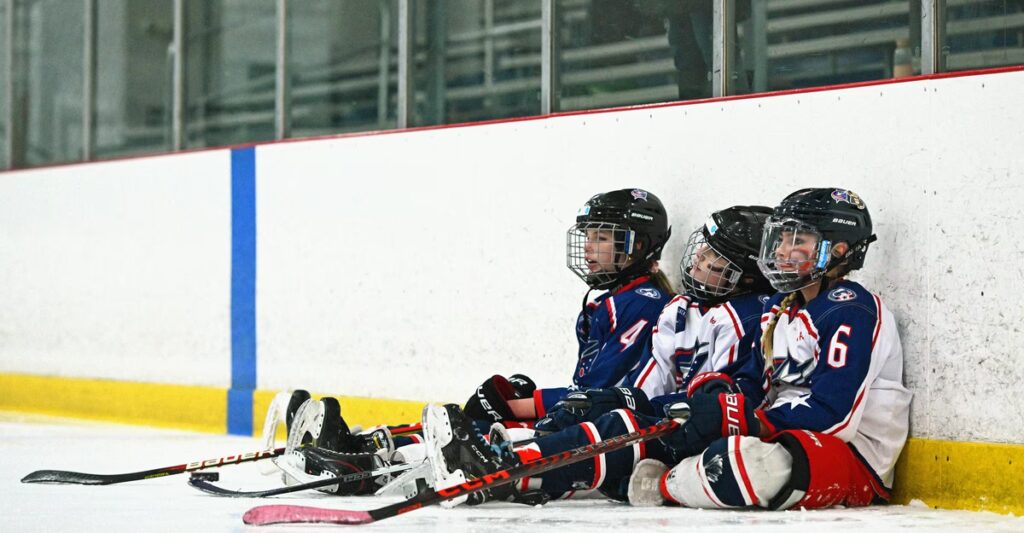
My 14-year-old son competes in a serious, multistate hockey league. During his five-month, 60-game season, he travels up and down the East Coast on weekends, and I occasionally miss votes in the Senate to watch him. Rider isn’t likely to play in the National Hockey League, nor is he interested in devoting his entire childhood to chasing a pro career as a goalie. He still plays other sports—flag football, basketball, and golf. That sounds about right for an eighth grader.
But for the owners of the Atlantic Hockey Federation—the youth-hockey association that pulls together elite teams from Connecticut and many other states, as far west as Arizona—kids’ sports is a cutthroat business, a way to make a handful of people very rich. Black Bear Sports Group owns the AHF, several other youth hockey leagues, and many of the rinks where the teams practice and play. Methodically and quietly, Black Bear—backed by the private-equity firm Blackstreet Capital Holdings—is tightening its stranglehold over the youth-hockey infrastructure along the Eastern Seaboard. Whereas Rider sees hockey as character-building fun, Black Bear’s objective is far simpler: to make a grotesque amount of money.
I first came face-to-face with this reality when I noticed a parent from our team sheepishly recording his son from a dark corner of the rink during one of our league games. Because our team travels so much, both parents—or other relatives—can’t always attend. Streaming games for grandparents or recording a child’s shifts on the ice seems like a natural way to share in these moments. I approached the parent and asked why he wasn’t standing in a better spot.
[Read: How private equity is changing housing]
“Wish I could,” he said. “I heard we could be docked points in the standings if parents are caught filming their kids.”
I was stunned. When my father recently uploaded all of our old home movies to the cloud, the first videos I pulled up were of my grade-school basketball games and tennis matches. What I learned next shocked me further. Black Bear had installed cameras in each rink that feed video footage into a subscription service—Black Bear TV—that charges parents as much as $37 a month. Subscribers can watch games remotely and must pay for the “premium” tier to share highlights, such as their daughter’s game-winning goal, with relatives. Of course, Black Bear could have allowed parents to livestream games to family members and still made money off the low-cost, AI-operated camera system. But that, apparently, wasn’t enough for the executives, so the company banned parents from streaming games for grandparents or the mother or father who didn’t drive two hours to the rink.
Investor money has warped youth sports in another way: It has individualized and professionalized the experience. Black Bear creates a youth-hockey experience that feels like the NHL—the youth league’s website keeps meticulously updated standings and individual statistical leaders’ pages. The kids on our team always know exactly where they rank in the race for the points, goals, and assists titles (and, if I’m honest, I also spend too much time on those pages). The winners of the league receive heavy embossed rings and championship hats, just as the Stanley Cup winners do.
The result is that youth-league hockey ends up being about the players, not about the team. Rider never plays with the same kids from one season to the next. Each year, players are reshuffled so that the best kids land on the most elite teams. If parents feel their child was unfairly cut, they move to another program—sometimes far from home—just to secure the best placement. This high-pressure environment, driven by parents and profit-hungry owners alike, has produced a youth-sports culture in which profit and individual achievement matter more than teamwork or character building.
This was not always the case. For most of the past century, youth sports were managed primarily by local park departments, parent-led leagues, and nonprofit groups such as Pop Warner and the Catholic Youth Organization. Parents’ dues went to support their work, not to maximize outside investors’ returns. The extent of commercialization was limited to a handful of local businesses donating a few hundred dollars to sponsor teams (my very first Little League team was sponsored by Dillon-Baxter Funeral Home, and our main rival was the team sponsored by Dillon-Baxter’s main rival, D’Esopo Funeral Chapel). Youth sports were mostly treated as a public good.
This was the better approach—and it served many valuable purposes. Few rituals are more formative and unifying than youth and high-school sports. For children, they build teamwork, resilience, and work ethic. For parents, they provide bonding moments—long car rides, talks after tough games, camaraderie with fellow parents. For communities, youth sports offer collective pride, bringing together adults across political, racial, and economic divides to cheer for their kids.
Now youth sports is seen as a profit opportunity—and in America, no such opportunity goes unpursued. Black Bear isn’t an outlier. Billion-dollar private-equity groups are rapidly buying up leagues and affiliated services. For instance, Varsity Brands, a company owned by the private-equity firm KKR, has a dominant position in youth competitive cheerleading. Kids’ sports are now a commodity, not a common good.
When I learned that the only way my parents could watch Rider’s games was by paying a fee a monopoly-seeking private company, I nearly gagged. A vital coming-of-age ritual for kids, and a bonding ritual for families, has been hollowed out and sold back to us. A grandfather shouldn’t have to help Black Bear’s investors buy a third vacation home just to watch a highlight reel of his grandson’s game.
But the sell-off of youth sports is no surprise. In America, little remains of what used to be called the public commons—the essential parts of life organized for mutual benefit rather than profit extraction. Hospitals, nursing homes, and insurance companies were once mostly nonprofit, run by local boards. No more. Education, from preschool to college, is being colonized by for-profit owners. Even utilities such as electricity and water, once treated as public goods, are being taken over by profit-obsessed investment firms.
Virtually everything in America has become a commodity—even middle-school hockey. Every minute of our life is fodder for profit maximization. And when everything exists primarily for someone else’s gain—even your child’s Saturday-afternoon game—it breeds emptiness and resentment.
That discontent doesn’t stay contained. It spills, inevitably, into our politics. Donald Trump is a symptom, not the cause, of America’s spiritual unraveling. He is no ordinary symptom. He could prove fatal to our 250-year experiment in multicultural democracy. But our nation would make a grave error if we believed we could repair what is broken within us simply by defeating Trump—or his successor—at the ballot box. A deeper rot festers in the American soul: a callousness toward our neighbors, a me-first selfishness, a relentless focus on “getting mine” even if it leaves others behind. Today, we worship false cults—profit at any cost, consumerism instead of citizenship, a blind faith in technology, a winner-takes-all politics—that leaves us feeling empty and devoid of purpose.
[Rogé Karma: The secretive industry devouring the U.S. economy]
We see the signs of this disintegration everywhere: in rates of addiction and self-harm, the retreat of young people into electronic devices, the collapse of once-powerful religious and civic institutions, rising political tribalism. Our waning concern for the common good—for broad, shared prosperity that gives every American a chance at a dignified, purposeful life—is the underlying crisis that has fueled Trump’s brand of divisive, bombastic politics.
Americans want to feel powerful and connected—in their individual life, in their family life, and in their community. They want work that feels meaningful and tethered to something more than the cold accumulation of profit. They want to live in communities whose fate is determined not by faraway forces but by the contributions and shared projects of their neighbors. They want a capitalism that rewards ingenuity and hard work but doesn’t leave people living lives of indignity. They want ethical and moral rules that bind everyone, with no exemptions for people with money or political power.
To achieve these ends, electoral politics is essential but insufficient. Democrats must do more than win the midterms or defeat Trump’s chosen successor—or Trump himself—in 2028. My party did that in 2018 and 2020, and it did little to change the social conditions that made the United States so fertile for Trumpism—including the runaway technology and consumerism that have given us a world where your teenager’s life may be made available to you via streaming service. Unless we repair the underlying emptiness in American life and restore a belief in the common good, new demagogues will always find an opening.
Chris Murphy is a Democratic senator from Connecticut. This essay is adapted from his forthcoming book, Crisis of the Common Good: The Fight for Meaning and Connection in a Broken America.
The post Money Is Ruining Youth Sports appeared first on The Atlantic.