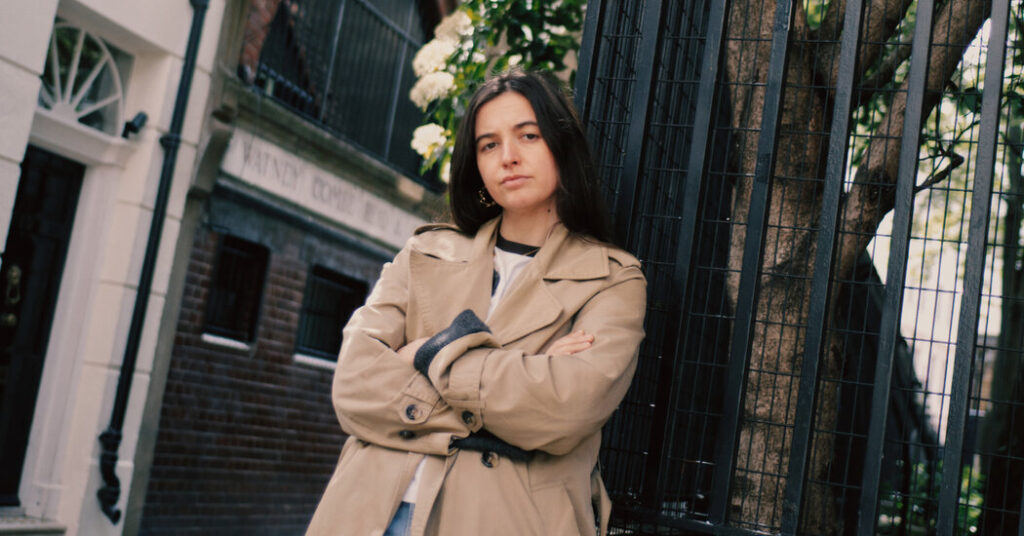
It was a few days before opening night, and Ava Pickett still wasn’t happy with her script. “1536,” the historical drama she was preparing to premiere on the West End, had already had a sold-out run at the Almeida Theater, where it picked up enthusiastic reviews and several awards. But something about the ending was bothering her. Was there time to tweak it?
“It’s like a song you keep playing and you find different things,” said Pickett, 32, sitting in the deserted bar at the Ambassadors Theater before the show opened there early this month. She looked embarrassed about adjusting the actors’ lines so close to the wire.
“I’m sure I do their heads in,” she said. “They’re very patient.”
You could forgive the nerves — Pickett said she never dreamed of being here. Seven years ago, she was a recent acting school graduate who couldn’t find work and had slunk home to the English coastal town of Clacton-on-Sea. Running out of cash and options, she decided to try her hand at writing.
A few years later came “1536,” which reached the stage last year. It was her first full-length play.
From there, things moved at warp speed. Margot Robbie came onboard as a West End producer. Around the same time, the BBC snapped up the script for an eight-part TV adaptation. And Baz Luhrmann got in touch to ask if Pickett would co-write his next movie. “I recognized her as a creative soul mate,” Luhrmann said in an email. “She is the Charli XCX of young playwrights.”
“I can’t quite comprehend it,” Pickett said of her fast-forward rise. “It’s a massive shift — nuts, crazy.”
“1536” is set in the year of the title, when Henry VIII’s second wife, Anne Boleyn, fell from grace. Unlike innumerable previous versions of the story, such as the play and movie “A Man for All Seasons” or the recent musical “Six,” which are centered on the viper’s nest of the Tudor court, “1536” unfolds in a more unlikely location: a field in rural Essex, then two days’ journey from London. Amid the stifling summer heat, three young women kill the time, tease, squabble and swap gossip.
When news arrives that Anne has been sentenced to death for treason, they are confounded. “Kings don’t kill their wives!” says one. “It doesn’t just happen, all right?”
As that quote hints, the really distinctive thing about “1536” is the way Pickett’s characters talk: as if they’re in 2026 rather than the 16th century. And the gags land thick and fast. “You said I didn’t have the bone structure to be mysterious,” laments one of the women. “You would if you ate less,” fires back her frenemy. That exchange got a loud laugh during a preview show from gang of women in the audience who appeared to be on a bachelorette party.
The play comes off like a mix between “Wolf Hall,” “Three Sisters” and “The Only Way is Essex.” Somehow, it works.
Pickett said that Anne Boleyn had haunted her since childhood, when she became “obsessed” by the Tudor period. (She added that, like generations of British schoolchildren, she had chanted the mnemonic “Divorced, beheaded, died; divorced, beheaded, survived” to remember the grisly fates of Henry VIII’s six wives). “I would watch every documentary, read every book,” she said.
But it wasn’t until that post drama-school experiment with playwriting that she realized there could be another way into the story — from the margins, in a version where Anne never appears onstage. At first, Pickett said, she tried to compose mock-Tudor verse, then abandoned that experiment.
In the end, her heroines have voices that sound somewhere between contemporary British speech and something more poetic and timeless. “I think of them as real,” Pickett said. Still, she drew the line at having them address each other as “babe,” she added with a smile. “That just wouldn’t work.”
That proximity to the present day makes elements of a well-worn story seem prescient. As stories about Anne’s sexual history spread from the court to the countryside and the atmosphere hardens, the men in the play start to seem as if they’ve been listening to manosphere podcasts. “A lot of younger women are experiencing that right now,” Pickett said.
Another reason these characters feel so vivid is their connection with Essex, a region with a somewhat brash reputation that neighbors London, and where Pickett grew up. The playwright was the first member of her family to go to college; her mother is a social worker and her sister a nail technician.
Apart from occasional childhood visits to musicals, live theater didn’t feature much growing up, and Pickett said she felt class and wealth divides in the British theater and TV scenes deeply. “Everyone talks a good game,” she said of industry attempts to make things more equal. “But I’ve definitely been in writers’ rooms,” she added, where “you have to pay for a hotel and the expenses don’t cover the whole hotel.”
Expenses presumably won’t be a problem for the Baz Luhrmann project, a much-anticipated retelling of the Joan of Arc story named “Jehanne d’Arc”: After recent table reads for Warner Bros. execs at the Chateau Marmont in Los Angeles, Pickett said, she and the director were finalizing the script, which is scheduled for release next year with the young British actor Isla Johnston in the lead.
Luhrmann said that one reason he’d selected Pickett was her ability to find something fresh in period material. “She has this extraordinary ability to take a historical piece of storytelling and infuse the characters with the voice of a universal young woman,” he said.
In the meantime, Pickett is tackling yet another infamous historical woman: Helen of Troy, in a new play called “Bloodsport” that’s set to premiere in London in September.
Pickett didn’t want to say too much other than that this play, too, is set in the present day — and she hoped it would also resonate with new audiences. “The joy of seeing women I’d grown up with” at her shows, she said, “or women I know, or my sister, or my sister’s friends, and them coming and finding it funny — that’s felt so incredible.”
Wherever her career goes next, she’s determined to put female experience center-stage, she said. “That’s what I want to continue doing.”
1536 Through Aug. 1 at the Ambassadors Theater in London; theambassadorstheatre.co.uk.
The post ‘The Charli XCX of Young Playwrights’ Arrives on the West End appeared first on New York Times.