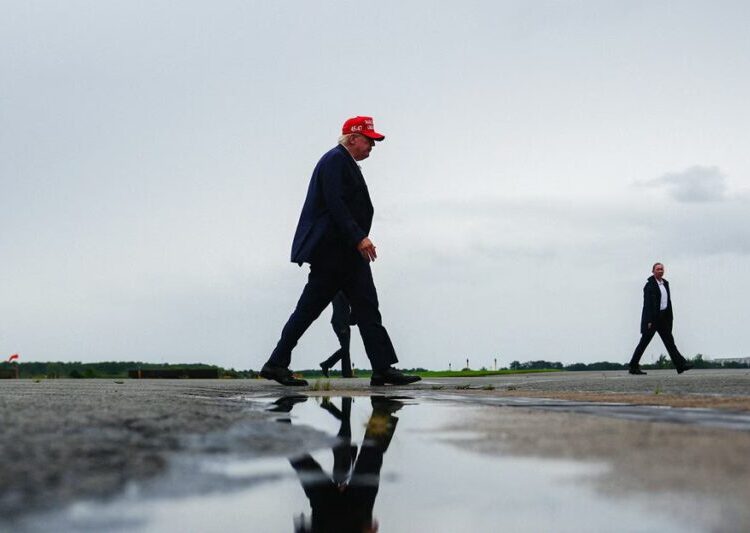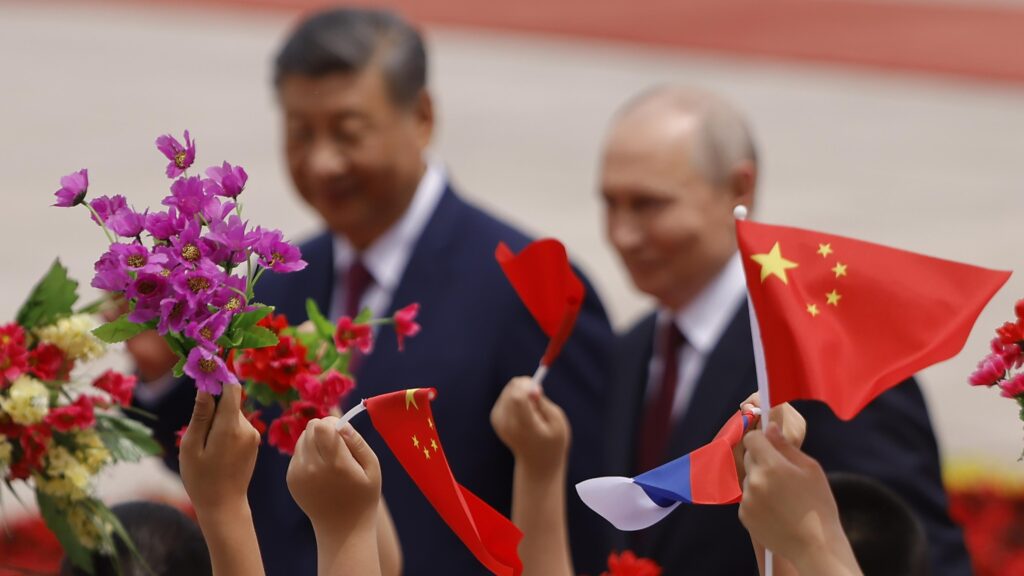
It felt like the contrails from Air Force One had barely melted into Beijing’s skies by the time Vladimir Putin touched down late Tuesday, as all eyes turned to how China’s reception for the Russian President would compare with that of the recently departed Donald Trump.
The first points were firmly scored by the U.S. President, who had been met on the tarmac by Chinese Vice-President Han Zheng, while Putin was greeted by lower ranking Foreign Minister Wang Yi. Trump’s swag game was also far superior—flanked by the bosses of Apple, Tesla, and Nvidia among other bigwigs—while Putin’s entourage consisted of square-jawed security personnel and a smattering of sanctioned banking and oil execs.
Still, a degree of informality is to be expected, given this marked Putin’s 25th visit to China, among over 40 meetings overall with President Xi Jinping, underscoring a bilateral relationship infamously described as “no limits” back in February 2022, just days before Russian troops marched into Ukraine.
Upon arrival, Putin gushed that “today, our relations have reached an unprecedentedly high level, serving as a model of comprehensive partnership and strategic interaction.” Xi, meanwhile, was more poetic, welcoming his guest via the two millennia-old Chinese idiom: “One day apart feels like three autumns have passed.”
But other than underscoring the strength of bilateral ties deeply rooted in history and 2,615 mi. of shared border, Xi’s welcoming of two of the world’s most powerful leaders just four days apart spotlights China’s growing global clout as the U.S. rails against allies and an international order it helped construct but now abhors. (Xi has also hosted the leaders of Canada, South Korea, Vietnam, Spain, Ireland, the UAE, and U.K. so far this year.)
“Xi has consolidated this position that Great Power politics now must go through Beijing,” says Alexander Korolev, an expert in China-Russia relations at the University of New South Wales. “This is now where the most important issues of global geopolitics are being discussed.”
On the eve of his arrival, Putin published a video in Chinese state media that lauded recent bilateral accomplishments, such as mutual visa-free policies and trade that totaled $228.1 billion last year. Though citing that figure in dollars is malapropos since, as Putin gleefully pointed out, nearly all was conducted in rubles or renminbi.
Trump and Putin have very different styles, of course, with the former real estate mogul lapping up the pomp and pageantry on offer in Beijing, while the ex-KGB spy appeared polite but stiff before the cheering crowds.
That contrast was also manifest in the relative outcomes; the White House only belatedly announced deals for the sale of 200 Boeing jets and at least $17 billion of American agricultural products annually to China through 2028. Meanwhile, Xi and Putin will ink some 40 documents and issue a 47-page joint statement on their strengthening partnership, according to the Kremlin, as well as a joint declaration on a “new type of international relations” and establishing a multipolar world order.
“Trump went for cash, to put it bluntly” says Korolev. “He went as a tradesman to sell airplanes and do some agricultural deals. But Putin goes more for strategic cooperation.”
It would be wrong to read much into the timing of the visits, however. Putin’s arrival was officially to celebrate three decades since Beijing and Moscow signed a strategic partnership agreement, as well as 25 years since the Treaty of Good-Neighbourliness and Friendly Cooperation. It had been on the books for many months and only followed Trump so closely after he postponed an original visit scheduled for March.
One thing both guests have in common is being mired in wars that they started and from which they are increasingly eager to extricate themselves. China has the wherewithal to help on both counts—selling advanced weapons to Russia and reducing purchases of Iranian oil—though Xi has steadfastly refused to exert that leverage. Although the Financial Times reported that Xi told Trump that Putin may end up regretting the war, citing people familiar with the conversation, any hope that China may intervene to resolve that quagmire is scant.
“Russia’s economy is not in good shape, the casualties are heavy, and it is totally impossible for Ukraine to say, ‘Okay, we will give it to you,’” says Zhou Bo, a retired PLA senior colonel and senior fellow at the Center for International Security and Strategy at Tsinghua University. “In this kind of situation, I don’t believe anybody can be of tremendous help.”
As Russia’s economy flounders, dependence on China becomes more entrenched, with China hoovering up over a quarter of Russia’s exports. Beijing has bought more than $367 billion of Russian oil and gas since the start of the war, according to the Centre for Research on Energy and Clean Air.
Xi is keen to reduce reliance on the double-blockaded Strait of Hormuz, through which some 50% of China’s crude oil and 30% of its liquefied natural gas imports passed before the Iran war effectively sealed this vital chokepoint. As such, the headline topic for discussion in Beijing is the stalled 1,600-mile Power of Siberia 2 natural gas pipeline transiting Mongolia, which would potentially add some 50 billion cubic metres of Russian gas export capacity to China.
Any deal would boost Putin’s domestic image, which is flagging amid coup rumors and Russian forces bogged down on the battlefield. Speaking after a scaled-back Victory Day military parade in Moscow earlier this month, Putin said the Ukraine war “is coming to an end,” while lashing out at Western support for Kyiv. However, Putin’s intentions in issuing those comments have been hotly debated.
“President Putin said that to pressure the European Union, which has used Ukraine as a justification for remilitarization and reindustrialization,” says Prof. Wang Yiwei, director of the Institute of International Affairs at Beijing’s Renmin University. “Frankly, the war will continue because it’s still very difficult for Russia to occupy the whole Donbas region.”
Regarding the Iran war, while Beijing has been enjoying a healthy dose of schadenfreude as the U.S. sullies its international reputation, both Russia and China share unease over the final outcome. In particular, the Kremlin may baulk at the autocratic Iranian regime falling only to be replaced by a government more aligned with the U.S. just south of the Caucuses.
“President Putin may suffer nightmares about the U.S. defeating Iran,” says Victor Gao, director of the China National Association of International Studies. “From the Russian perspective, it will be a recipe for disaster, and they will do whatever they can to stop the United States from winning the war in Iran.”
Conversely, there is room for Moscow to play a role in any settlement, with Russia a possible destination for Iran’s stockpiles of some 440 kg enriched uranium to be diluted. That may offer Putin a route back into the good graces of the international community, which Trump also appears happy to assist with, already inviting the pariah to December’s G20 in Miami and waiving certain sanctions.
But while Putin is due to depart Beijing early Thursday, it is not the end to Xi’s diplomatic cavalcade, with sources telling TIME that China’s leader will visit North Korea for a state visit perhaps as early as next week. The visit is framed as a response to Japan’s new Prime Minister Takaichi Sanae, who has shifted China’s old adversary away from its strict pacifist stance and adopted a more assertive geopolitical posture.
“China and North Korea will coordinate more against the new militarism of Japan,” says one source briefed on the arrangements, asking to remain anonymous since plans had not yet been officially announced.
It’s more evidence that, while Trump and Putin can debate points scored regarding pomp and poetry, the ultimate winner in Beijing is irrefutable. It was back in 2017 during the 19th Chinese Communist Party National Congress when Xi first announced his goal to reclaim “center stage” of the world. Nearly a decade on, few would deny that time has come.
The post Putin, Following Trump, Visits the World’s Center Stage appeared first on TIME.