
If you’ve been a fan of Pedro Almodóvar’s films since the beginning, or even just for the past decade or so, you’re probably already familiar with his magnificent obsessions: He loves striking-looking women, and he writes willful, complicated characters for them to play. He adores vivid, out-there color combinations—lime-ade greens and tropical pinks, sunburnt ochres and sour-cherry reds—in both production and costume design. He’s attentive to all facets of love, from simple maternal devotion to forbidden caverns of sexual desire. And, more recently, he’s become preoccupied with the mysterious source of human creativity: Where do good ideas come from? And is there any possibility he might be running out of either ideas or the time to execute them? He’s one of our most emotionally generous filmmakers; his glorious oversharing isn’t beside the point; it is the point.
The good news and the bad news is that Almodovar’s Bitter Christmas, premiering in competition here at the Cannes Film Festival, is more of the same. In his recent pictures—like 2024’s The Room Next Door, in which Tilda Swinton plays a terminally ill woman who asks an old friend, Julianne Moore, to help her die with dignity, or 2019’s extraordinary Pain and Glory, in which Almodóvar’s longtime collaborator and muse Antonio Banderas plays a filmmaker beleaguered with aches, pains, and ennui—have had a ruminative, almost brooding quality. Almodovar is feeling old—but then, who isn’t? And once again, as in Pain and Glory, Bitter Christmas features a filmmaker, Bárbara Lennie’s Elsa, who has not only lost her creative spark, but is also struggling with chronic pain—in her case, debilitating migraines.
At least Elsa isn’t alone, and her pain hasn’t made her selfish: she seeks to persuade one friend, Patricia (Victoria Luengo), to finally abandon her cheating husband, and she reaches out to another friend, Natalia (Milena Smit), who’s in agony over having lost a child. But she also has a loyal and much younger boyfriend, Bonifacio (Patrick Criado)—that he’s a firefighter who moonlights as a stripper is the movie’s greatest, wittiest Almodóvarian touch—whom she treats as an afterthought, though he appears to feel the utmost tenderness for her. This is a story in which a woman’s life absolutely doesn’t revolve around a man—yet Elsa’s treatment of her lover isn’t so much a triumph of feminism as it is evidence of her callousness as a human being.
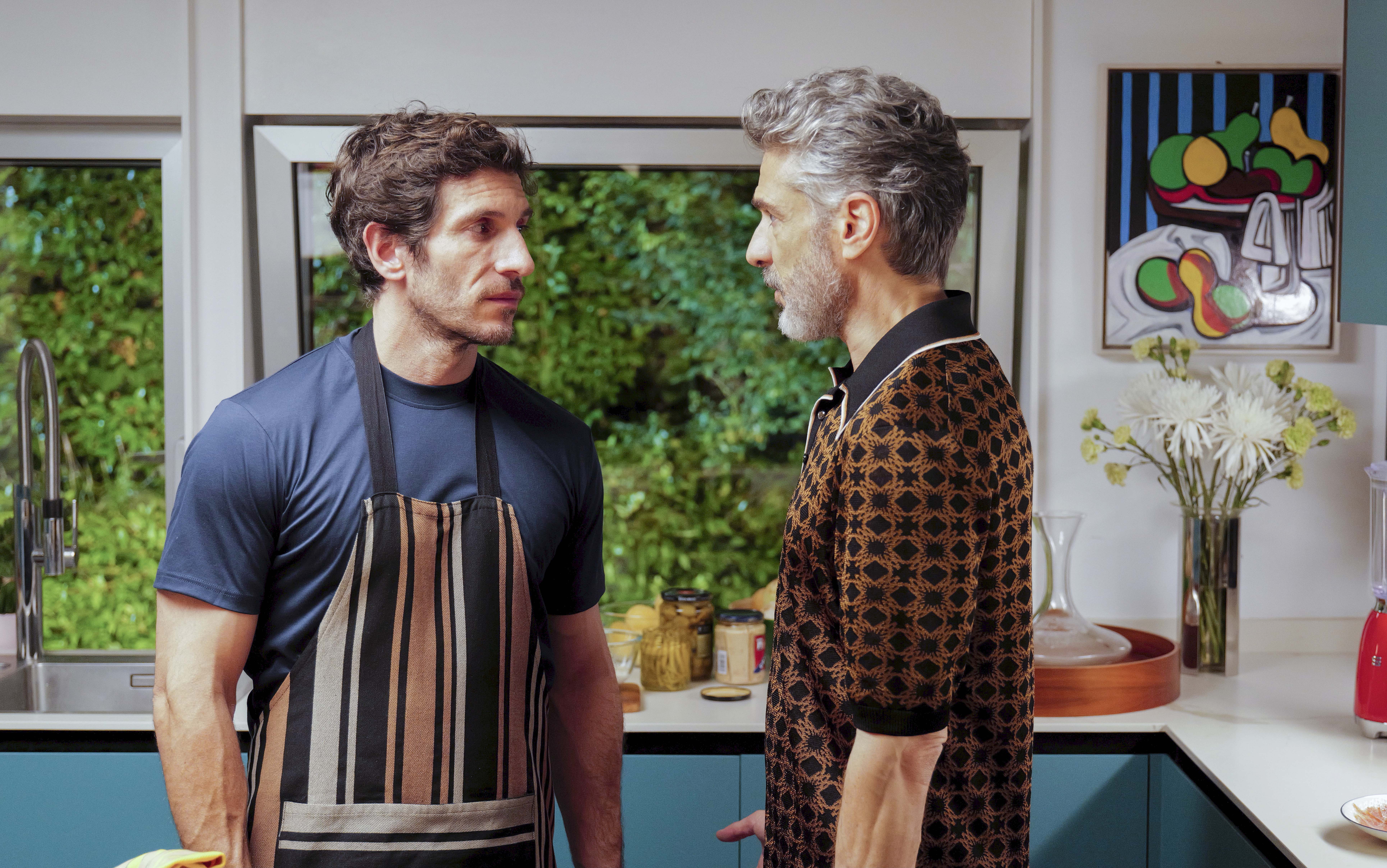
Maybe that’s because Elsa, her lover, and her two women friends are figments of another character’s imagination: Raúl, played by Argentine actor Leonardo Sbaraglia, is searching listlessly for the key to his next movie, only to settle on tearing a page from the real-life travails of his loyal assistant, Mónica (Aitana Sánchez-Gijón), who has been with him for years but has recently left his employ to help a close friend deal with a tragedy. One narrative nests within another; Raúl’s story, set in 2026, is “real” life, while Elsa’s, which takes place in 2004, is his creation. But he doesn’t seem to realize that other people’s life experiences aren’t ripe for the taking, and his insistence on doing so becomes a metaphor for the selfishness of artistic creation. And he too has a “Bonifacio” in his life, Quim Gutiérrez’s Santi. The Jenga puzzle of parallels comes to feel a little daunting, and perhaps too cleverly artificial.
Even so, Bitter Christmas is so enjoyable to watch that you almost will yourself into believing that Almodóvar isn’t simply reworking, with certain beats that feel a little too familiar, some of his recent preoccupations. His trademark color combinations are pleasurably on point: when Elena tosses a pillar-box-red coat over a cobalt sweater, you may as well have died and gone to Almodóvar heaven. (The movie’s production design is by the director’s longtime collaborator Antxon Gómez; the costumes are by Paco Delgado.) The score, by Alberto Inglesias, who has frequently worked with Almodóvar, has a lush, melodramatic, Sirkian quality—it helps carry the movie through some of its rougher patches. In the end, Bitter Christmas may not be as thoughtful or deep as it strives to be. It’s not wrong to expect more from Almodóvar than an anguished shrug in movie form, one that might be summed up as “Creation is hard, but it’s the only thing that makes me feel alive!” But then Rossy De Palma shows up in just one brief scene, with her sensational Modigliani-meets-Picasso face, and you suddenly remember why even some of Almodóvar’s lesser movies simply feel like home. We come for the colors, the histrionic plots, the faces, the oversharing. It’s hard to get enough of the too-muchness of Almodóvar.
The post In Pedro Almodovar’s Bitter Christmas, the Ideas Feel Familiar But the Packaging Is as Pleasing as Ever appeared first on TIME.