Bond markets convulsed on Tuesday, pushing the rates on U.S. Treasuries to levels not seen since the global financial crisis nearly 20 years ago, as investors grew increasingly anxious about rising inflation because of the war in Iran.
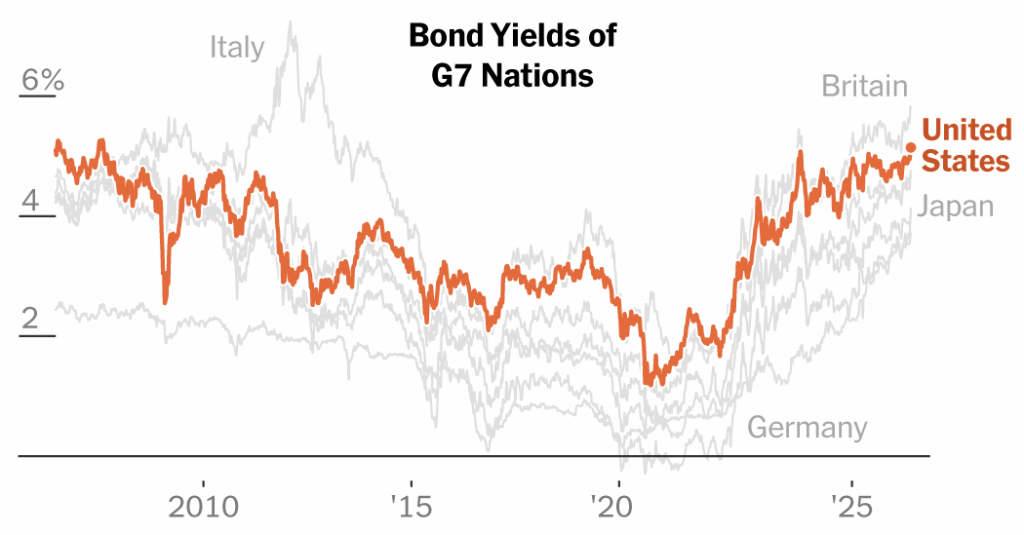
The yield on the 30-year Treasury note rose to 5.18 percent on Tuesday, its highest level since 2007. Bond yields move inversely to prices.
The rising rates, which are pushing up borrowing costs for governments, homeowners and businesses, could be a critical pressure point for the Trump administration as it continues to pursue its campaign against Iran, which has pushed up oil prices worldwide.
The last time President Trump faced such turmoil in the Treasury market was after he announced in April last year that he would raise tariffs on nearly every U.S. trading partner. The steepening rates were cited as a primary reason that Mr. Trump later backed down from many of his most draconian proposals.
This time, investors across the world are becoming increasingly concerned about the fallout from the monthslong conflict in the Middle East, where, despite a cease-fire between the United States and Iran, efforts to find a lasting peace deal have stalled.
The yields on 30-year bonds in Canada, Germany, France, Spain, Portugal, the Netherlands and Switzerland all traded at their 12-month high on Tuesday. Across the rest of Europe and Asia, the long yield was also elevated
In Britain, the tumult in the government bond market is even more extreme. A leadership crisis facing Prime Minister Keir Starmer has helped push the country’s 30-year bond to its highest level since 1998.
Japan’s 30-year bond yield sits at 4.13 percent, the highest it has ever been, as rising energy prices strain the country’s already struggling economy.
Bond investors around the world are focused on the continued blockade of the Strait of Hormuz, the vital shipping lane that before the war had funneled roughly a fifth of the world’s oil supply, predominantly to Asia and some parts of Europe.
In the United States, the impact of higher oil prices was reflected in a series of inflation reports last week showing consumer and producer prices both rising at their fastest pace in several years.
Another factor weighing on the Treasury market is last weekend’s summit between Mr. Trump and China’s leader, Xi Jinping. Investors’ hopes that the much anticipated meeting would result in China’s help with ending the war in Iran were dashed.
In Europe, world leaders met on Tuesday to discuss ways to tamper inflation, though many in the group were upset about a U.S. decision this week to further ease sanctions on Russian seaborne oil in an attempt to bring down global fuel costs. Some European officials said the move rewarded Russia while its aggression in Ukraine continued.
“I think there is just a lot of fear out there right now and a collective hesitancy to step in front of the sell-off,” said Vail Hartman, a U.S. rates strategist at BMO Capital Markets, noting concerns that yields could continue to move higher.
Unlike during last year’s tariff turmoil, Mr. Trump appears less willing to back down over Iran, analysts say. The economy is otherwise in good shape, underpinned by the growth of artificial intelligence and blockbuster corporate profits. The stock market has risen for seven consecutive weeks, hitting record highs along the way.
But the rising rates are also starting to add pressure on stocks. On Tuesday, the S&P 500 fell about 0.7 percent, its third consecutive daily drop, as investors awaited developments in the tenuous cease-fire in the Iran war. When asked on Tuesday how long Iran had to return to the negotiating table, Mr. Trump said: “Two or three days. Maybe Friday, Saturday, Sunday. Maybe early next week. A limited period of time.”
The climbing Treasury yields could complicate Mr. Trump’s other economic priorities, like jump-starting the stalled housing market.
The 10-year Treasury yield, which underpins borrowing costs for mortgages, has also surged higher since the start of the war with Iran.
That yield has risen roughly three-quarters of a percentage point since the war began, to 4.67 percent, its highest level since the start of 2025. The average 30-year mortgage rate has risen to 6.36 percent from below 6 percent before the war, according to data from the housing agency Freddie Mac.
Some of the increasing Treasury yields are driven by anticipation that the Fed will potentially need to raise the short-dated interest rates it controls to try to slow inflation. These expectation are increasing even with the appointment of the new Fed chair, Kevin Warsh, whom Mr. Trump picked with hopes of lowering rates.
Before the war began, investors had expected the Fed to cut rates at least half a percentage point by January. Now, they have lowered those expectations to a quarter-point rise, based on prices in interest rate futures markets.
“There is a feeling that this is going to get worse before it gets better,” said Joseph Purtell, a portfolio manager at Neuberger Berman, adding that the market is “pricing in some kind of premium for that uncertainty.”
Emmett Lindner contributed reporting.
Joe Rennison writes about financial markets, a beat that ranges from chronicling the vagaries of the stock market to explaining the often-inscrutable trading decisions of Wall Street insiders.
The post Bond Yields Hit Highest Level Since 2007 as Inflation Fears Set In appeared first on New York Times.