On Monday, the Supreme Court decided not to thrust another dagger into the nearly lifeless corpse of the Voting Rights Act.
The Voting Rights Act of 1965 is arguably the most successful civil rights law in American history. Before the Roberts Court began to dismantle it, the VRA included a web of provisions intended to prevent states from denying anyone the right to vote because of their race. And the law started to dismantle Jim Crow voter suppression almost immediately after it took effect. Just two years after it became law, Black voter registration rates in Mississippi grew from 6.7 percent to 60 percent.
But the Supreme Court’s Republican majority loathes this law. As Justice Elena Kagan wrote in a 2021 dissenting opinion, her Court “has treated no statute worse” than the Voting Rights Act. As a young White House lawyer, future Chief Justice John Roberts unsuccessfully pushed then-President Ronald Reagan to veto a 1982 amendment to the VRA that the Court recently repealed in Louisiana v. Callais (2026).
After Callais, it is unclear whether the VRA has any remaining force whatsoever.
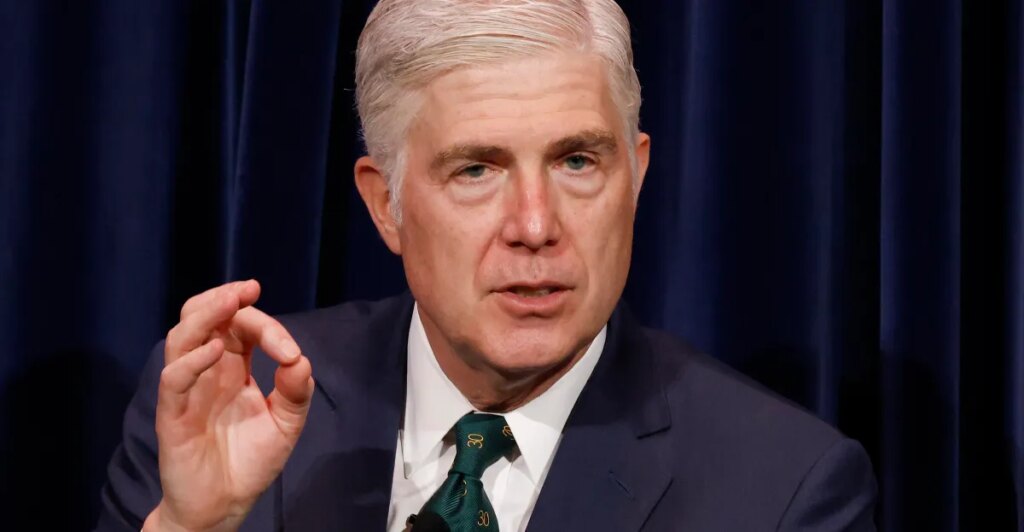
The two orders the Court handed down on Monday, meanwhile, concerned an alternative proposal to strangle the Voting Rights Act that Justice Neil Gorsuch floated in a concurring opinion in Brnovich v. DNC (2021), the same case where Kagan said that her Court has treated no law worse than the VRA. But the Monday orders neither endorsed Gorsuch’s theory nor rejected it — it merely asked two lower courts that previously considered this theory to consider it again.
The orders came in two cases, Turtle Mountain Band v. Howe, where the lower court backed Gorsuch’s attempt to further neutralize the VRA, and Board of Election Commissioners v. NAACP, where the lower court rejected Gorsuch’s attack on the law.
It’s unclear why this Supreme Court, which has been so relentlessly hostile toward the VRA, decided to punt this latest fight until some future date. It’s also unclear whether this fight still matters, as the Court has already bled the Voting Rights Act so deeply that the law may no longer actually do anything.
Still, as it appears there is still one more big legal dispute looming over this most diminished of federal laws, let’s take stock of just how much of the Voting Rights Act remains.
Does the Voting Rights Act still do anything at all?
Before the Republican justices started to dismantle the VRA in Shelby County v. Holder (2013), the law used several mechanisms to ensure that voters of color were not locked out of power. As originally enacted in 1965, the law required states with a history of racist election practices to “preclear” any new election laws with officials in Washington, DC, to ensure that those laws did not target voters because of their race. This provision was effectively repealed by Shelby County.
Meanwhile, the 1982 amendment required some states to draw a minimal number of majority-Black or majority-Latino legislative districts. And it forbade a state election law that “results in a denial or abridgement of the right of any citizen of the United States to vote on account of race or color,” even if the plaintiffs challenging that law could not prove that it was enacted with racist intent.
This 1982 amendment was effectively repealed by Callais.
That said, Callais does say that a Voting Rights Act plaintiff may still prevail in very limited circumstances. The law, Justice Samuel Alito claimed in his Callais opinion, “imposes liability only when the circumstances give rise to a strong inference that intentional discrimination occurred.” So a voting rights plaintiff may still win their case if they can show that a state law was motivated by racist animus.
Realistically, however, this means that the post-Callais Voting Rights Act does no independent work whatsoever. As Alito acknowledges in Callais, the Constitution already contains a voting rights provision — the 15th Amendment — that, in Alito’s words, “bars only state action ‘motivated by a discriminatory purpose.’” So state laws that intentionally discriminate on the basis of race were already illegal before the VRA became law.
Indeed, even prior to the VRA’s enactment in 1965, the Supreme Court did occasionally strike down state election laws that intentionally discriminated on the basis of race, holding that they violated the 15th Amendment. The Voting Rights Act was necessary not because Jim Crow voting laws were legal, but because Jim Crow states were creative. Whenever a court did strike down a state law intended to keep Black people from voting, Southern states would typically respond by enacting a new law that achieved the same goal in a different way — thus forcing civil rights advocates to bring another lawsuit that could take years before another judge issued a new injunction against the new law.
The whole point of preclearance was to prevent racist laws from ever taking effect, and thus prevent Jim Crow lawmakers from outrunning slow-moving courts that were struggling to enforce the 15th Amendment.
Meanwhile, while Jim Crow lawmakers were often quite explicit about their white supremacist goals, by the 1980s most lawmakers who still harbored racist beliefs were shrewd enough not to say such things out loud. The 1982 amendment, which targets state election laws that have negative racial impacts — even if the plaintiffs cannot prove racist intent — was designed to ensure that the VRA would still function even in a world where plaintiffs could not produce direct evidence that a state law was enacted for racist reasons.
The combined effect of Shelby County, Brnovich, Callais, and similar cases, in other words, is to return (or, perhaps, retvrn) US voting rights law to 1964. While some shell of the Voting Rights Act remains on the books, it does not appear to do any independent work that isn’t already done by the 15th Amendment.
And that brings us back to Gorsuch’s proposal in Brnovich, which, if taken to the extreme, could potentially leave voting rights plaintiffs even worse off than they were prior to the Voting Rights Act’s enactment.
Gorsuch wants to make it impossible to sue for violations of the Voting Rights Act
Gorsuch’s concurring opinion in Brnovich suggests that the Voting Rights Act does not include an “implied cause of action.” This means that, if Gorsuch’s view were to prevail in the Supreme Court, no private plaintiff would ever be able to bring a lawsuit alleging a violation of the VRA ever again (although the federal government would still be able to do so, assuming it was controlled by a president who supports voting rights).
Some federal laws state explicitly that certain individuals or institutions may sue in order to enforce them. When a federal law does not contain such explicit language, however, the Supreme Court has developed a set of rules governing when private parties may sue to enforce the law.
Until last year, these cases were governed by the rule the Court most recently laid out in Health and Hospital Corporation v. Talevski (2023), which held that a federal law may be enforced by private lawsuits if it is “‘phrased in terms of the persons benefited’ and contains ‘rights-creating,’ individual-centric language with an ‘unmistakable focus on the benefited class.’”
Thus, for example, if a federal law says that “no state may prevent an athletic person from riding a bicycle,” this law would be enforceable by private lawsuits because the law’s text focuses on the people who benefit from it (athletic people). A similar statute saying that “states shall not impede access to bicycles” would be unenforceable by private lawsuits, because that hypothetical law lacks the “individual-centric language” demanded by Talevski.
Two years after Talevski, however, the Court appeared to abandon its framework. In Medina v. Planned Parenthood (2025), the Court considered whether a statute that permits “any individual eligible for medical assistance” under Medicaid to choose their own health provider could sue after a state denied Medicaid benefits to patients who choose Planned Parenthood as their health provider.
Although this statute clearly permits Medicaid patients to file lawsuits, at least under the Talevski rule, the Court’s Republicans issued a confusing majority opinion disallowing the suit. It is unclear whether Medina was intended to overrule Talevski, or if it was merely a one-off decision that the Republican justices reached because they did not want to rule in favor of an abortion provider.
That said, Medina does include several pages suggesting that federal laws that use the word “right” in their text may be enforced through private lawsuits.
So, with these two competing frameworks in mind, consider the language of the Voting Rights Act:
No voting qualification or prerequisite to voting or standard, practice, or procedure shall be imposed or applied by any State or political subdivision in a manner which results in a denial or abridgement of the right of any citizen of the United States to vote on account of race or color…
Under Talevski, the VRA may be enforced via private lawsuits because the statute is phrased in terms of the people who benefit from it (“any citizen of the United States”). Similarly, while the Medina decision is difficult to parse, it does suggest that statutes that use the word “right” may be enforced by private lawsuits. And that word is front and center in the Voting Rights Act.
Gorsuch’s Brnovich opinion is only a paragraph long, so it does not explain how Gorsuch reached the odd conclusion that the VRA does not authorize private lawsuits. Gorsuch doesn’t even specify whether he thinks that Talevski’s framework, Medina’s framework, or some secret third thing should govern VRA lawsuits.
But he did write that opinion, and it was joined by Justice Clarence Thomas. So it appears that there are at least two votes on the Supreme Court to cut off private lawsuits under the VRA altogether.
One uncertain question is whether these two justices would still permit private plaintiffs to sue under the 15th Amendment. Like the Voting Rights Act, the 15th Amendment’s language (“The right of citizens of the United States to vote shall not be denied or abridged by the United States or by any State on account of race, color, or previous condition of servitude”) should permit suits under either Talevski or Medina. But, if Thomas and Gorsuch are willing to shut down VRA suits in the absence of any law or precedent justifying such an outcome, why wouldn’t they also shut down 15th Amendment suits?
We don’t know. But on Monday, the Court decided to delay resolving this question — the question of whether any private plaintiffs may sue under the VRA — until some future date. So we will have to wait until then to find out if Thomas, Gorsuch, or any other justice wants to make federal law even less favorable to voting rights plaintiffs than it was under Jim Crow.
The post The Supreme Court just handed down two surprisingly timid Voting Rights Act decisions appeared first on Vox.