After a messy public fight between New York transit officials and five Long Island Rail Road unions whose three-day strike shut down the nation’s busiest passenger rail service, both sides are claiming victory.
Gov. Kathy Hochul struck a conciliatory note when announcing the deal that ended the strike at a Monday night news conference in front of the Manhattan headquarters of the Metropolitan Transportation Authority, the state agency that runs the railroad.
“I always believed we could reach a good, fair compromise that achieved two principles,” Ms. Hochul said. “Protecting affordability for Long Islanders and commuters, while giving fair wages to the employees.”
Kevin Sexton, the national vice president of the Brotherhood of Locomotive Engineers and Trainmen, one of the striking unions, also celebrated the deal on Monday, though he said he wanted to discuss the specifics with his members before sharing more details.
Ms. Hochul said the agreement, which includes a wage increase for the current year and a retroactive raise for the past three years, would not result in higher fares or state taxes — a key consideration for the governor ahead of her November re-election bid.
But the new contract could set a new precedent for the M.T.A.’s dealings with more than 80 unions, with repercussions that could be felt for years to come.
“There are no winners in a strike,” said William Dwyer, an associate professor at Rutgers University and a former labor negotiator for management at the utility company PSE&G in New Jersey.
The acrimonious dispute has eroded trust between the railroad’s workers and leadership, Mr. Dwyer said, noting that the two sides must negotiate their next contract in just a year.
And it is unclear how much the deal will cost the M.T.A. in the long run, as it prepares to engage with other unions that are likely to now seek higher wage increases than those the agency has budgeted.
The five striking Long Island Rail Road unions — including engineers, signalmen and machinists — were seeking a retroactive 9.5 percent wage increase covering the last three years in which they did not have a contract, which was the same offer made to dozens of other unions. But they also wanted a raise of at least 5 percent in the current year, a demand that far exceeded what other groups had been offered.
The finer details of the new contract are not yet known, because it has not been ratified by the union members, a process that could take several days. But the deal includes both the retroactive pay raise and a roughly 4.5 percent wage increase in 2026, spread out over a period of at least a few weeks longer than a year, according to three people familiar with the negotiations who were not authorized to discuss them.
Extending the agreement beyond a 12-month period saves the authority some money by delaying the next round of negotiations, when wages could increase further. But the raise in 2026 is higher than the 3 percent offer the authority made before the strike.
The M.T.A.’s $21 billion annual operating budget is balanced for now but could soon face shortfalls. The authority expects a budget gap of $160 million in 2027 and $243 million in 2028, according to its financial plan.
The authority has said that, across its entire work force, every one percentage point wage increase could cost an additional $100 million a year.
Andrew Rein, the president of the Citizens Budget Commission, a fiscal watchdog group, cautioned that the higher wage increases in the new contract would put pressure on the budget that could only be resolved with higher fares, more taxes or less service.
“We all have to remember, the M.T.A.’s future is fiscally fragile,” he said. “At the end of the day, the people pay.”
The M.T.A. also gave up on trying to change a number of work rules that the authority has argued can inflate payroll costs and make service less efficient.
For instance, if an engineer drives a diesel train at the start of a shift but is asked to switch to an electric train in the same day, the M.T.A. must compensate that worker with two days’ pay. If, on the same day, the engineer is also asked to switch from driving passengers to driving a train back to a yard for maintenance or storage, that worker is entitled to a third day’s pay.
These penalty payments added almost 15 percent to the average engineer’s compensation in 2024, the M.T.A. said.
These rules, which are likely to come up again in next year’s contract negotiations, are notoriously hard to amend. The M.T.A. tried and failed to change a number of the rules in negotiations in 1994 that led to a two-day strike on the Long Island Rail Road.
The bargaining of this contract took on political overtones almost immediately.
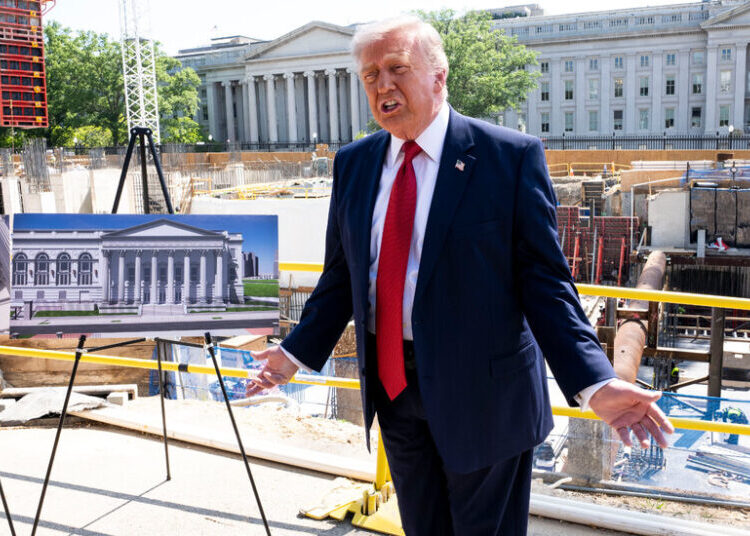
With the process at a standstill within the last year, the striking unions sought — and received — support from two federal review panels that were appointed by the Trump administration, which said that the unions should receive at least a 4.5 percent raise this year. The recommendations were not binding, but helped bolster the unions’ argument.
Governor Hochul, a Democrat, insisted that President Trump had increased the odds of a strike after the National Mediation Board, a federal agency, released the parties from mediation last year without a deal.
Mr. Trump denied any responsibility, writing in a post on Truth Social that he had “NOTHING TO DO WITH IT” and praising the Republican nominee for governor, Bruce Blakeman.
Mr. Blakeman, the Nassau County executive, used the opportunity to bash Ms. Hochul for “mismanagement” and reiterate his support for the union. “When I’m Governor, labor will finally have an ally in the Governor’s mansion,” he wrote on social media.
The tension reflected a political realignment that has led to some strange bedfellows.
For years Republicans have railed against what they saw as sweetheart deals won by public sector unions, particularly teachers. But many of the rail employees working on Long Island, which has moved to the right in recent years, are Republicans themselves.
That put them at a disadvantage in negotiations with a Democratic governor who enjoys the support of many other major unions, said John Kaehny, the executive director of the watchdog group Reinvent Albany.
“I don’t think you have other unions jumping up and down in sympathy and putting pressure on the governor and saying, ‘This is a matter of union solidarity,’” Mr. Kaehny said. “Also, they’re extremely highly paid.”
Cash compensation for members of the five negotiating unions averaged over $136,000 in 2025, according to M.T.A. figures, making them among the highest-paid rail workers in the nation. Union leaders have argued that their workers don’t make enough money to keep up with the cost of living in one of the most expensive metro areas in the United States.
Leery of a protracted fight and how it would reflect on the governor, Ms. Hochul’s office invested heavily in communication ahead of the strike, advising riders of service disruptions and urging people to work from home if they could. The idea was to make the commute predictable, if not pleasant.
Still, it was painful.
After waiting for hours in traffic or taking roundabout routes that doubled commute times, riders were frustrated with both the union and the M.T.A.
Michaelle C. Solages, a Democrat who represents the western end of Long Island in the State Assembly, looked on the bright side. “It was definitely aggravating, but it wasn’t mass mutiny,” she said.
And while a full picture had yet to emerge, she said that the deal appeared thus far to be a fair one.
“Everyone equally shared the pain,” she said, adding, “No one came out with bruises.”
Stefanos Chen is a Times reporter covering New York City’s transit system.
The post L.I.R.R. Workers Are in Line for Raises, but at What Cost to New York? appeared first on New York Times.