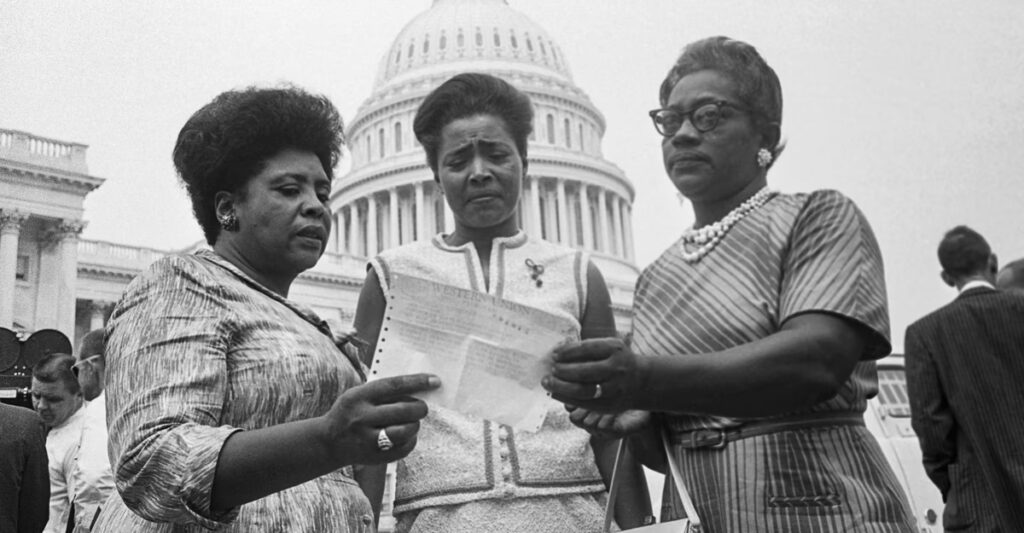
Last month, the Supreme Court set fire to the remnants of the Voting Rights Act, the law that made America a true democracy. Now southern Republicans are annihilating Black political power.
In Louisiana, which has six congressional representatives, Republicans moved rapidly to eliminate one of the state’s two majority-Black districts. Tennessee Republicans redrew the state’s congressional map to get rid of its only Black-majority district, in Memphis, then stripped Democrats who protested the move of their membership in state house committees. Governor Tate Reeves of Mississippi declared that the “reign of terror” of the state’s lone Black congressman, Bennie Thompson, would soon be over, and announced that he expected lawmakers to draw new districts before the 2027 elections. South Carolina legislators are hard at work to eliminate Representative Jim Clyburn’s plurality-Black district, the only one in the state. More than half of the United States’ Black population lives in the South, so this amounts to an all-out assault on Black political representation in Congress.
For many decades after Reconstruction, southern states deprived Black people of the right to vote while counting their bodies toward congressional seats. The 1965 Voting Rights Act effectively invalidated the superficially race-neutral schemes designed to deprive Black people of the vote. No longer able to directly deny the vote, racist lawmakers developed new methods of diminishing Black political power through schemes such as racial gerrymandering. Congress updated the VRA—repeatedly—to address these schemes. The law worked extraordinarily well, leading to dramatic increases in minority representation, a Congress that better reflected the diverse nation it represented, and, in 2008, a Black president.
And that was the last straw.
Since Barack Obama’s election, conservatives have argued that the VRA’s protections are no longer needed—indeed, that they are themselves racist. The backlash to the Obama presidency that swept Trump into office allowed him to appoint three justices—fully a third of the Court—who agree.
Writing on behalf of the majority in that April case, Louisiana v. Callais, Justice Samuel Alito argued that Louisiana’s creation of a second majority-Black congressional district, out of six, in a state whose population is one-third Black, was “an unconstitutional racial gerrymander.” Eliminating that district to disempower those voters was, apparently, not. The fact that “black voters have been aligned with the Democratic party,” Alito wrote, actually “undercut” any “showing of intentional racial discrimination because race and politics are so intertwined.” But this idea—that the more motivated partisans are to discriminate against Black voters, the less racist that discrimination is—is a perverse inversion of the Fifteenth Amendment. Thanks to this Supreme Court, so long as Republicans take care not to explicitly announce their intention to discriminate, they may discriminate as much as they like.
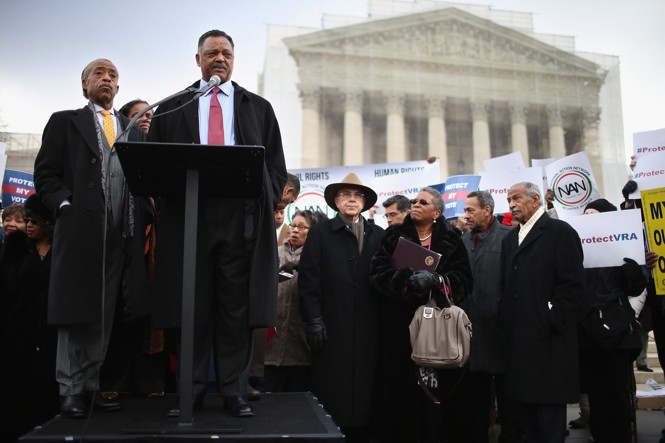
You can draw a line through American conservatism beginning with the argument that racism was necessary and proper, to the argument that laws meant to address racism were worse than racism, to the argument that those same laws were so effective that racism was eradicated and thus the laws were no longer necessary. More than a decade ago, the Supreme Court heard Shelby County v. Holder. At issue was Section 5 of the Voting Rights Act, which required jurisdictions with a history of discrimination to submit voting changes to the Justice Department in advance. Shelby County, Alabama, wanted to be free of such oversight, and during oral arguments, the attorney representing the county made the case that racial discrimination in voting was “an old disease, and that disease is cured.” If that were true, the VRA wasn’t necessary. But Justice Antonin Scalia went further, referring to the VRA as the “perpetuation of racial entitlement.” I was in the courtroom, and heard gasps from the gallery.
The Court decided in Shelby County’s favor; in her dissent, the late Justice Ruth Bader Ginsburg wrote that Section 5 had “worked and is continuing to work to stop discriminatory changes.” Nullifying it, she warned, is “like throwing away your umbrella in a rainstorm because you are not getting wet.”
The deluge is enough to refill America’s whites-only pools. The vaunted “progress” the justices cite at every opportunity to justify gutting the VRA was a result of the law effectively neutralizing racial discrimination, not an absence of the desire or intent to discriminate. Scalia’s remark that the VRA was a “racial entitlement” is illuminating in the way that statements from many ideologues are, in that they express their own motives rather than those of their targets. Until 1965, democracy itself was a “racial entitlement” in America. Much of the Republican Party is trying to make that true once again.
We’re now finding out exactly how far the Court will let them go.
In 2023, Alabama Republicans drew a map with just one majority-Black district (out of seven, in a state that’s a quarter Black), but a federal court blocked the map, concluding that “we cannot understand the 2023 Plan as anything other than an intentional effort to dilute Black Alabamians’ voting strength.” On Monday, the Supreme Court gave its blessing for Republicans to proceed with the map.
The Court has sometimes refused to order states to change maps close to an election—even when those maps have been found to discriminate against Black voters—on the theory that it would cause confusion (a doctrine known as the “Purcell principle,” after the 2006 case Purcell v. Gonzalez). And yet the Court is now allowing Alabama to apply this new map despite its primary elections being already under way. Some Alabamians, the writer Madiba K. Dennie points out, have even sent in their ballots: They “may have their votes thrown out so that Republicans can hold a do-over election, under a map that a federal court already determined is too racist to be legal.”
There appears to be no rule of constitutional or legal interpretation here beyond what will aid the Republican Party in retaining its congressional majorities—even if states have to violate the constitutional rights of American citizens to do so. As the attorney Stephen Vladeck writes, the Supreme Court has intervened in map disputes in Alabama, New York, and Louisiana, with “the remarkably coincidental effect of benefitting Republicans in all three contexts.” Excluding California’s redistricting effort, which benefited Democrats, and which the justices allowed to proceed, the Court has consistently decided that if a map is advantageous to Republicans, it is always too close to an election to change it; if a map is not advantageous enough, there is always time to replace it with a new map, even if voters have already started casting ballots.
The central question, William F. Buckley wrote in National Review in 1957, is “whether the White community in the South is entitled to take such measures as are necessary to prevail, politically and culturally, in areas in which it does not predominate numerically? The sobering answer is Yes.” He continued: “The White community is so entitled because, for the time being, it is the advanced race.” If a “majority wills what is socially atavistic,” he added, “then to thwart the majority may be, though undemocratic, enlightened.”
This same sense of entitlement animates the attempts to obliterate Black representation in the South today. South Carolina Representative Ralph Norman explained the logic of eliminating Clyburn’s district clearly, saying that Clyburn “does not represent the rest of South Carolina, which is conservative. His district is close to 47 percent African American.” The implication is that Black people do not vote the right way, and so they are not entitled to equal representation. To thwart their will may be undemocratic, but, in Buckley’s worldview, it is “enlightened,” and the white community is entitled to do so.
“The majority straight-facedly holds that the Voting Rights Act must be brought low to make the world safe for partisan gerrymanders,” Justice Elena Kagan observed in her dissent in Callais. “For how else, the majority reasons, can we preserve the authority of States to engage in this practice than by stripping minority citizens of their rights to an equal political process?”
Alito’s argument—that race and partisanship are too entangled for the Fifteenth Amendment to prevent almost all racial gerrymandering—would have sounded absurd to the authors of that amendment. Black suffrage was, at that time, an entirely partisan cause. Democrats opposed it; Republicans supported it. And they supported it for partisan reasons as well as ideological ones. They were blunt about it.
“You need votes in Connecticut, do you not?” the Republican Senator Charles Sumner declared in 1869. “There are three thousand fellow-citizens in that State ready at the call of Congress to take their place at the ballot-box. You need them also in Pennsylvania, do you not? There are at least fifteen thousand in that great State waiting for your summons. Wherever you most need them, there they are; and be assured they will all vote for those who stand by them in the assertion of Equal Rights.”
The Republican Party was then in a state of relative emergency—the Civil War had been won and slavery had been abolished, but Black Americans in the South were still subject to terrorism and intimidation, while whites in the North had shown resistance to the idea of Black suffrage. Northern Democrats were having some success with their—admittedly accurate—arguments that Black suffrage would lead inevitably to Black equality, which they and many other white northerners opposed. The Radical Republican Congressman Thaddeus Stevens, as Michael Waldman writes in The Fight to Vote, was even blunter than Sumner about the necessity of enfranchising Black men. “We must establish the doctrine of National jurisdiction over all the States in State matters of the Franchise”—by which he meant the right to vote for all men, regardless of race—or the Republicans “shall finally be ruined.”
Republicans, the historian John Hope Franklin wrote in Reconstruction After the Civil War, “knew that there was little chance of luring the former Confederates” into the party. One did not have to “belong to the Thaddeus Stevens–Charles Sumner wing of the party to reach the conclusion that suffrage for blacks was not only desirable but imperative.” Radicals such as Sumner also warned, presciently, that the Fifteenth Amendment did not go far enough, and that its flaws would ultimately allow anti-Black reactionaries to undermine its purpose.
Democrats, on the other hand, knowing that they would have little luck winning Black votes for a program hostile to Black rights, decided that it would be best if Black people did not vote at all. In Louisiana, Waldman writes, white “rifle clubs” marched through the streets chanting “A charge to keep I have, a God to glorify. If a nigger don’t vote with us, he shall forever die.”
“I do not recall the name of one man who favored emancipation as a policy and adhered to the Democratic Party,” wrote the Massachusetts Representative George Sewall Boutwell, one of the authors of the Fifteenth Amendment, in his 1902 memoir. “When a man reached the conclusion that the negroes should be free, he could not do otherwise than join the Republican Party.”
The Fifteenth Amendment, in other words, was never not partisan. If it had not been intended to prevent politically motivated racist disenfranchisement, it would have done nothing at all. The entire purpose was to ensure that neither party—not Democrats in the 19th century nor Republicans in the 21st—could ignore Black voters. Attacking or defending Black rights is not inherently partisan, except when the parties themselves make it so, and the point of inalienable rights is that politicians should not be able to take the shortcut of disenfranchising voters to whom they do not care to appeal.
The shadow of Jim Crow did not fall all at once. Black voters continued to cast ballots in some areas of the South, particularly where they managed to make common cause with white populists. The Democrats reacted fiercely to these alliances, breaking them with intimidation, terrorism, and, finally, disenfranchisement. “The plan set up certain barriers such as property or literacy qualifications for voting, and then cut certain loopholes in the barrier through which only white men could squeeze,” the historian C. Vann Woodward wrote in The Strange Career of Jim Crow. This disenfranchisement coincided with an increase in lynching and other forms of racist terrorism; “the more defenseless, disfranchised, and intimidated the Negro became the more prone he was to the ruthless aggression of mobs.” The purpose of this disenfranchisement was to limit democratic rights to those who were entitled to them.
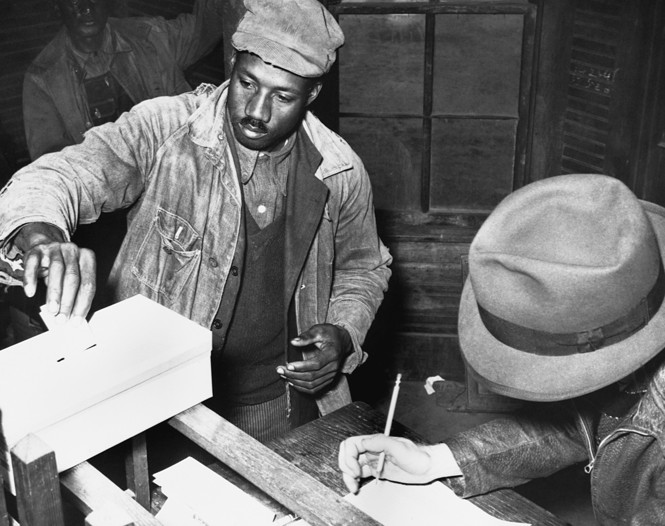
What the Democrats of the era understood was that, by neutralizing Black power, they were also neutralizing the motivations of the Republican Party—and of the populists—in protecting Black rights. If there were no votes to win for defending civil rights, racial equality, or defending Black people from terrorism, politicians would be less likely to support those causes. They celebrated this outcome much as Reeves did, by declaring an end to the oppression symbolized by Black people being elected to office.
How did such measures survive court review? Well, in the aftermath of Reconstruction, a Supreme Court very much like the current one decided in case after case that the “barriers” Woodward described were superficially race-neutral and therefore constitutional. In the 1898 case Williams v Mississippi, considering a state constitution that the future Democratic Senator James K. Vardaman announced had been adopted “for no other purpose than to eliminate the nigger from politics,” the justices saw no constitutionally prohibited discrimination. “The Constitution of Mississippi and its statutes do not on their face discriminate between the races, and it has not been shown that their actual administration was evil; only that evil was possible under them,” Justice Joseph McKenna wrote.
The message of Williams is identical to the message of Callais: that disenfranchising Black people is acceptable as long as you do not announce that as your intention. (But if you do, it’s also fine; we’ll just pretend we didn’t notice.) Southern states got the message and implemented disenfranchisement provisions with the same enthusiasm that modern Republicans have shown since Callais, and with the same intention of establishing one-party rule in the parts of the country where they feel entitled to power—no matter what voters have to say about it.
One could argue that, by modern standards, the Redemption-era Court—redemption was how southern Democrats referred to the restoration of white rule, and it has held on as a historical term for the period following Reconstruction—was extremely racist. But, to be fair, that Court confronted the reality of a popular white terrorist movement in the South. Even if it had ruled in line with the Reconstruction Amendments instead of neutering them, those decisions might have been unenforceable.
The Roberts Court faces no such pressure, no such threat of violence, no such popular demand. Six justices dismantled the Voting Rights Act and hollowed out the Fifteenth Amendment solely because they could. Doing so was politically advantageous to the party of the leader who appointed them, the party to which they presumably belong.
These justices have shown no particular alarm or regret over the sweeping attack on Black voting power that has followed their erosion of the VRA, displaying instead a haughty indignation that anyone would criticize their decisions or rationale. Earlier this month, Alito told the audience at a judicial conference that “it would be consistent with my public image if I told you that I spent the summer catching flies so we could pull the wings off,” as though he were the true victim of the ruling in Callais. It is not surprising that the justice who wrote the opinion setting off a wave of racist voting changes across the South flew a flag outside his home that many have used to symbolize support for the January 6 insurrection.
A return to the petty apartheid of Jim Crow segregation is unlikely—modern conservatism seeks the illusion of meritocracy in a rigged system, and de jure segregation would ruin the illusion. What we are unquestionably seeing, however, is an evolution of Jim Crow–era disenfranchisement, the purpose of which is to shape the electorate into one where inequalities of wealth, race, and gender can be maintained with a veneer of democratic consent.
That is not to say that this plan will inevitably succeed—these schemes do not always work as intended. In close Republican contests, for example, appealing to Black voters may provide a margin of victory—and so lawmakers who sought to diminish those voters’ influence may find themselves relying on it. No Supreme Court decision, no matter how reactionary or ill-reasoned, will ever extinguish the desire of Black Americans to be free and equal.
Defending the enfranchisement of Black men, Sumner noted that what he called an “oligarchy of the skin” was a protean enemy, one that would alter its appearance as needed.
“I have warred with Slavery too long, in its different forms, not to be aroused when this old enemy shows its head under an alias. It was once Slavery; it is now Caste; and the same excuse is assigned now as then. In the name of State Rights, that Slavery, with all its brood of wrong, was upheld; and it is now in the name of State Rights, that Caste, fruitful also in wrong, is upheld,” Sumner observed. The danger, he warned, was that “citizens, whose only offense is a skin not colored like our own, may be shut out from political rights.”
In the Roberts Court, Sumner would have recognized his old enemy.
The post Democracy Is a Racial Entitlement Now appeared first on The Atlantic.