On May 19, 1998, the soundtrack for the highly grossing but ultimately disappointing film Godzilla was released alongside the movie. Despite the film’s negative reception, the soundtrack featured surprisingly big names.
The most popular single, “Come With Me”, featured Jimmy Page alongside Diddy (not yet in jail and going by Puff Daddy at the time), and sampled Led Zeppelin’s “Kashmir”. It also had tracks by Jamiroquai, Foo Fighters, Silverchair, and a reworked Green Day single. Still, the soundtrack was almost as negatively received as the movie, but for one exception.
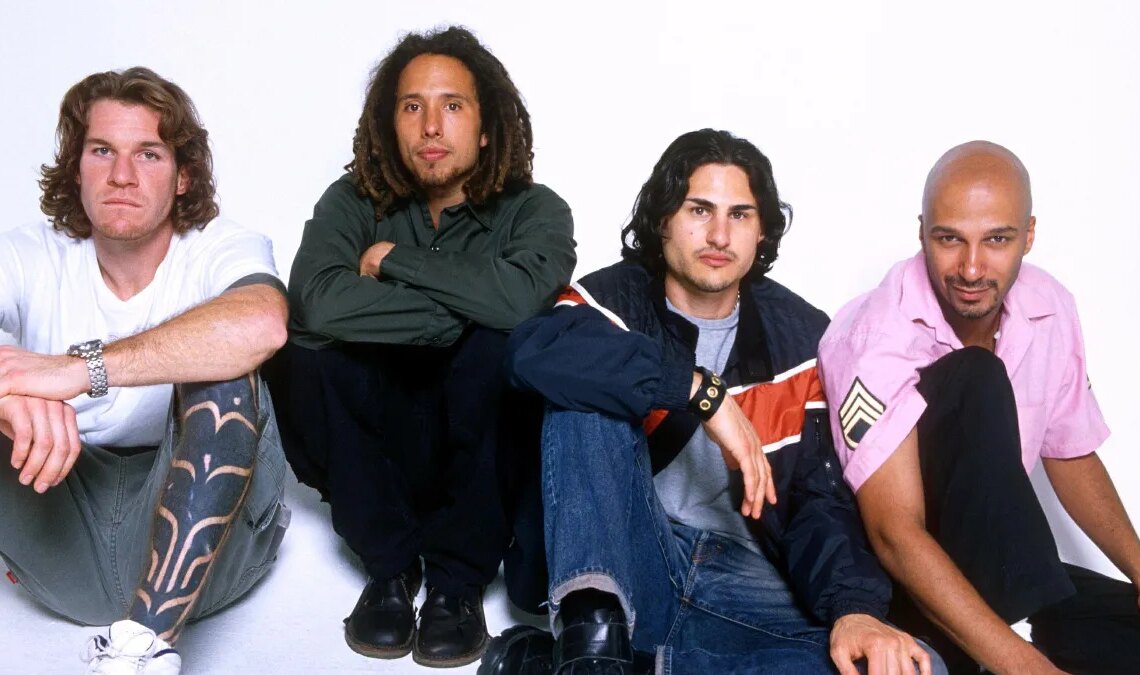
The track that sparked the 1998 equivalent of modern online discourse was Rage Against the Machine’s “No Shelter”. A well-known aspect of the band’s overall message was a vehement rejection of consumerism, capitalism, the mainstream, and mass media. So, to many critics familiar with their publicly expressed beliefs, appearing on a blockbuster movie soundtrack looked a lot like selling out.
Rage Against the Machine Condemn Mass Media Control By Calling Out the ‘Godzilla’ Movie on the ‘Godzilla’ Track
To critics, a Rage Against the Machine needledrop in one of the biggest mainstream movies of the summer “reeked of selling out and hopping in bed with the enemy,” wrote Colin Devenish in his 2001 biography of the band. But those who turned their nose up at it missed the contextual irony of one particular line.
With Zack de la Rocha’s usual whip-smart lyrical stylings, “No Shelter” took aim at mass media, consumerism, and Hollywood pop culture. And it was not subtle. Whoever put together the soundtrack for Godzilla possibly grabbed a Rage Against the Machine feature to entice the youth without looking too deeply at the result. Or, they knew that Rage would want to make a statement. Dismantle the system from the inside, so to speak.
The song opens with a swift right hook, “The main attraction, distraction,” then lands hit after lyrical hit without respite for the remainder of the track. “Empty ya pockets, son, they got you thinkin’ that / What ya need is what they selling / Make you think that buying is rebelling” and “Memories erased, burned and scarred / Trade in ya history for a VCR” are all within the open verse. Additionally, “The thin line between entertainment and war” is a repeated sentiment throughout.
But it’s at the end of the second verse that Rage Against the Machine really aims for the head: “Godzilla, pure mothaf—kin’ filler / To keep ya eyes off the real killer”. Strategically name-dropping the expensive Hollywood film your song appears in alongside several other derisive references? That’s a ballsy move. But of course, Rage weren’t newbies. Zack de la Rocha knew what he was doing.
‘The Thin Line Between Entertainment and War’
As expected, the irony of “No Shelter” flew over several heads. Typically, those adjacent to the entertainment industry and the band’s vocal critics. But those who got it, really got it. In an academic analysis of the song, scholar Jeffrey A. Hall posited that including the song on a blockbuster soundtrack actually amplified Rage Against the Machine’s message.
Among other analyses, one of Hall’s standout conclusions theorizes that “the band acknowledges its role in the circular relationship between the text and its commercial context: the song is set forth as a promotion of the film and its soundtrack, and yet it returns as an assault on that very context.”
In short, the Godzilla soundtrack was almost like a Trojan Horse for Rage Against the Machine. Yes, purchase this soundtrack, bring it into your home, they said. There’s definitely nothing that could radicalize your family into rejecting mass media control and pop culture consumerism. Definitely not.
The post On This Day in 1998, Rock’s Most Anti-Capitalist Band Was Accused of Selling Out Over a Blockbuster Movie Soundtrack Song appeared first on VICE.