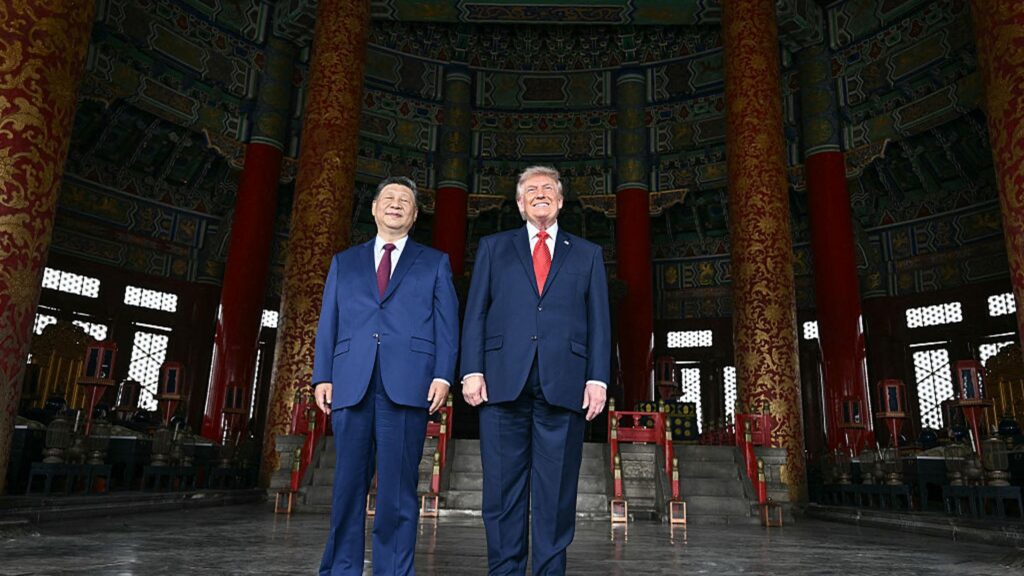
President Donald Trump is back from Beijing after a state visit, the first by an American leader since he made the trip in 2017. In the intervening years, this most consequential bilateral relationship in the world had become dysfunctional, battered by a cascade of schisms including a global pandemic, increasing ideological antagonism, accelerating geopolitical rivalry, and surging trade tension. The United States and China seemed unable to have a dialogue, and conflict seemed inevitable.
The question now is, having travelled across the world, what did Trump achieve in China? It is true that there was no “grand bargain”—yet he managed to move the U.S.-China relationship in a more positive direction, to the benefit of both countries and the world. Indeed, the tone between the two superpowers is moving away from endless confrontation and toward stability and, mutual respect, and renewed cooperation.
This is because the symbolism and pageantry of the state visit, and the sustained, face-to-face dialogue between Trump and Chinese President Xi Jinping over two days, represent a success in their own right and serve to build confidence and inject stability into the relationship, something that cannot be replaced by phone calls or brief meetings on the sidelines of other gatherings. This is especially true in light of the many storms the U.S.-China relationship has weathered in recent years.
Avoiding the Thucydides Trap
And it’s likely that things will get better. Trump and Xi might meet three more times this year. There is ample opportunity to continue developing goodwill, finding areas of cooperation, managing tensions, and pivoting the relationship away from a New Cold War toward a Cold Peace.
Contrary to the allegations by many analysts in Washington, President Trump’s stance toward China is not about “surrendering” U.S. interests or “getting played” by Beijing. He correctly recognizes that China is no longer merely a “rising” power but a true peer in many respects, and that the U.S. must secure a peaceful and more productive coexistence with China, rather than pursuing ever more unsustainable schemes to contain and confront the world’s other leading global power.
When it comes to the substance of the summit, the important discussion of the “Thucydides Trap” underlines a mutual recognition of the imperative to avoid the historical tendency toward catastrophic great power war. President Xi raised the question of whether the two great powers could successfully navigate the challenges posed by China’s rise and America’s response.
While the “Thucydides Trap” may suggest that a declining America would fear and seek to suppress a rising China, Trump responded with confidence and politely brushed off concerns about America’s decline. The American president does not seem to fear that China’s rise is coming at America’s expense, rightly rejecting the zero-sum thinking that remains so pervasive in Washington.
On the most important and thorniest security challenges—Taiwan and Iran—Trump and Xi both opted for opaque answers to avoid challenging each other. That is not a bad outcome for now, given how many problems the two leaders needed to address and how dysfunctional the relationship had become. These choices allow the two leaders to maintain their flexibility, keep talking, and address those hot-button issues as needed with domestic audiences.
When reporters probed on Taiwan, Trump, standing next to Xi, replied, “China is beautiful.” He discussed Taiwan arm sales with Xi but gave no indication of his thinking, continuing to steer U.S. policy back toward “strategic ambiguity” and away from a dangerous embrace of “strategic clarity” on Taiwan. Considering that the question of Taiwan is likely the only one that could bring these nuclear-armed superpowers to blows, Beijing’s plea for “utmost caution” should rightfully be heeded.
For its part, China also demonstrated ambiguity on Iran. Beijing reiterated support for the current ceasefire and broader cessation of hostilities, but refrained from offering policy details, including commenting on Iran’s proposal for tolls in the Strait of Hormuz. A spokesperson for the Chinese Ministry of Foreign Affairs sidestepped a reporter’s question about whether Iran had been a topic of conversation between Xi and Trump.
When America and China cooperate
Many analysts will be tempted to draw conclusions about this state visit based on which deliverables—the proposed Board of Trade and Board of Investment, rare earth agreements, and agricultural and Boeing purchases—are or are not immediately announced. But in evaluating the true value of this Trump-Xi summit, it is prudent to watch what happens in the aftermath, not just to read instant press releases.
Consider the question of fentanyl, the synthetic opioid, which kills tens of thousands of Americans each year. The Trump Administration had been accusing Beijing of not doing enough to curb the flow of fentanyl and fentanyl precursors from China to America.
In October 2025, Trump met Xi in Busan, a city in South Korea, and the two leaders pledged to work on the issue. While similar pledges had been made during both the first Trump and then Biden Administrations, and modest gains were achieved, the policy shifts that followed Busan were far more visible and the follow through far more rapid.
Soon after the Busan meeting, FBI Director Kash Patel travelled to Beijing and met with Xu Datong, a Vice Minister in the Ministry of Public Security (MPS). According to Patel, China agreed to controls on 13 fentanyl precursors and seven chemical modifiers, drastically reducing drug flows in the U.S.
The U.S. shared intelligence that recently led to multiple arrests in China, with the Drug Enforcement Administration giving China’s MPS credit “for their thorough and swift investigative work on this case.” Fentanyl-related deaths have been falling, and this kind of quiet, pragmatic cooperation saves lives and satisfies an important policy priority for the Administration.
Similar patterns help reveal which additional areas of cooperation could emerge: the two leaders forge an agreement, immediately assign high-ranking officials to address the issue, publicly announce what they are doing, and deliver results. In Busan, Trump raised the idea of selling American energy to China and hinted that Secretary of Energy Chris Wright might visit. The visit never took place, however, and major progress stalled. The issue resurfaced later, along with a number of other possibilities, including bilateral investment.
But for anything to succeed, presidential direction is needed to overcome bureaucratic inertia and incentivize the allocation of scarce time and resources. Success will also require consistent effort to overcome the residue of a decade of unhelpful ideological estrangement and the breakdown of diplomatic contacts.
And yet, there are hopeful signs. Beyond the two leaders’ efforts at stabilizing relations, a series of polls over the last year consistently showed that Americans are moderating their views on China and becoming more supportive of a constructive relationship between the two countries—a sentiment seemingly reciprocated by the Chinese public. A July 2025 survey from the Chicago Council on Global Affairs found that 53% of Americans preferred cooperation and engagement with China, a jump from 40% in 2024. Only 44% of the respondents in the poll favored containing China.
Public opinion does not directly determine U.S. foreign policy. But, if the trend continues, Trump’s efforts to repair relations could prove popular and endure beyond his presidency. At a minimum, it should become normal once again for the leaders of the world’s two superpowers to meet for extended bilateral discussions at least once a year. Now, as the leaders look ahead to their next meeting––potentially a formal Xi state visit to the U.S.—there is an opportunity to keep the stabilizing momentum going, deepen the leader-to-leader relationship, and insist on following through.
The road ahead will be imperfect and bumpy. But if the leaders succeed, the two countries could arrive at a pragmatic and mutually beneficial relationship that keeps the peace and meets the needs of their peoples. It will not be a return to the “engagement era” of the 1990s and early 2000s, when the United States tried to remodel China in our own image. It will not be a New Cold War either.
The relationship between the U.S. and China will be a Cold Peace, the outlines of which are just now taking shape.
The post How Trump and Xi Traded a New Cold War for a Cold Peace appeared first on TIME.