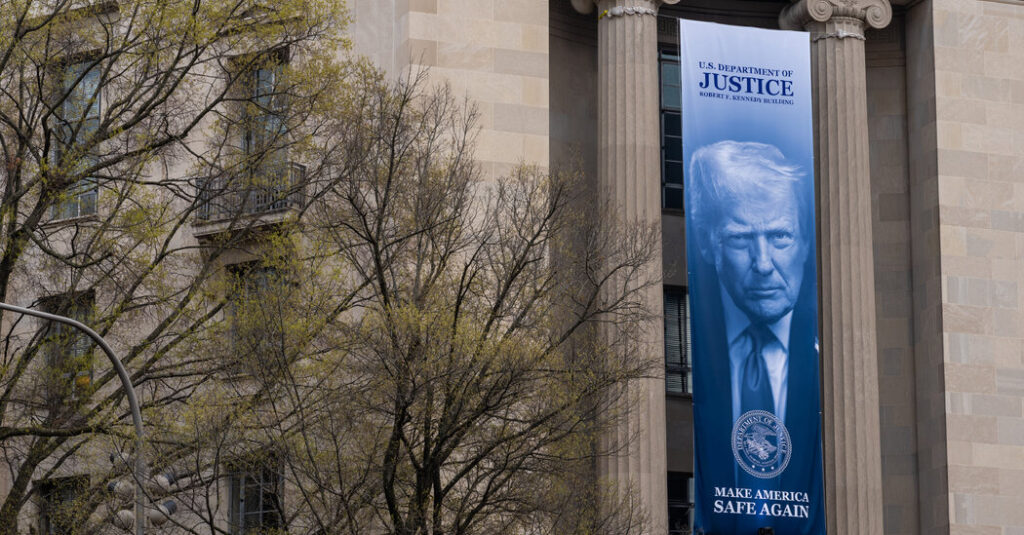
The Justice Department announced on Monday that it was setting up a new $1.8 billion fund to compensate people who it said were victims of “weaponization and lawfare,” a group that will almost certainly be made up of President Trump’s political allies.
The creation of the fund came in exchange for Mr. Trump dropping his lawsuit against the Internal Revenue Service, as well as two additional, administrative claims he had made against the federal government that he currently controls.
The Justice Department said that Mr. Trump would not himself receive money from the fund. But it did not provide many other details about how it would operate or who could be eligible for compensation. That fueled criticism that the money was a “slush fund” Mr. Trump would use to pay supporters who have faced federal investigations and convictions, including those who stormed the Capitol on Jan. 6.
Here’s what we know:
Where is the money coming from?
To create the $1.776 billion program, the Justice Department is tapping an unlimited fund created by Congress to settle lawsuits filed against the government. That pool of money, called the Judgment Fund, gives the Justice Department the authority to make monetary settlements without needing approval from Congress.
Under the terms released by the Justice Department, the Trump administration will deposit $1.776 billion from the Judgment Fund into the separate account. Money from that account will be disbursed to the people deemed to be victims of “weaponization.”
Paul Figley, a former Justice Department official, said that Congress had long neglected to more tightly control how money from the Judgment Fund is used, giving the Trump administration the ability to make this payment.
“It’s not wrong legally. But the problem is he is creating a new federal program, and if he is doing so with money from the Judgment Fund, it’s not the way Congress anticipated the Judgment Fund would be used,” Mr. Figley said. “It’s horrible policy.”
How will the money be controlled?
Todd Blanche, the acting attorney general, will appoint a board of five people to oversee the money, with one of those people selected with input from congressional leaders. Mr. Trump will be able to fire members of the fund’s commission at will.
Once money has passed from the Judgment Fund to the new, “anti-weaponization” account, the five-member board will have the freedom to use the money to “pay for per diems, administrative services, funds, facilities, staff, travel and other support services as may be necessary,” though they won’t draw a salary, according to the Justice Department.
Beyond that, though, the terms released on Monday include few stipulations about how the money should be used and did not describe how claims for compensation might be evaluated.
The Justice Department said the fund would provide quarterly reports to the attorney general.
Who will receive money?
Justice Department officials, in the announcement, did not lay out who will be eligible for the money, only saying that it was intended for “victims of lawfare and weaponization” and people wrongly targeted for “political, personal, or ideological reasons.” The announcement also states that “there are no partisan requirements to file a claim.”
Mr. Trump’s political movement is filled with people who say that they were wrongly targeted by the Justice Department and the federal government more broadly, including the people who stormed the Capitol on Jan. 6, 2021. A lawyer for about 430 Jan. 6 defendants celebrated the creation of the fund and said he would seek payments for his clients from it.
The anti-weaponization fund will exist until Dec. 15, 2028, at which point any remaining balance of the original $1.776 billion will revert to the federal government.
Why is this happening now?
An upcoming court deadline in Mr. Trump’s lawsuit against the I.R.S. prompted the Trump administration to introduce the fund. Mr. Trump, as well as two of his sons and his family business, had demanded at least $10 billion from the I.R.S., arguing that the agency should have done more to prevent the leak of their tax information. The judge overseeing that case had questioned whether the president’s suit was valid, given that he controlled both the lawyers bringing the suit and the government attorneys responsible for responding to it.
Judge Kathleen M. Williams of the Southern District of Florida had ordered Mr. Trump’s private lawyers and the Justice Department to write briefings by Wednesday explaining whether the case was a genuine controversy — or an attempt by Mr. Trump at self-dealing.
The creation of the “anti-weaponization” fund cleared the way for Mr. Trump to withdraw that suit before Judge Williams had the chance to rule on its legitimacy.
Andrew Duehren covers tax policy for The Times from Washington.
The post Trump’s ‘Anti-Weaponization’ Fund, Explained appeared first on New York Times.