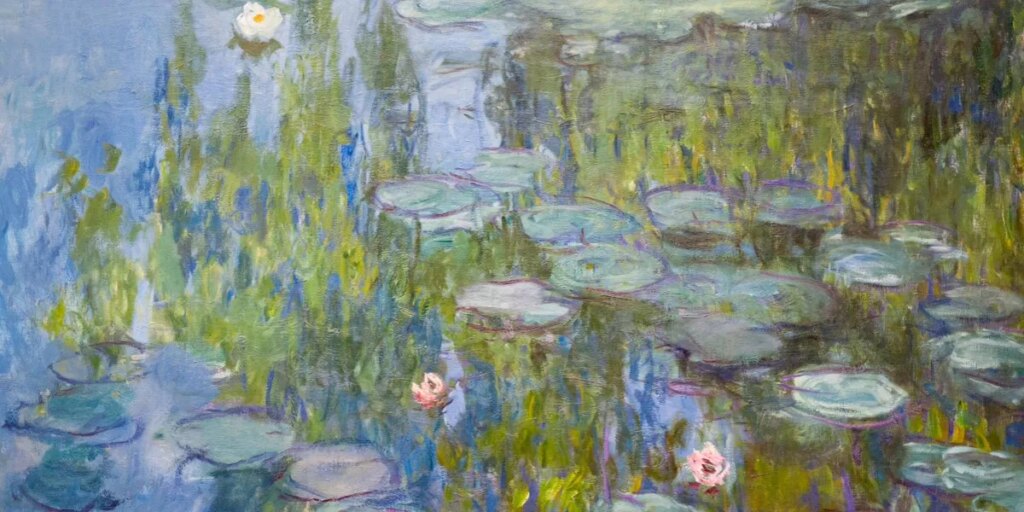
The internet was certain: the painting lacked “coherent composition,” the colors were an “incoherent muddle of inconsistently saturated greens.” Commenters piled on with extraordinary confidence, picking apart what they believed was an obvious AI-generated knockoff of Claude Monet. One person even wrote an over 700-word breakdown of the supposed fake’s shortcomings. There was just one problem: it was a real Monet.
The experiment, which went viral on X last week, was set up by an anonymous conceptual artist who goes by the pseudonym @SHL0MS. He posted a cropped image of an authentic Monet Water Lilies painting—created around 1915 and currently hanging in the Neue Pinakothek museum in Munich, Germany—with the caption: “I just generated an image in the style of a Monet painting using AI. Please describe, in as much detail as possible, what makes this inferior to a real Monet painting.” He even affixed X’s official “Made with AI” label to add to the deception.
A catalog of confident wrongness
The replies did not disappoint. Commenters ripped apart the depth and color choice, the lack of depth or contrast. One even declared the image “cluttered slop” that “doesn’t look anywhere near like a Monet” and achieves “like 20% of it.” That’s since been deleted—as have multiple comments once the reveal landed, but screenshots were preserved by other users before they disappeared.
Not everyone was fooled. Oil painter Kendric Tonn pushed back in real time: “Disagree with the people saying it lacks depth — there’s a clear plane with the lily pads and an inverted space with the willow reflecting. Paint texture looks pretty believable as a physical object, though thinner than most Monets I’ve seen … It’s not a top-tier Monet, but it’s a very credible Monet.”
Art historian A.V. Marraccini was more direct: “What the f*ck dude this is a detail from an actual late Monet? You can tell because the brush strokes are super similar to the Agapanthus in MOMA. Late ones always have that kind of wild impasto.”
The results, embarrassing as they were for individual commenters, are consistent with what researchers have found about how context shapes artistic perception. A 2024 study published in Nature found that while participants generally preferred AI-generated artworks over human-made ones when they didn’t know the source, they significantly downgraded the same works after being told AI produced them. “Participants were unable to consistently distinguish between human and AI-created images,” wrote researchers Simone Grassini and Mika Koivisto, adding that people “displayed a negative bias against AI-generated artworks when subjective perception of source attribution was considered.”
The 2004 Kruger “effort heuristic” study similarly found that people value art more when they believe it required significant human effort to create.
The great cultural critic Susan Sontag, writing in 1964, argued that “camp” is defined by “love of the unnatural: of artifice and exaggeration.” It’s a sensibility, she argued, that prizes the knowing, self-conscious gesture over the genuine one. What happened to Monet’s painting online was camp turned inside out: a crowd so trained to detect artifice that it could no longer recognize the genuine article when it appeared.
In short: people weren’t seeing the painting. They were seeing a label.
LinkedIn commentator Fabio Ciucci drew a broad lesson: “While too many believe fake AI images to be real, the contrary is also true: too many people believe a real image is an AI fake if told so.” Most people’s judgment about whether something is or isn’t AI is wrong and biased by its source.
It seems to confirm what AI researcher Vivienne Ming told Fortune recently: “Most of our fears about AI are fears about other people.”
For this story, Fortune journalists used generative AI as a research tool. An editor verified the accuracy of the information before publishing.
The post 6.7 million people thought they were ripping apart an AI-generated Monet painting. But it was real appeared first on Fortune.