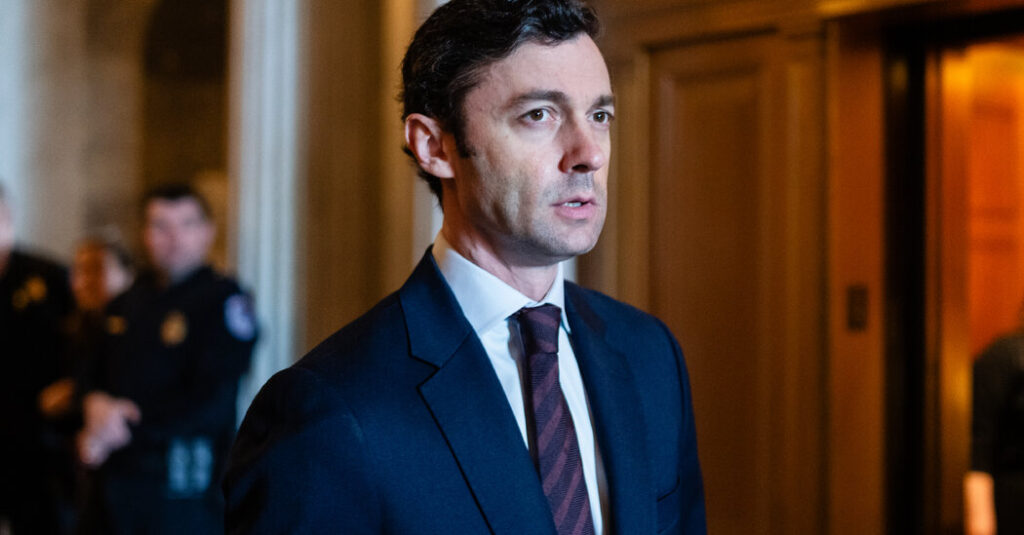
Senator Jon Ossoff of Georgia is widely regarded as the most vulnerable Democratic senator in the November midterm elections. But on the eve of the primary, there is a creeping anxiety in Republican circles that their party is poorly positioned to challenge him.
Eighteen months after President Trump won Georgia by about two percentage points, Republicans in the state worry about national political headwinds, an extended G.O.P. primary fight, and Mr. Ossoff’s popularity, interviews show. Ben Burnett, a Republican commentator in Georgia, said he could not detect a winning argument among any of the candidates.
“The three Republicans in the U.S. Senate race are all competing,” he said, “to see who is going to be the sacrificial lamb in November.”
Running to challenge Mr. Ossoff are two Trump-aligned Republican congressmen, Mike Collins and Buddy Carter, and the former University of Tennessee football coach Derek Dooley. Each would most likely enter the general election in a fund-raising hole. Each suggest their opponents are not up to task of taking on Mr. Ossoff. None have won a statewide race.
Still, some Republican and Democratic strategists predict Georgia will host one of the hardest-fought Senate races in November, and that a flood of funding will meet with the winner of the Republican primary. Democrats need to gain at least four seats to win the Senate majority, a once far-fetched goal that has looked more realistic in recent months amid growing voter anger with Mr. Trump. Mr. Ossoff’s seat is one of a handful at the center of the fight for control of the chamber.
Republicans will take a first step toward settling their differences on Tuesday, when voters head to the polls in a primary that is widely expected to go to a runoff on June 16. The challenge facing their party this year is clear: The three leading candidates have each sought to put electability at the center of the campaigns.
Mr. Collins, an immigration hard-liner who built a trucking company in central Georgia, has consistently led in the polls. He says he can appeal to working-class voters and points proudly to his work with Mr. Trump on immigration.
“Georgia needs the right Republican to take on Jon Ossoff,” Mr. Collins wrote on social media last week. “Someone who’s delivered, has the conservative record to prove it, and had President Trump’s back when it mattered most.”
Mr. Dooley, running as an outsider, says he can win over voters of all backgrounds by leaning on his experience as a football coach. “You better have somebody who can find some common ground,” he said at a recent campaign stop at a coffee shop in Milton, Ga.
Hanging over the race is Gov. Brian Kemp of Georgia, a popular term-limited Republican set to leave office. Some Republicans had hoped he would challenge Mr. Ossoff this cycle. Instead, he put his weight behind Mr. Dooley, a friend since childhood, and has joined him on dozens of campaign stops around the state in recent months.
“I don’t know if y’all have noticed, but we haven’t done so well in U.S. Senate races here in the state of Georgia in the last several cycles,” Mr. Kemp said at the coffee shop. “We’ve got to have the right person.”
Mr. Carter, a former pharmacy owner whose campaign website brands him a “MAGA Warrior” and outlines no policy positions, says that his rivals are too flawed to have a chance in November.
He said in an interview that Mr. Dooley had “not been engaged at all” in state politics and did not have as close a relationship with Mr. Trump. And he said that Mr. Collins, who has a history of incendiary social-media posts and is facing a House ethics inquiry, would be brought down by his “baggage.” (The ethics inquiry relates to claims that an intern in his office had a romantic relationship with a member of his staff and received pay for no work.)
“If Derek Dooley is our candidate we lose,” Mr. Carter said. “If Mike Collins is our candidate, we lose.”
Mr. Collins’s campaign said in a statement that Mr. Carter was losing in the primary to a “failed and fired Tennessee coach” and that the “only winning occurring in his camp is the consultants taking him to the cleaners.”
Nationwide, Republicans are facing challenges posed by the unpopular war in Iran, Mr. Trump’s low approval ratings, and voter frustration over rising energy prices. In Georgia, Mr. Ossoff, a rising Democratic star and strong fund-raiser who has amassed a large war chest, has impressed voters on both sides of the aisle with his focus on constituent services in state that is growing more diverse.
“Ossoff is a remarkable political talent,” said Joel McElhannon, a retired Republican strategist in Georgia, adding, “It’s going to be very, very difficult to beat him.”
Last month, Republicans in the state received a warning shot in a special House election in former Representative Marjorie Taylor Greene’s district: Republicans kept the seat, but a Democrat running on his opposition to the war shifted the district 25 points to the left compared with the 2024 presidential election.
Although Republicans performed well in the state in 2024, their history in recent Senate races is filled with disappointment. Mr. Ossoff and Raphael Warnock both won runoffs in early 2021, and Mr. Warnock was re-elected in 2022 after facing Herschel Walker, a first-time candidate and former star football player at the University of Georgia who was widely seen as a flawed nominee.
For now, the leading Republican candidates are more focused on outshining each other. Each has, in their own way, angled for the endorsement of Mr. Trump, a potent political kingmaker who has stayed out of the race.
Mr. Kemp and Mr. Trump have had a tense relationship ever since the governor refused to join Mr. Trump’s efforts to reverse the 2020 presidential election result in Georgia. The mention of Mr. Kemp’s name has in the past drawn jeers from crowds at Trump rallies.
But in August, Mr. Dooley met with the president in the Oval Office, discussing sports and politics, according to his campaign.
Mr. Carter said in the interview that he was regularly in touch with Mr. Trump and had been asking the president to endorse him. “I don’t know that he will,” Mr. Carter said.
Mr. Collins has often raised his role in passing the Laken Riley Act, a law targeting undocumented immigrants that was the first piece of legislation Mr. Trump signed after returning to office.
In recent days, Mr. Collins has appeared to turn his focus on Mr. Dooley. “You don’t beat Jon Ossoff by having no record,” he wrote on social media last week.
The attacks could sharpen in a runoff, bruising the candidates and draining resources that could otherwise be used in the general election. Already the “prolonged, protracted primary has hurt all three,” Stephen Lawson, a Republican strategist, said, though he predicted the general election would still “get tight as we get closer to November.”
Mr. Ossoff, for his part, will not have to worry about the primary or any runoff. He is running unopposed.
The post Can Anyone Beat Jon Ossoff? Georgia Republicans Grasp for a Contender. appeared first on New York Times.