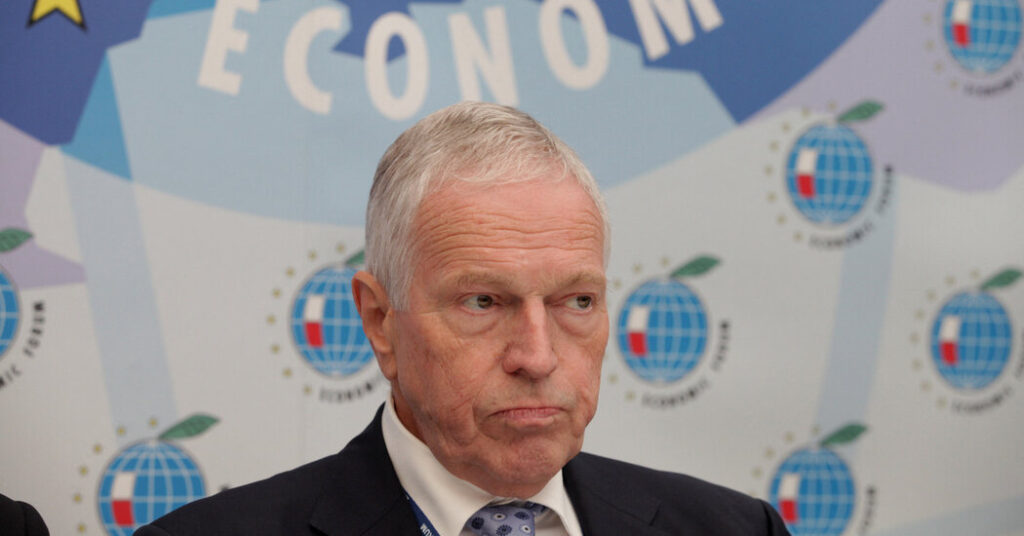
Edmund S. Phelps, who was awarded the Nobel in economic science in 2006 for work that helped upend the conventional wisdom about the balance of inflation and unemployment, inspiring central banks to push for low inflation, died on Friday at his home in Manhattan. He was 92.
His wife, Viviana Phelps, said the cause was Alzheimer’s disease.
In the mid-20th century, the popular view among economists was that slightly high inflation was a price worth paying to keep unemployment low. But in a landmark 1968 paper, “Money-Wage Dynamics and Labor-Market Equilibrium,” Dr. Phelps argued for a more complex view.
He agreed that stoking the economy to keep inflation up might help keep unemployment down in the short term. But to do so over the long term, he wrote, economic stimulus would have to keep growing, and inflation would keep rising, too.
Dr. Phelps’s paper also introduced the idea that some amount of unemployment is necessary in a healthy economy; he called it the equilibrium unemployment rate. Too little unemployment for too long, he argued, would drive up wages and prices.
Central to these ideas was Dr. Phelps’s contention that expectations about inflation, particularly among businesses, had an important effect on inflation itself.
“Whether you have high inflation or not depends largely upon whether expectations of inflation are acting upon the players,” Dr. Phelps said in an interview with The New York Times in 2023. “If everybody’s expecting inflation elsewhere, they’re going to be raising their prices, too.”
When it awarded Dr. Phelps the Nobel Memorial Prize in Economic Sciences, the Royal Swedish Academy of Sciences wrote, “Phelps showed how the possibilities of stabilization policy in the future depend on today’s policy decisions: Low inflation today leads to expectations of low inflation also in the future, thereby facilitating future policymaking.”
Dr. Phelps came to many of the same conclusions, at around the same time, as another Nobel recipient, Milton Friedman, one of the most famous and polarizing American economists of the 20th century.
Jason Furman, a professor of economic policy at Harvard who served as chairman of the Council of Economic Advisers in the Obama administration, said in an interview with The Times that Dr. Phelps’s message was more generally accepted than Friedman’s because he was not considered the kind of partisan conservative figure that Friedman was.
“Milton Friedman looked like he was wielding an ideological ax in an ongoing fight with Paul Samuelson,” Dr. Furman said, referring to Friedman’s liberal sparring partner. “And Phelps looked more like a scientist trying to explain and understand the world.”
Their ideas changed the way central bankers thought about balancing inflation and unemployment.
“Phelps, together with Milton Friedman, explained why an increase in inflation engineered by the central bank could at best lead to a temporary reduction in unemployment while potentially leaving inflation permanently higher,” Ben S. Bernanke, a former chair of the Federal Reserve, wrote in an email in 2023. “As a result of the Friedman-Phelps arguments, central bankers don’t try to use inflation to push unemployment below sustainable levels, but instead aim to keep inflation and inflation expectations low.”
Edmund Strother Phelps was born in Evanston, Ill., on July 26, 1933, to Edmund and Florence (Stone) Phelps. His mother was a nutritionist, and his father worked in advertising at a Chicago bank.
Both of his parents lost their jobs at the height of the Great Depression.
“The reality of the economy and the importance of it to people,” Dr. Phelps later said, “was something that I sensed very early on in my life.”
When he was 6, his family moved to the Westchester suburbs of New York after his father found work in advertising and sales in the city. An avid music fan, young Edmund played the trumpet as a child and into his college years.
As an undergraduate at Amherst College, he was considering majoring in philosophy when his father suggested that he might enjoy an economics course. He was immediately taken with the field.
After graduating from Amherst in 1955, he started graduate school at Yale, driven in part by a desire to bridge what he saw as a disconnect between macroeconomics and microeconomics in textbooks like Mr. Samuelson’s classic “Economics: An Introductory Analysis.”
“When you opened up Paul Samuelson’s book, it starts with macroeconomics and then it jumps to microeconomics — the individual firm, the individual household — without any reference back to macroeconomics,” he said. “More important, vice versa. All of this macroeconomics didn’t have a microeconomic foundation.”
He received a Ph.D. from Yale in 1959. After a year at the RAND Corporation, he took a research and teaching position at Yale’s Cowles Foundation for Research in Economics in 1960. He gained attention for a 1961 paper, “The Golden Rule of Accumulation: A Fable for Growthmen,” which demonstrated that there was an optimal savings rate for a nation.
“If you want to get on that highest consumption path in the long run, you don’t want to save too little,” Dr. Phelps said, because then “you’ll never get there.”
He added, “You don’t want to save too much, because you’ll overshoot.”
Dr. Phelps stayed at Yale until 1966, when he took a position at the University of Pennsylvania. In 1971, he moved to Columbia University, where he stayed for more than half a century. He retired from teaching in 2021, but continued to direct Columbia’s Center on Capitalism and Society.
Dr. Phelps met his wife, the former Vivian Montdor, an Argentine-born interpreter, at Columbia, when she had a clerical job in the economics department. They married in 1974, and he helped raise her two children. In addition to her, he is survived by his stepdaughter, Monica Caveda Pucci, and seven step-grandchildren.
Dr. Phelps wrote, edited or contributed to more than two dozen books, including his “Political Economy: An Introductory Text” (1985) and “Mass Flourishing: How Grassroots Innovation Created Jobs, Challenge and Change” (2013). He wrote widely on a variety of ideas in economics not confined to any one ideological corner.
In 2024, he was one of a group of 16 Nobel laureates who signed a letter during the presidential campaign warning of the effects — including reignited inflation — of the economic policies in a second Trump term.
Dr. Furman said: “A lot of the big-name economists in the last 60 years, for better or worse, have been pretty associated with one side of the aisle or the other, and he just isn’t. And I think that’s made his thinking more creative.”
Dr. Phelps said he did not go out of his way to avoid being branded a liberal or conservative. Rather, he tried to call it as he saw it.
“If I felt that a certain proposition was correct and I could make a good theoretical argument for it,” he said, “then what did I care whether it’s left or right?”
Charlotte Dulany contributed reporting.
The post Edmund Phelps, Who Upended the Way We View Inflation, Dies at 92 appeared first on New York Times.