Over the past year, the Gulf states have lived with the highs and lows of an American president who likes to take big bets. In May 2025, he visited Riyadh, Doha, and Abu Dhabi, wagering heavily on their economic success and on the prospect of their renewed partnerships with the United States. He celebrated the region’s modernization efforts and its ambitious economic diversification plans.
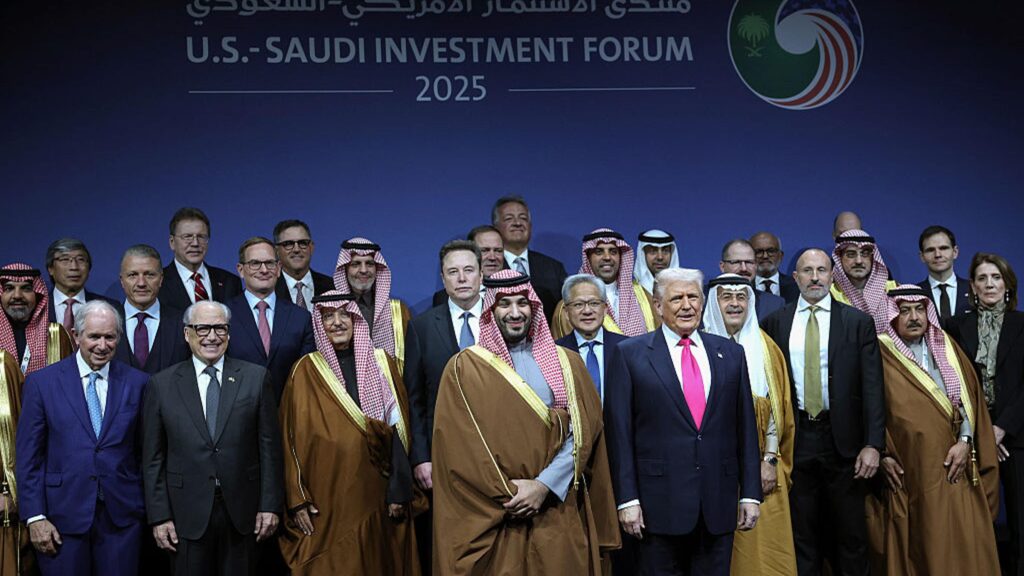
Standing alongside the leaders of some of America’s largest corporations, Trump announced a cascade of deals between American and Gulf businesses, along with pledges by Gulf states to invest trillions in the United States. The numbers were eye-popping, and, as always, more aspirational than bankable.
Beneath the Trumpian spectacle and the brazen self-dealing was a serious strategic idea: Washington’s relationships with Riyadh, Doha, and Abu Dhabi should no longer be defined by oil, weapons, and crisis management, but should instead be built around technology, investment, and the Gulf’s ambitions for economic transformation. This vision resonated with the leaders of the Gulf states and their citizens, who have increasingly come to see themselves not as mere custodians of oil fields and checkbooks, but as builders of dynamic new economies and societies.
In February, Trump turned his attention back to the Middle East, brushed aside warnings from the Gulf states, and made his most reckless wager yet: he launched a war against Iran. The gleaming skylines Trump had so lavishly praised were now streaked with plumes of smoke. Iranian missiles and drones threatened everything the Gulf states had spent decades building. The Gulf states performed admirably in defending their skies, but the war exposed a core vulnerability: Iran had effectively blocked the Strait of Hormuz, the narrow chokepoint through which flows much of the region’s oil, gas, and trade.
Iranʼs strikes also broke a psychological barrier. Oil facilities can be repaired. Airports can reopen. Confidence is harder to restore. Investors, executives, and expatriates—some of whom fled—felt vulnerable and uncertain. Some outside commentators have questioned whether the Gulf’s new economic model is over. That is far too pessimistic.
The leaders of the Gulf states always understood they lived in a dangerous neighborhood. Their modernization projects rested on the idea that regional danger could be managed well enough for commerce to continue; that security would allow the Gulf to serve as a hub linking Asia, Europe, Africa, and America; that sovereign wealth would be converted into domestic transformation and global influence; and that a societal and economic opening would generate dynamism.
The war has dented these pillars. It has not destroyed them. The Gulf states can still build a future based on security, connectivity, capital, and social opening. And their success still matters to the U.S. and the world.
Consider the stakes. The Middle East badly needs a better model of possibility and success. The diversification efforts in the Gulf Arab monarchies are far from perfect, and these states are not liberal democracies. But their transformations have something important to offer: women entering the workforce, young people building careers outside government, global companies establishing a presence, tourism and entertainment expanding, and national identity becoming less dependent on piety than on possibility.
For decades, the U.S. has grappled with an urgent strategic question: Can Middle Eastern states build stable, globally connected, prosperous societies, or are they condemned to authoritarian stagnation or worse? Saudi Arabia’s Vision 2030, the United Arab Emirates’ global hub strategy, Qatar’s investments in educationand international sportsand Oman’s logistics ambitions are serious attempts to answer that question.
For Iranians, the success of their neighbors is a reminder of why they demand more from their government than fundamentalism and anti-American ideology. For the U.S, the war’s disruptions—from oil to fertilizers to inputs for microchips—made clear that the Gulf security directly affects the world economy and our own.
A thriving Gulf is also a source of investment, profit, deals, and jobs for Americans. Some Gulf states, such as Saudi Arabia and Oman, have actually seen their oil revenues increase, even as others, like Kuwait and Qatar, have seen their economies sharply contract. However they fared during the war, Gulf states will continue to mobilize capital quickly, deploying nearly 40% of the worldʼs sovereign wealth to make strategic long-term bets even as they refocus some funds toward recovery from this war. The U.S. remains, overwhelmingly, the Gulf’s overseas investment destination of choice.
The war has also clarified what the next phase of Gulf development requires. In the near-term, the region may need the armored-car version of economic transformation rather than the sports-car version; it needs to trade top speed for additional safety, but to arrive at the same destination. That means hardened infrastructure, redundant logistics, jointly developed air and missile defenses, more resilient energy systems, and upgrades to pipelines, ports, rail, and trade routes. That agenda should interest Washington.
For American companies, the Gulf market has already expanded to include new industries from quantum computing to mining to manufacturing. As Gulf states work to harden what they have built and build what they lack, American firms can help. But Gulf states will notice who left and who returns. To succeed, American businesses must show commitment.
Despite Iran’s targeting of American data centers in the Gulf, artificial intelligence, which was last May’s centerpiece, remains a significant opportunity. American tech companies and Gulf governments have been exploringambitious joint projects. These now require creative thinking about security and redundancy, but the basic case remains. If the U.S. wants to lead the AI era globally, it should ensure that Gulf capital and infrastructure are tied to American technology, safeguards, and standards.
A similar logic applies to international waterways. Reopening the Strait of Hormuz is not American generosity. It is a strategic necessity on which our economy depends, and a pass-fail test of American leadership. The path forward lies not in open-ended escalation but in sustained diplomacy backed by military pressure to reopen this critical artery of global economy.
From there, Washington should return to last May’s agenda. Circumstances have changed. Gulf budgets face new pressures, and some joint projects will be delayed or shelved. But major opportunities remain.
The U.S. does need its military to address the Iranian threat, but an overreliance on military tools has a way of blotting out everything else. It leaves Americans with the burdens of Middle Eastern security but fewer of the benefits of Middle Eastern prosperity. And it tells the regionʼs young people that the U.S. is interested in their airspace and waterways, but not their futures.
Trump’s trip last May attempted to mobilize American business and diplomacy together around the Gulf’s future. That was the right instinct—before he allowed it to be overtaken by the wrong war. It still is. Washington needs to embrace it again.
The Gulf’s next chapter may require a bit more armor, redundancy, and realism. But it still deserves American attention. And American ambition.
The post Why America Can’t Walk Away from the Gulf Economies appeared first on TIME.