Matthew Lynn is a financial columnist and author. He writes for the Daily Telegraph and the Spectator in London.
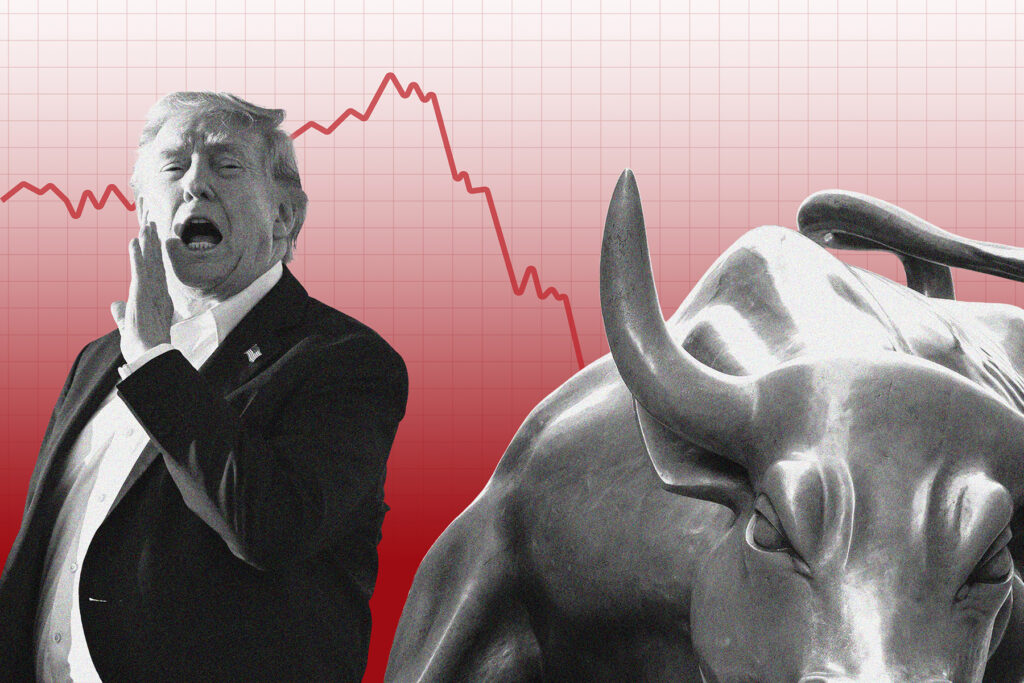
A Rose Garden announcement triggers panic on Wall Street; then a post on Truth Social sends stock prices soaring. A promise of upcoming news launches a market rally, which slumps when the actual news is delivered that evening. Anyone who follows the stock market is familiar with the phenomenon. In President Donald Trump’s second term — particularly its first few months — his abrupt announcements have driven the stock market in a way that past presidents’ moves have seldom done. And that’s troubling.
Many of us might have suspected that this is the Trump stock market, but we now have confirmation. According to a recent report from the financial research firm Fundstrat, Trump was the driver of the five best trading days on the S&P 500 index since the start of his second term. And he was also responsible for its five worst trading days. Such as? On April 3, 2025, the S&P 500 fell 4.8 percent when Trump announced “Liberation Day” tariffs, and it bounced back 9.5 percent when most were suspended six days later.
From trade wars to military strikes, Trump’s moves have been the dominant force on Wall Street. What he says can create or destroy billions of dollars of wealth in an instant. He has become so significant that a whole set of acronyms has emerged to signal what’s going on. TACO stands for “Trump always chickens out,” TUNA for “Trump usually negates announcements” and NACHO for “Not a chance Hormuz opens.”
Certainly, presidential announcements have shifted the market in the past. The most powerful person in the world matters. But the Fundstrat analysis, which goes back to the start of Ronald Reagan’s first term in 1981, found that no other occupant of the White House in that time held anything like as much sway over equity prices.
None of the five best or worst trading days under Joe Biden were driven by one of his announcement. During Bill Clinton’s eight years in office, only one of the five worst days could be pinned on the president or his administration, and none of the best. Sentiment on the stock market was routinely driven by interest rate announcements, corporate earnings or economic data. Not by the guy in the White House.
It is not healthy for the stock market to be so dominated by one political leader. There are two big problems. First, Trump is wildly inconsistent. What he says today will be different tomorrow. So the stock market is far more volatile than it needs to be, with dramatic swoons followed by giddy rebounds. That might be good for a handful of high-frequency traders with the right algorithms to exploit the situation. But it is very bad for everyone else.
As Warren Buffett once put it, “If you aren’t willing to own a stock for ten years, don’t even think about owning it for ten minutes.” Unfortunately, it’s very hard for the rest of us to imitate the Oracle of Omaha. Too much volatility will encourage too much trading, and that depresses overall returns. Even worse, it deters ordinary people from putting their money into stocks. We can’t eliminate wild swings in market sentiment. But we should certainly resist letting the president create them.
Next, nothing that Trump says or does makes much difference to the actual business of making and selling things. Even the tariffs eventually had little impact (especially after the Supreme Court ruled that Trump did not have the authority to impose them). The market keeps getting worked up over very little.
And that matters. A stable stock market is fundamental to the health of the U.S. economy as well as to the wealth of ordinary people. Sixty-two percent of Americans own stocks, either directly or through a mutual fund or self-directed retirement plan. Many own equities through their pension plans, which links their retirement security to how well the market performs.
Companies use the market to raise the capital they need to invest, and investors are the main force keeping corporate leaders focused and disciplined. The market should be driven by such factors as the amount of money that companies can make, how fast they can develop new technologies, whether they can expand into new markets, and whether they can become more efficient at making and selling stuff.
In short, all the things that private industry is supposed to do. When values are driven instead by the increasingly bizarre statements of a single individual, so much noise is created that no one can hear the signals.
In fairness, there are some signs that Wall Street has started to learn to ignore the president. Though a ceasefire in Iran triggered one of the most hectic days of stock market action in his second term (a 2.5 percent jump in the S&P 500 on April 8),what might be termed “Trump days” are less frequent than they were in 2025. The war in the Persian Gulf and the threats to destroy Iran’s “whole civilization” have impacted the market for sure, but not as much as you might expect.
Even Trump observed, in late April, “I thought [the market] would be down much more.” Anyone who just checks their portfolio every few weeks might not notice that anything had happened.
That’s encouraging, but with more than two President Trump years still in store, it needs to go a lot further. Perhaps the traders on Wall Street should try adopting a whole new acronym. How about MUTE, for “mindfully unsubscribing from Trump entirely”? Or even, since the existing tropes seem to have been cribbed from the menu at a Mexican restaurant, TEQUILA, for “tuning out every quip, utterance, incident, line and announcement”? That would be a lot better for everyone’s portfolio, for investment in American industry — and for everyone’s mental health.
The post The stock market has got to tune out Trump appeared first on Washington Post.