When Donald Trump took the oath of office last January, he was the oldest president to begin a term, clocking in at 78 years and 220 days. He replaced the man who formerly held that title, Joe Biden, who had dropped out of the race after it became quite obvious to the entire country that he had aged too much, too quickly. But as Trump himself grows older—traveling less, switching to more comfortable shoes, and seeming to nod off during meetings—his age isn’t getting the same kind of scrutiny.
I have long thought that a reason for that is the president’s sheer size. Trump stands 6 foot 3 and, according to his most recent physical, weighs 224 pounds (yes, questioning that number is a legitimate thing to do). He is a big presence in any room, as opposed to Biden, who grew visibly thinner as he got older, adding to the appearance of frailty. Trump is also LOUD; Biden’s voice was frequently reduced to a gentle whisper. And Trump has the gift of omnipresence. His genius is in capturing attention. Biden’s public schedule grew sparse, and he actively avoided generating news; Trump holds multiple events in front of the press nearly every day. He fills Americans’ TV screens and social-media feeds seemingly nonstop, with an almost unspoken message: How could he be fading if he’s everywhere?
But as Trump turns 80 next month, his recent behavior should prompt even more questions than usual about his stability, judgment, and mental sharpness. Among the points of concern: a late-night social-media storm a few days ago featuring more than 50 messages, many strewn with dangerous or nonsensical misinformation, which followed a similar Truth Social broadside weeks earlier; an apocalyptic threat to wipe out a civilization; more and more insults (“nasty,” “stupid,” “ugly,” “treasonous”) hurled at reporters; appearing to fall asleep in public, sometimes twice in one week; deep bruises on his hands, which are covered in makeup and accompanied by confusing explanations; and long, odd tangents in speeches that seem longer and odder than his usual tangents. Never known for his ability to self-censor, Trump seems to have completely abandoned any sort of filter, tossing out messages from one extreme (He’s glad that Robert Mueller is dead!) to the other (actually, Trump is Jesus and shall heal the sick).
Biden’s team relentlessly pushed back against worried murmurings about his age and ability to handle the responsibilities of the presidency, and, for a while, the story line was mostly relegated to the background. Democrats who had concerns bit their tongue. The president had enough good days to allow his aides to try to dismiss the narrative as a right-wing talking point, while encouraging allies—and some in the media—to look the other way. But then Biden’s deficiencies burst into the open with his faltering, confused performance in a general-election debate that was followed by a wave of recriminations and finger-pointing that continues among Democrats and journalists to this day.
Trump’s White House, as you’d expect, has also vehemently brushed away concerns about having another octogenarian in the White House. Those close to him say that, yes, Trump moves a little slower these days, but that he’s still a commanding, charismatic force. That’s just it: Whereas Biden noticeably changed, Trump appears in many ways to be the same. He’s always been erratic; he’s always been bombastic. But as Trump has aged, he’s becoming a purer, less filtered version of himself. Because the changes are less obvious, they’ve drawn less attention. For now, at least.
The differences between first-term Trump and second-term Trump are numerous. One of the biggest: He has dramatically scaled back his travel. Though he has taken several foreign trips, including one last week to China, his domestic travel schedule is nowhere near as busy as it was in his first term, and months of White House promises that it would ramp up have gone unfulfilled. Trump has long prized what his staff deems “executive time”—unstructured hours in the morning usually filled by watching cable TV and using his phone—and he rarely has a public event before late morning.
Once in public, Trump’s remarks continue to feature many of his longtime hallmarks—disdain for scripts, a disregard for time, mixing up names and facts, and an impulse to say whatever pops into his head. But these days the displays of disinhibition are more pronounced, and many include seemingly aimless stories and distracted observations. (Take, as just one example, a White House Christmas reception five months ago when Trump spent nearly 10 minutes telling a story that involved a White House doctor—actually two White House doctors—and Barack Obama’s daughters and a poisonous snake in Peru. He interrupted himself to mention his own brush with death and to claim that his health is better than that of Obama or George W. Bush. “Trump is in the best health of all,” he said.)
A White House spokesperson ignored my long list of questions about Trump’s behavior and changes to his schedule and quickly sent me a personalized statement. “Here’s where you’re wrong, Jonathan,” White House Communications Director Steven Cheung told me. “President Trump has done more public events and has engaged with the press more than any other president in history.”
Republican lawmakers have, for years, given Trump notoriously wide latitude for his behavior. (“I haven’t seen the tweet” became an entire meme of deflection.) But some have quietly begun to wonder about the president’s judgment, particularly when it comes to political priorities. Gone is the promised attention to the economy and lowering prices. Instead, Trump’s focus is often on grandiose ways to burnish his own legacy, including trying to seize foreign lands and build over-the-top monuments to himself (“No one wants an arch when people can’t afford to buy gas,” one Republican lawmaker told me about Trump’s plans for a 250-foot monument, inevitably dubbed the Arc de Trump, between the Lincoln Memorial and Arlington National Cemetery). When the president departed Beijing on Friday, one of his first China-related social-media posts from Air Force One was not about any deal struck in the summit but rather on the host nation’s grand ballroom and how the U.S. should have one too.
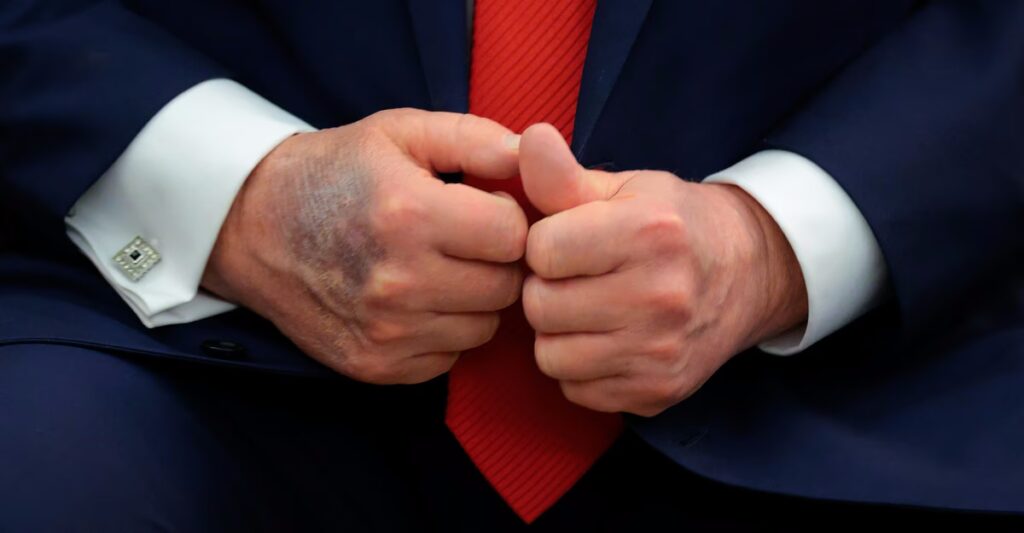
Trump has also switched to more comfortable shoes, tossing aside the dressier pairs he used to wear for $145 Florsheims, and then giving them to aides, an act of generosity that—call me cynical here—also makes his own pair stand out less. Then there are his hands: Throughout this term, Trump has sported a deep bruise on his right hand, which at times is covered up (poorly) with makeup. When asked about it, he has said he takes a lot of aspirin to have “thin blood,” perhaps to ward off clots, strokes, or heart attacks. White House aides have said that leads to bruising after handshakes. But in recent weeks, the bruising has also been spotted on his left, non-shaking hand.
Trump now notably delivers far more of his remarks while seated. In his first term, he typically spoke behind a podium either in the Oval Office or elsewhere in the White House. Now the standard configuration is Trump sitting behind the Resolute Desk, while officials and aides fan out behind him. And sometimes, while sitting in that chair, Trump’s eyes … begin … to … close. In what has become fodder for late-night comics and liberals on social media, Trump has had his eyes shut for a suspiciously long time, as if he might be sleeping, at a number of events lately. Trump aides have strenuously denied this, suggesting that the president is simply listening intently. Last Monday, when a reporter observed on X that Trump’s eyes were closed during an Oval Office event on maternal health care, the official White House Rapid Response account retorted, “He was blinking, you absolute moron.” If true, this blink lasted for at least 10 seconds.
Maybe Trump is tired because he’s up late. He has long boasted about how little sleep he needs, and reporters covering his two terms have grown accustomed to news made by social media both early in the morning and late at night. But even the wild Twitter sprees of his first term have been eclipsed by some of the Truth Social barrages of late. Aides long ago stopped trying to curb Trump’s social-media habits, even if they sometimes create political problems. The posts are normally created (or found to repost) by longtime aide Dan Scavino, other times by Trump’s executive assistant, Natalie Harp. They will bring printouts of the posts to Trump, who signs off on every one. But sometimes he just posts on his own. The White House wouldn’t tell me whether that is the case during these late-night spewfests.
Trump’s audience on Truth Social (which he owns) is far smaller than the one he had on Twitter—12.6 million versus 111.4 million—and that, at times, has seemed to limit awareness of his posting. (Trump was kicked off of Twitter after the January 6, 2021, Capitol riots; he was reinstated after Elon Musk bought the site two years later, but the president now prefers his own platform.) One night in December, he posted nearly 160 times, the most in one go during his second term. In February, he posted a racist video that depicted Barack and Michelle Obama as monkeys. Early last month, he threatened Iran by saying “a whole civilization will die tonight.” A few days later, he decreed Pope Leo “WEAK on Crime.” And then overnight into the early morning hours of April 13, Trump amplified dozens of posts, including one that depicted him as Jesus. In just a few days, Trump had offended adherents of multiple religions and drew criticism from even some of his most loyal supporters. He eventually deleted the post that depicted him as the son of God, but only after absurdly claiming that he thought it showed him as a doctor, not Jesus. Last Monday night, his account posted 55 messages between 10:14 p.m. and 1:12 a.m., including a mix of his own thoughts and a slew of reposts of multiple messages that falsely claimed the 2020 election was stolen and called for Obama’s arrest.
[Read: Trump voters are over it]
The strain on the president is obvious: The nation he leads is at war; the economy he promised to revive is teetering; and his approval ratings are falling. His behavior has renewed Democrats’ calls to invoke the Twenty-Fifth Amendment to remove the president from power for not being able to serve. (That would require the Cabinet to act and is a nonstarter.) Senate Minority Leader Chuck Schumer has called Trump “an extremely sick person,” and his counterpart in the House, Hakeem Jefferies, deemed the president “unhinged” and “out of control.”
But it’s not just Democrats. Some former Trump allies have also questioned his psychological fitness, and a poll released last week found that 59 percent of Americans believe that Trump does not have the mental sharpness it takes to lead the country. But Republicans in Congress have defended Trump, and the White House, which always touts the president’s stamina, has mocked any suggestion that he was not up for the job.
That defensiveness reminds me of just how aggressively Biden’s aides would push back at journalists who dared to ask questions about his age. It’s worth revisiting how Biden’s declining health was shielded by those around him.
Biden’s age had been front and center during his 2020 campaign, and even some of his Democratic primary opponents wondered whether he was “declining” or “forgetting” things. He never formally vowed to serve only one term, but it was the expectation among many Democrats, and some in Biden’s inner circle, that he would act as a transitional figure, one who would vanquish Trump and steer the nation out of the coronavirus pandemic before stepping aside. He took the oath of office at age 78, the oldest man ever to serve as president. (He was 78 days older at the start of his term than Ronald Reagan was when he ended his.) But Biden enjoyed remarkable legislative success in his first two years, and then Democrats fared surprisingly well in the 2022 midterms.
With hindsight, many Democrats believe that had Biden announced then that he would step down after four years, he would have been remembered as one of the more accomplished recent presidents. Of course, he did not. Trump’s comeback on the Republican side fueled the belief among those close to Biden that he had to stay in the fight; he had beaten Trump once, and only he could do it again. But Biden’s decline, which was already the source of Washington whispers, seemed to accelerate in full public view. White House aides furiously fought any suggestion that Biden, then 81, was too old to run again, too old to serve another four years (he’d have been 86 when he left office in January 2029), and pushed back against any Democrats who suggested that their party needed a new, younger standard-bearer. They chided reporters who wrote about it.
[Read: How Biden destroyed his legacy]
Stories came anyway. Then came the disastrous debate in Atlanta, and the three-plus weeks of calls for Biden to drop out of the race, a rancorous fight that nearly tore the Democratic Party apart. Trump, in private, boasted to aides that his “Sleepy Joe” nickname for Biden was spot on, even as his own advanced age received less attention. “It was fair to ask about Trump’s health in 2024, but Democrats were afraid to do it because it would boomerang on Biden,” Larry Sabato, a political scientist at the University of Virginia, told me. Veterans of Biden’s White House have expressed regret that their West Wing did not fully understand the groundswell of reservations about the president’s age, and some believe it grew too insular and overly protective of the president. Andrew Bates, who was the senior deputy press secretary for Biden, told me that their “outdated approach to media undercut Joe Biden’s superpower—his connection with working people.”
In Bates’s view, Trump has a different problem, one that exposes the president for who he really is. “The most obvious impact of age on him is that he has lost the capacity to pretend he cares about other people,” Bates said.
The White House announced this week that Trump will undergo a medical and dental checkup on May 26, which will be his fourth publicly disclosed doctor’s visit in his second term. (He has also had two dental visits in Florida.) Last year he had an annual physical in April 2025, and then what the White House described as a “routine yearly checkup” in October. Across his terms, Trump has bragged repeatedly about acing multiple cognitive tests, a boast that only raises more questions.
Many presidents have faced inquiries about their physical and mental health. Reagan seemed to slip late in his presidency in the years before he announced that he had Alzheimer’s. Franklin D. Roosevelt was in poor health before dying just a few months into his fourth term. Woodrow Wilson suffered a debilitating stroke. Abraham Lincoln battled depression. Dwight Eisenhower had a major heart attack. And some of Richard Nixon’s own aides privately worried about his drinking and his mental stability.
Nixon often utilized the “madman theory,” in which he would act unstable to intimidate foes and achieve better results. Trump’s aides say he does the same, including in his genocidal threats toward Iran; they are comfortable with that comparison to Nixon. But they may soon face more similarities with Biden.
The post The Newest Oldest President appeared first on The Atlantic.