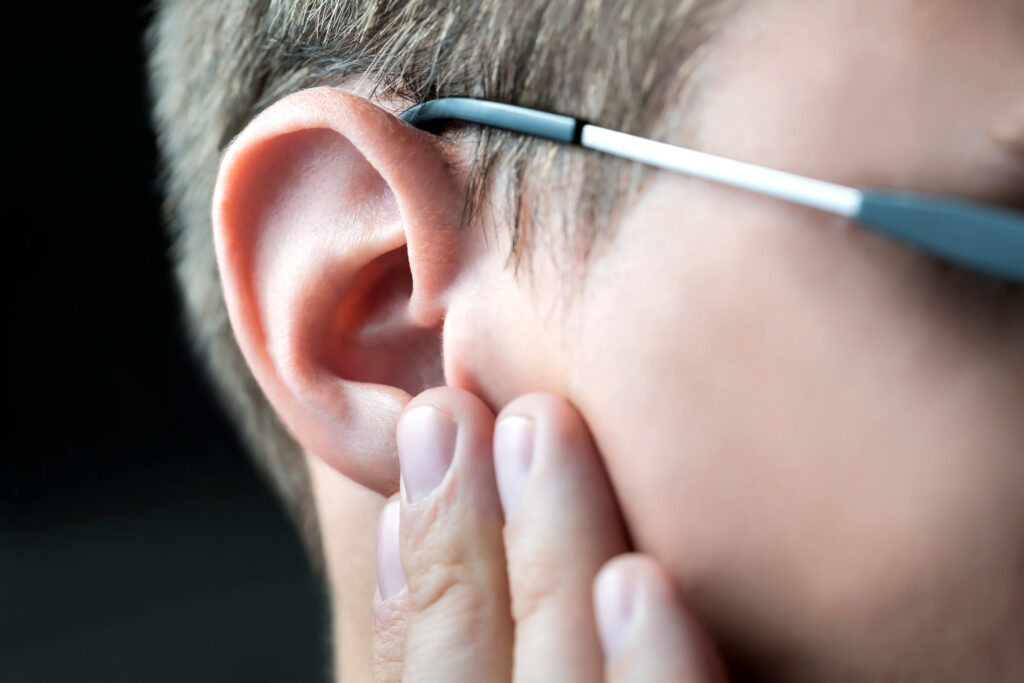
One morning, you wake up and your ear feels plugged. Or maybe you hear a loud “pop.” You might answer the phone and realize the caller sounds farther away than usual. You could notice a new ringing in one ear or begin to feel dizzy.
Any of these experiences may seem harmless or temporary. And oftentimes, they are. Common causes of muffled hearing include a buildup of earwax, ear or sinus infection, congestion from a cold or allergies, pressure changes and age- or noise-related hearing loss.
But these symptoms could also signal a medical emergency that many people don’t recognize — known as sudden sensorineural hearing loss.
I experienced this myself at 32. One evening, a sudden ringing started blaring in the right side of my head. When I held my phone up to my right ear, the person on the other end sounded like they were underwater. Still, I didn’t realize I had actually lost hearing. I sought medical attention for the ringing within 48 hours, but the doctor prescribed a nasal spray, which didn’t help.
Here’s what I wish I’d known beforehand, so that I could have advocated for myself and received emergency treatment sooner.
When a plugged ear is something worse
Sudden sensorineural hearing loss is a rapid decline in hearing, happening all at once or developing over the course of a few days. It’s a potentially reversible condition that is distinct from hearing loss caused by aging, noise exposure or earwax — but it requires prompt treatment for the greatest likelihood of recovery.
“It’s an emergency,” said Nicholas Deep, a Mayo Clinic neurotologist. Not unlike treating a heart attack or stroke, he said, but “in this case, the organ is the cochlea, not the heart or the brain.” The cochlea is a tiny structure in the inner ear containing sensory hair cells essential for hearing.
Treatment within seven days of symptom onset gives you the best chance of recovery. The sooner you treat it, though, the better the outcome will be, Deep said.
The most common treatment is a short course of high-dose oral prednisone, a powerful steroid that works by reducing inflammation, to give the inner ear the best opportunity to recover, Deep explained. Steroid injections through the eardrum and hyperbaric oxygen therapy may also be recommended if the initial dose of oral steroids doesn’t completely restore hearing.
The signs are often easy to miss. “Hearing loss is a lack of stimulus,” Deep explained. “You don’t know what you don’t hear.”
Many people might also dismiss the symptoms, chalk them up to something minor — like a cold or allergies — and assume they need to just wait for things to get better, Deep said.
Navigating the medical system can also be intimidating, leading people to put off seeing a doctor, said Meaghan Reed, an audiologist at Mass Eye and Ear.
Subtle signs of sudden hearing loss to look out for
Sudden sensorineural hearing loss isn’t always an obvious loss of hearing. It might feel like ear fullness or pressure, or like your ear needs to pop after a flight or a drive through the mountains.
It also might appear as a subtle change in sound quality or as a distortion in certain frequencies rather than a volume decrease. Voices may be loud enough to hear but difficult to understand. Everyday sounds may seem muffled or like you’re underwater. It can also become harder to distinguish where sounds are coming from because your brain relies on both ears to pinpoint direction.
Since sudden sensorineural hearing loss often affects only one ear, and the unaffected ear can compensate a bit, some people don’t notice a change until they plug their better-hearing ear, said Deep.
Reed experienced sudden sensorineural hearing loss and recovered with prednisone. In describing her symptoms, she said that “sounds became very robotic and unnatural” in her impacted ear. “If I was not an audiologist, I don’t know that I would have gone in to see a physician about it, because mine was actually a relatively mild low frequency loss, and I might have just thought my ear was clogged or plugged and I just couldn’t get it to pop open.”
About 80 to 90 percent of people with sudden hearing loss also experience tinnitus, which may sound like ringing, buzzing, humming or another phantom noise in the ear and can be extremely distressing. Tinnitus is widely accepted as the brain’s response to hearing loss, Deep said. “It’s the brain trying to reconcile why there’s not something there and trying to put something in that place.” New tinnitus could indicate a hearing change, especially when it’s in only one ear.
Reed said the tinnitus is actually what leads many people to seek care, not the hearing loss itself. “Sometimes we do a hearing test and people think they’re not doing well on the hearing test because of the ringing.”
Another sign of sudden sensorineural hearing loss is dizziness or vertigo, which can range from mild unsteadiness to a spinning sensation severe enough to induce vomiting. This could indicate inflammation affecting the inner ear’s hearing and balance systems, said Deep.
What to do if you experience these symptoms
“You know your body best,” said Lisa Houston Wenstrup, an audiologist at the University of Cincinnati. If something suddenly seems off with your hearing, don’t assume it will go away on its own — get it checked.
An ear, nose and throat doctor (ENT) or audiologist can perform a diagnostic hearing evaluation, but if you can’t get an urgent appointment, Deep said you may need to go to the ER, explain the sudden hearing loss and ask to be evaluated. “You want to really emphasize the sudden portion,” he said. “Most ENTs in the country and audiologists always have spots for sudden-hearing-loss patients because we all recognize it as an emergency.”
Primary care doctors can perform a tuning fork test to help distinguish sensorineural hearing loss from conductive hearing loss, which is treated differently. However, “sudden sensorineural hearing loss is invisible,” Reed said, so it’s possible a clinician may look in the ear and see slight redness, mistake the problem for an ear infection and prescribe antibiotics, which will not help.
If you’re unsure what you’re experiencing, there’s a quick at-home hum test you can try, Deep and Reed said. If you hum and hear it louder in the ear that isn’t experiencing symptoms, this might suggest a sensorineural hearing loss. However, this is just a clue — not a diagnosis.
Free online hearing tests, found through a quick Google search, may give you more motivation and evidence to seek treatment right away, Reed said, but a detailed hearing assessment is needed to identify the type and extent of hearing loss.
Even with rapid treatment, some people may have lasting hearing loss, while others recover spontaneously without treatment.
In about 90 percent of cases, doctors cannot identify a specific cause for sudden sensorineural hearing loss. Researchers have proposed several theories, including disrupted blood flow to the cochlea, viral injury, inflammation or an abnormal immune response. “It can happen to anybody,” said Deep. “There’s nothing you could have done to prevent this,” Wenstrup said.
For those who don’t recover their hearing, it’s normal to feel fear, grief and anger. “You’re losing half of a sense. It’s scary,” Wenstrup said.
If you miss the treatment window, “don’t beat yourself up,” she added. “We’re all navigating this difficult health care system the best that we can.”
Two years after the onset of my symptoms, my hearing has not recovered, and my tinnitus remains constant. I don’t know if earlier treatment would have helped restore my hearing. Still, I wish I’d had the knowledge and information that I do now and hope others seek prompt treatment for the best chance of avoiding the difficulties of permanent hearing loss.
The post The subtle changes in hearing you should never ignore appeared first on Washington Post.