BORREGO SPRINGS, Calif. — A planned high-voltage power line in the San Diego County desert has sparked outrage over its proposed path through the heart of California’s largest state park.
At nearly 650,000 acres, Anza-Borrego Desert State Park is known for its sprawling solitude: miles of lunar rock faces and sandy washes frame spindly Ocotillo stands, wildflower superblooms and designated dark skies. But the proposed Golden Pacific Powerlink from San Diego Gas & Electric could soon change that, opponents say.
The 500-kilovolt transmission line would run some 140 miles from an important substation in southeastern Imperial County, near the Mexican border, to a new one on the border of Orange and San Diego counties near the Pacific Ocean — carving a steel-towered path through Anza-Borrego to get there.
The estimated $2.3-billion powerlink is among the largest and most expensive projects in California’s transmission plan, and would connect one of the state’s major coastal population centers to one of its richest renewable energy zones. The Imperial Valley is a key interconnection point for regional solar, geothermal and battery storage projects.
Both the San Diego utility and the state’s grid manager, the California Independent System Operator (CAISO), say the project is essential for meeting ambitious carbon reduction goals and alleviating constraint on power lines in Southern California during high demand.
“This would provide a critical pathway to unlock the additional generation that we know will be necessary, that will be part of the demand that’s forecasted to increase in the future,” said Erica Martin, the project’s director of development with SDG&E. Construction would begin toward in 2029 to go online in 2032.
The conflict reflects a broader challenge in California: how to move increasingly clean power across the Golden State while simultaneously preserving the deserts, wildlife habitats and public lands that define it.
There is no official tally of how many other state parks have high-voltage transmission lines running through them, although it is clear Anza-Borrego would not be the first. In 2010, Southern California Edison removed about 40 high-voltage transmission towers from Chino Hills State Park after years of public opposition.
It’s also not the first time this idea has been contested. In 2008, the controversial Sunrise Powerlink faced fierce opposition from environmental groups over its planned path through Anza-Borrego, and ultimately had to run below it. The route was similar to the one proposed today, but it was rejected by the California Public Utilities Commission as “environmentally unacceptable and infeasible” because it would result in more than 50 significant and unavoidable impacts to the park.
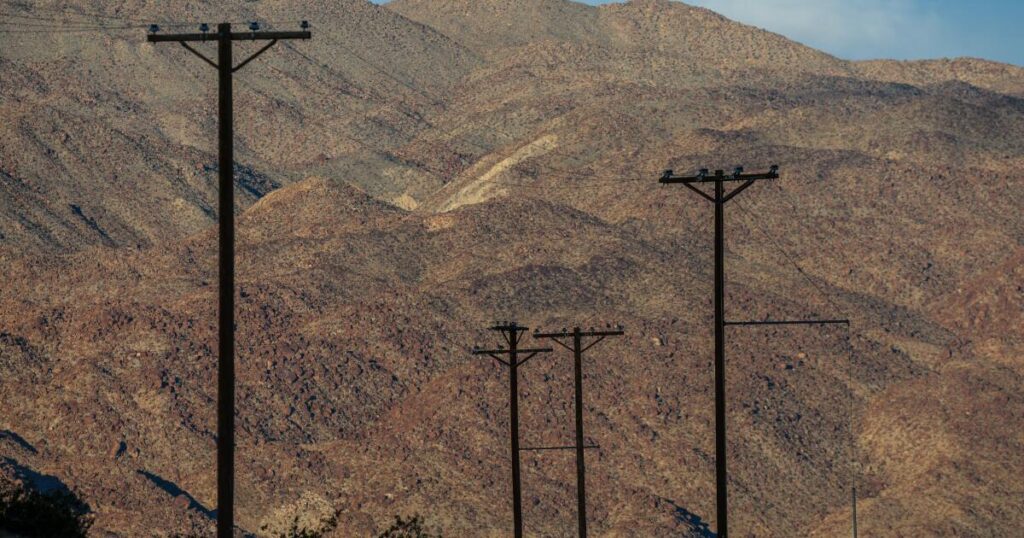
SDG&E maintains that this route is preferable for a number of reasons, including that it would allow them to “co-locate” the powerlink with the only other electricity infrastructure in the area: a 69-kilovolt line dating to the 1930s, before the park was established, which rests on 50-foot-tall wooden poles.
Opponents say the two are not comparable. While the weathered wooden poles largely blend into the landscape, the Golden Pacific Powerlink would require a 200-foot right-of-way for its X- or Y-shaped steel lattice towers as tall as 200 feet, which may require blinking safety lights at the top.
“There’s not very many of these places left where you can go and have pure wilderness,” said Bri Fordem, executive director of the nonprofit Anza-Borrego Foundation and one of the powerlink’s most vocal critics.
The plan would disrupt the habitats and migration patterns of many of the park’s 1,500 species of plants and animals, including endangered Peninsular bighorn sheep that are already being hemmed in by the U.S. border wall, Fordem said on a recent hike around the area. It would also require a rare act of “un-designating” some of the park’s protected wilderness areas.
Studies have found that high-voltage transmission lines can affect wildlife and ecosystems. A 2018 paper published in the journal Environmental Impact Assessment Review found at least 28 distinct impacts on biological diversity, including bird collisions with wires, habitat fragmentation and loss, and behavioral avoidance by birds, mammals and amphibians. Most of the impacts appear in the early stages of a project, during transmission line construction, but some persist during operation, the researchers found.
Fordem said she isn’t concerned only about the transmission line but with everything else that could come with it, such as access roads, switchyards and other industrial markers inside the park. Horizon West, the company that has been contracted to build the new substation on the coast, has already proposed “double-stringing” the line, or installing a second set of 500-kilovolt cables to increase the corridor’s power-carrying capacity — a move that could help meet higher demand.
The project would also affect recreation, tourism and sensitive cultural sites, Fordem said, since part of the line would be visible from the Tamarisk Grove Campground inside the park, and another part would run along the Angelina Spring Cultural Preserve, a historic archaeological site tied to the Kumeyaay and other local tribes.
Martin, of San Diego Gas & Electric, said the utility is weighing all of these factors as it moves forward, and is gathering public feedback before filing its formal application with the state by the end of this year. More than 900 people signed up for virtual public meetings about the project conducted by the utility earlier this month. The project would also undergo state and federal environmental reviews.
Utilities such as SDG&E make money by building projects such as transmission lines, which earn regulated returns on investment.
The cost of the powerlink will be passed along to ratepayers, but it’s too early to say how much people’s bills would increase, Martin said. However, she said the length of the line is the “largest cost driver for the project,” and cutting through the park would be much shorter than going around it.
“Regardless of the possible merits of new transmission, routing it through the heart of California’s largest state park makes no sense,” said Brendan Cummings, conservation director with the nonprofit Center for Biological Diversity. “If it is ultimately built at all, it absolutely should not be constructed through Anza-Borrego Desert State Park.”
While the utility originally touted the project as helping to “integrate more clean energy,” that language has largely disappeared from its public materials. Asked about that, Martin pointed back to CAISO, which identified this project along with 44 others in its 2022-2023 transmission plan as necessary to help maintain the system’s reliability and “unlock access to renewable generation resources to meet state energy needs.”
“All of the electrons that flow across the transmission system in California could flow on this line,” Martin said.
The powerlink has garnered support from members of the San Diego Taxpayers Assn., the Orange County Business Council and the local electrical workers’ union, IBEW 47. Chris Cate, president and chief executive of the San Diego Regional Chamber of Commerce, said the project is going through the group’s review process but it has supported it thus far.
“In terms of our rationale, it’s in part because the state has identified this as a must-complete project for helping California meet its climate and energy goals,” Cate said. “In addition, this project will help strengthen our regional and state electric grid capacity and prevent the kinds of rolling blackouts that we’ve seen in past years and that have negatively impacted businesses and residents.”
Some experts agreed new transmission projects are important.
“Southern California has a high population density with a high electricity demand, which is projected to continue growing substantially,” said Patricia Hidalgo-Gonzalez, director of the Renewable Energy and Advanced Mathematics lab at UC San Diego.
However, she said there are other cost-effective ways to meet growing demand, such as utility-scale and distributed solar power and long-duration energy storage.
Hidalgo-Gonzalez said she hasn’t studied SDG&E’s preferred pathway through Anza-Borrego enough to comment on it. “However, in principle, and even as a power systems engineer, I believe it is important to prioritize our cultural, ecological and environmental assets.”
Others questioned why the San Diego utility believes the plan will work now when the Sunrise Powerlink was found to be environmentally unfeasible in 2008.
“We already went through this with Sunrise, and now they want to do it again,” said Charlie Van Tassel, a Poway resident who also has a home in Borrego Springs. Van Tassel was in the park photographing a group of long-eared owls perched in the trees above Tamarisk Grove on a recent weekday morning.
Danny McCamish, senior environmental scientist for the Colorado Desert District of California State Parks, said most of the problems identified back then haven’t changed, including impacts to sight lines, soundscapes, animal migration patterns and hunting and nesting areas.
“The infrastructure that goes in always comes with more disturbance,” McCamish said from one of the park’s vistas near the Pacific Crest Trail. “We want a complete ecosystem without interruption, and the more we begin to fragment and put roads in, and build barriers, and put in new pylons and roads around those pylons, the more ‘island’ effect we present.”
McCamish pointed to a nearby stand of cottonwood trees rustling in the wind.
“We don’t build things that are taller than the native vegetation,” he said. “And this would break that.”
The post Should a high-voltage power line run through California’s largest state park? Critics are furious appeared first on Los Angeles Times.