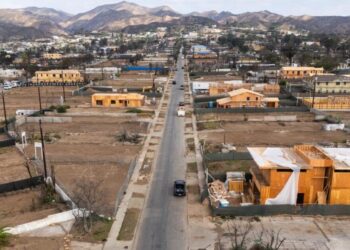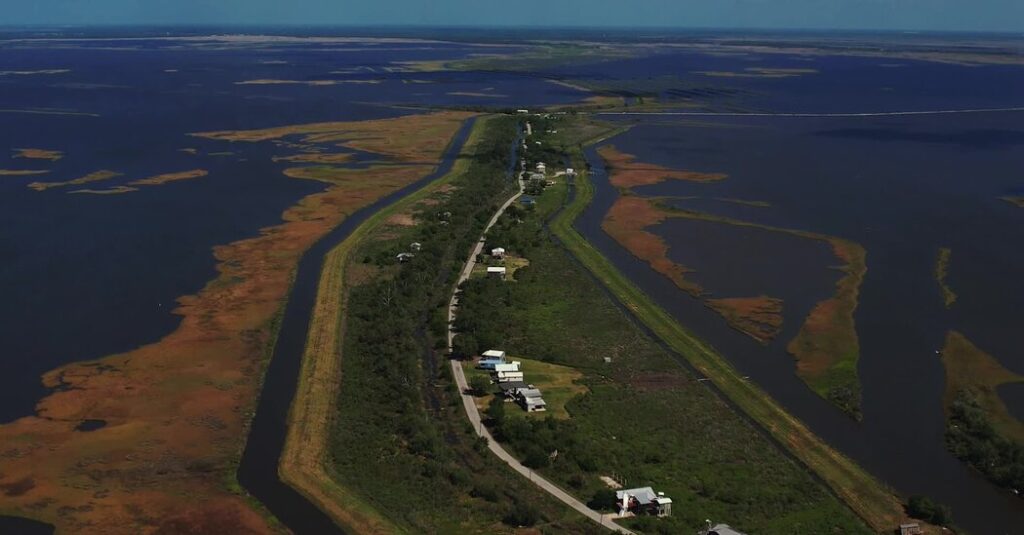
The community known as the New Isle looks a lot like how things used to be on Isle de Jean Charles, an hour’s drive south through the eroding Louisiana bayou: Families from the same native tribe living along a single lane, surrounded by glistening waters full of fish.
The New Isle’s artificial waterways, though, don’t contain the species Amy Handon loved to eat on the island where she lived before the federal government paid to move her. There are fewer bugs, mercifully, far from the marshes slowly drowning into the Gulf of Mexico. But there is also traffic speeding past, and a homeowner’s association that ordered Ms. Handon and her relatives to stop parking their cars on the grass.
She knows she’s supposed to be grateful for a free home and a fresh start. Yet a decade into the first large-scale federal experiment in climate-driven migration, she also knows what she would tell other communities facing relocation: “Don’t do it.”
“This was supposed to be a model,” Ms. Handon, 47, said one sunny spring evening on her mother’s porch as her children bought ice cream from a truck. “It’s not worth it. I wouldn’t recommend it to anybody.”
The resettlement of Isle de Jean Charles, which began a decade ago using a landmark $48 million federal investment, was envisioned as the first in a wave of retreats from the dangers of rising seas and intensifying storms. But even as human-driven climate change accelerates those threats, the Louisiana effort remains an isolated example.
In some ways, it’s become a cautionary tale.
Nominally, it succeeded: 37 families moved to higher ground from an island increasingly surrounded by open water, exposed to rising tides and pounding storm surges. Still, some residents of the New Isle don’t see it that way.
Many are angry over shoddy construction or that residents had little say in how the money was spent. Funds paid for a community center they don’t often use and water they don’t want to fish in. A second phase of construction was supposed to house more island natives, but none could afford to build there. Instead, a charity built homes that have sat empty for months.
Nations will have to figure out how to get climate migration right: Rising temperatures could force 216 million people globally to relocate within the next quarter-century, according to the World Bank. Social scientists have warned that displacement can cause major upheaval, with consequences that ripple for generations.
One recent study in the journal Nature concluded that sea level rise and erosion are eating away at southern Louisiana so quickly that New Orleans will become an island within decades. Because migration can be so fraught, the authors urged immediate conversations about relocating moving whole communities.
“Time is of the essence,” they wrote. “The longer this is put off, the more challenging it will become.”
Even a decade of planning, though, couldn’t recreate Isle de Jean Charles.
Early Glitches Before the Move
In Démé Naquin’s memory, the missteps started with mountains of plans and paperwork.
In 2016, the Obama administration announced a grant to move the community to higher ground. After years full of missed work and school when high tides covered the only roadway to Isle de Jean Charles, residents (then led by Mr. Naquin’s uncle, Albert Naquin) were ready to leave.
They had been grappling with the idea ever since a cost-benefit analysis left it on the wrong side of a levee system known as Morganza to the Gulf, still under construction across Terrebonne and Lafourche parishes in Southern Louisiana. But that relocation wasn’t an easy sell, even with the federal money.
Some residents balked at initial demands that they tear down their old homes to get new ones. Others struggled to understand the complex legal documents presented to them, either because they had never gone through the process of buying a home or because they had limited ability to read and write, said Mr. Naquin, the current chief of the Jean Charles Choctaw Nation, which includes most island residents.
The community seemed like an obvious candidate for resettlement, with its relatively small and cohesive population. But because the tribe is not federally recognized, it couldn’t receive the relocation grant directly.
Instead, money flowed through a Louisiana state agency that eventually sought input from all the island’s residents (which also included members of another tribe, the United Houma Nation) and made decisions about the New Isle.
The Louisiana Office of Community Development led a process that Marvin McGraw, a spokesman, said was “built on extensive and ongoing outreach efforts — unprecedented for a project of this scale and scope.” It included three workshops where residents worked directly with planners, while a resident-led steering committee convened six times to oversee their work, he said.
Eligibility was strict: Only those living on the island when Hurricane Isaac swept through in August 2012 would receive new homes at first. Others might be able to obtain lots and build homes for themselves in later phases.
The result was a plan that many in the community considered a list of promises: a health clinic, a market, parks and cultural touches, including a museum and powwow ground.
‘Totally Different from the Island’
Cullen Curole has a nickname for those early visions of the New Isle: “Disneyland.”
There was never going to be enough money to build it all at once, said Mr. Curole, economic development administrator at the South Central Planning and Development Commission. The group, one of eight focused on regional planning across Louisiana, took over the New Isle project last summer.
By then, residents had already realized that the New Isle wasn’t everything they imagined.
Since moving in 2022, they had endured multiple leaks in homes, leading to discoveries of pipes that they said appeared never have been properly glued or connected. Initial problems were covered by warranties, through claims that Mr. McGraw said had been resolved. But residents have had to handle other repairs.
When a faulty pipe flooded Ms. Handon’s closet, the floor damage was never fixed, she said. Nor were the floorboards at her parents’ home nearby after water seeped in through the front door.
And then there is the help that residents didn’t want: They rejected the idea of a homeowner association, but the state established one anyway, now managed by South Central Development. Mr. Curole said he had “sent a few letters” to enforce some HOA guidelines, but that officials weren’t being too strict.
“You want the neighborhood not to fall apart,” he said. “You don’t want abandoned vehicles. You don’t want foot-high grass.”
The new residents were used to controlling their own turf, though. Keith Brunet said he remembered once wielding a shotgun to block anglers from entering Isle de Jean Charles.
So Mr. Brunet, 50, didn’t take kindly to a letter warning him that he needed to clean up his carport.
“Being here’s totally different from the island,” Mr. Brunet said. “You’ve got so many rules. They just keep piling up on us.”
The community filed a federal civil rights complaint against Louisiana officials in December 2023, arguing they unfairly left the tribe out of the process and asking the U.S. Department of Housing and Urban Development to investigate. But nothing changed, residents said, and this year the community withdrew the complaint after the Trump administration’s cuts to fair housing and civil rights enforcement within H.U.D.
Mr. Naquin, the tribal chief, frequently travels to conferences focused on what scholars call “managed retreat,” the resettlement of communities like Isle de Jean Charles away from extreme weather hazards.
He has built connections with leaders from threatened communities as far away as Shishmaref, Alaska, and the Marshall Islands, sharing experiences about what happens when land starts disappearing, and when governments fail to understand Indigenous communities.
When he’s asked what he learned, he’s direct.
“They did us dirty,” Mr. Naquin said of the way Louisiana handled the resettlement. “No other tribe or community should have to go through that.”
‘That Bayou’s Not the Same’
The New Isle community hasn’t grown much since the initial move.
Island families were offered free lots in a second phase of the community. When none could afford to build there, Jericho Road Episcopal Housing Initiative, a nonprofit group based in New Orleans, stepped in to build homes that would be available to the broader community.
But they’re still too expensive for many Isle de Jean Charles residents. Models are priced at $229,000 and $239,000, with roofing and windows designed to withstand powerful hurricanes, features meant to counteract another surging threat in this part of the country: insurance costs.
Because the group built the homes using a separate federal grant from the one awarded to Isle de Jean Charles, though, they can only sell them to families making less than 80 percent of the area’s median income, or less than $61,000 for a four-person household.
That was a blow to island natives like Cheryl Boquet, who visits the New Isle at least twice a week to take care of her 93-year-old uncle. She was eying one of the Acadian-style homes and said she was already planning Christmas celebrations and promising a room to her grandson when she learned that her combined income with her husband was too high for them to buy it.
Now nearly all the $48 million meant to make the New Isle a reality has been spent, but South Central Planning is still trying to build a commercial stretch and attract businesses. Officials sold off some land, raising $1.3 million, and the planning organization could sell more, Mr. Curole said.
“I would like them all to feel at home,” Mr. Curole said. “I don’t know how to create the island.”
There was hope that a small bayou running the length of the new community — dug out to help reduce flood risks, Mr. McGraw said — could help make residents feel more at home. But Ms. Handon wishes it wasn’t there.
“I did what I wanted on the bayou,” she said with frustration as she looked toward the shining waterway. “That bayou’s not the same.”
Scott Dance is a Times reporter who covers how climate change and extreme weather are transforming society.
The post How a ‘Model’ for Climate Migration Became a Cautionary Tale appeared first on New York Times.