Times Insider explains who we are and what we do, and delivers behind-the-scenes insights into how our journalism comes together.
Zach Caldwell, The New York Times’s manager of cinematography, first fell in love with filmmaking when he studied the movies of the Taiwanese director Hou Hsiao-Hsien in a class at Brown University. The films were slow, poetic — the director would hold shots for minutes, Mr. Caldwell said.
“That just blew my mind open to the possibilities of what image-making can be,” he said.
In the years since, Mr. Caldwell has shot documentary projects for “Frontline” on PBS; “Anthony Bourdain: Parts Unknown” on CNN; and Vice News, where he won more than a dozen awards as senior director of photography, including multiple Emmys.
“I’m really interested in filmmaking that has the power to bring about change,” said Mr. Caldwell, 38, who is based in Brooklyn.
After spending six years at Vice leading a team of cinematographers producing documentary journalism, he joined The Times last July. He now oversees a team of three cinematographers, a production coordinator and around a dozen freelance contributors, who work on shows like “Modern Love” and “Popcast,” as well as reporter videos and visual investigations.
In an interview, he explained how he thinks about a story in visual terms and a simple tip for shooting stronger videos on a smartphone. These are edited excerpts from the conversation.
How did you first become interested in visual storytelling? Did you ever think you would work in a newsroom?
I’ve always been interested in finding different ways to capture the world, in figuring out when the person behind the camera can inflect the image in a certain way, and when they can just step back and let the world unfold in front of them. Even within documentary and newsgathering nonfiction, there’s a huge range.
But I didn’t really catch the bug until I started working at Vice, and even then I was like, “Am I a journalist?” I kind of wanted to just be a camera guy. But as soon as I started to realize that my work could affect people’s lives, and not just in an artistic or an aesthetic way, but that it could have a real impact on the world, that really changed my mind.
What does a manager of cinematography do?
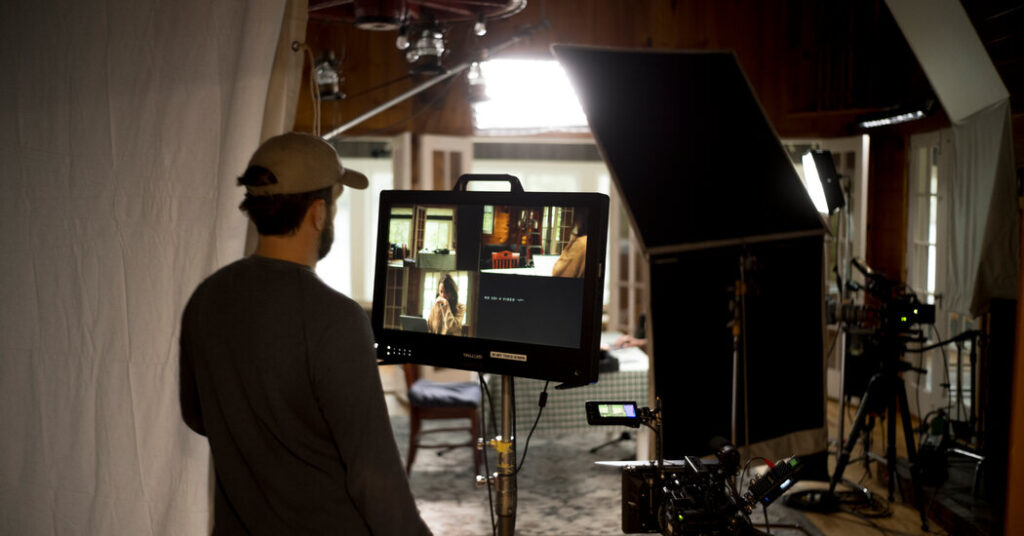
I oversee the camera work for the video department at The New York Times. That means making sure we have the right equipment to shoot all the stories that we want to, including cameras, lights and sound equipment. I also oversee the visual approach for our videos. How do we light a story? How do we move the camera? How do we put the right lens on the camera to capture something in the best way? I also shoot as well, here and there.
How do you approach thinking about a story in visual terms?
The challenge of my job is blending aesthetic, visual and practical considerations. Is this actually doable? Thankfully, I have an amazing team who can say, “Yeah, I think we can do that with two people in two hours.”
In journalism, we want to react to the story. So that presents a lot of challenges, because we have to be ready for any number of things. But in the world of podcasts, for example, where you know it’s going to be people sitting in a room talking, the biggest consideration is location. One thing that I’ve tried to do is find more places to shoot podcasts in the office in New York, because the building is so beautiful, and there’s so much that it has to offer in terms of the identity of this institution. And, frankly, it’s just really lovely to shoot in: The light and the architecture are incredible.
You’re coming up on a year at The Times. What’s one of the more memorable projects you’ve worked on?
My favorite shoot I’ve done so far was in Paris in January. We shot an episode of “The Interview,” the Times Magazine series with Lulu Garcia-Navarro, who was interviewing Gisèle Pelicot, the woman at the center of one of the most famous rape trials in history. It was so powerful getting to meet her, this incredibly graceful person who has changed not only France, but the world. Any international shoot presents huge challenges for a production team, but we were able to pull it off really smoothly.
You also think bigger picture about establishing a consistent style for our videos. What are some core tenets you’ve come up with?
Each show and team has its own challenges and wants something different. I want each video to feel fresh, but when you’re watching a podcast, I also want you to immediately know that it’s “The Interview.” Or when you’re looking at a reporter video, I want you to immediately know that this is a reporter at The New York Times. That’s been a fun challenge, to try and carve out visual identities for each team while also making sure they’re cohesive as New York Times videos.
From a visual point of view, I want to lean toward the natural, the real. I always want to let the reporting dictate not only the creative considerations, but how we crew something. If we need to shoot something on an iPhone, we should absolutely shoot it on an iPhone. I’m not interested in making every story look like cinema. If we have a reporter in another part of the world, and it’s either they shoot something or they don’t, I think it’s much better for them to shoot, whether it’s on an iPhone or a GoPro or a camera from 10 years ago. And I want to help them make that as good as possible: it’s about holding a shot, not being too shaky, making sure you’re getting specific shots.
The Times now has more than 100 video journalists on staff. What has it been like to see the newsroom embrace video?
Ultimately, we want to listen to what our audiences want, so having that be a priority is really exciting. Vertical video presents some really interesting challenges that we’re still working out, which I love tackling. It can be a bit overwhelming, just the sheer volume of stuff that we’re working on. But at the end of the day, it’s exciting because it shows that people are watching and want more. We have an incredible opportunity to make powerful and interesting and sometimes groundbreaking video.
What’s one tip you have for reporters who are shooting video?
Think about the final product, whether you’re filming yourself or something in front of you. If you’re holding your phone out and just kind of following the action around, that’s not going to make for a great video. But if you’re thinking in terms of shots that an editor can then place in sequence — a wide shot of whatever’s happening, maybe a little detail — then you’re storytelling.
Sarah Bahr writes about culture and style for The Times.
The post Viewing the World Through a Wide-Angle Lens appeared first on New York Times.