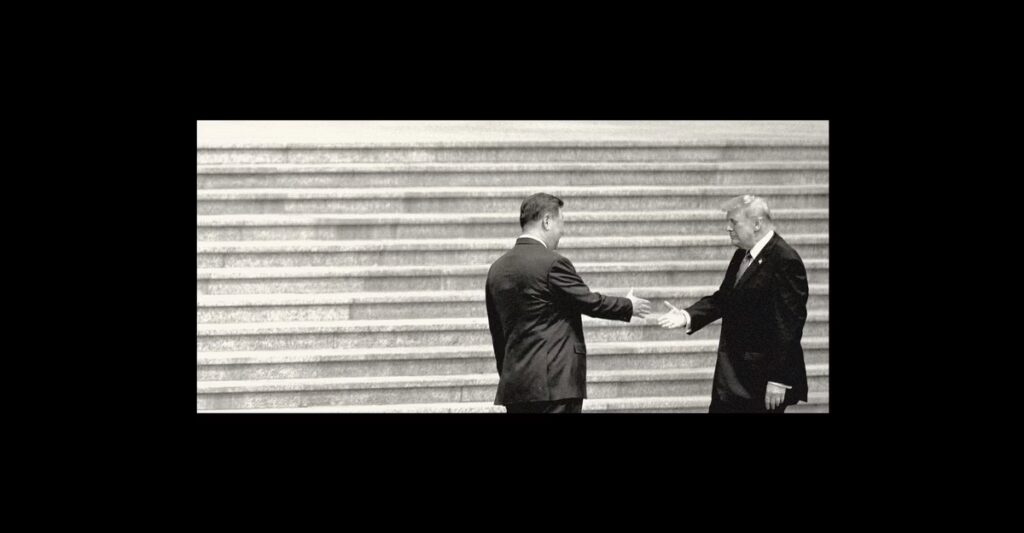
In the centuries when dynasties ruled China, kings and chieftains across Asia sent “tribute missions” to the imperial court to pay homage to the emperor in exchange for access to the empire’s riches and favors. Donald Trump’s trip to Beijing this week recalled those missions. The United States president arrived hat in hand, seeking money and promises from China’s latter-day emperor, Xi Jinping. The visit, meant to establish stability after a decade of trade wars and acrimonious one-upmanship, instead highlighted how the balance of power is tipping away from Washington. Despite America’s economic, military, and diplomatic heft, Trump’s missteps have put him and the country on the back foot in dealings with the far more disciplined Xi.
Trump opened the proceedings with his usual kowtowing. “You’re a great leader. I say it to everybody,” Trump told Xi at a welcoming ceremony yesterday at the Great Hall of the People. “Sometimes people don’t like me saying it. But I say it anyway because it’s true.” The fawning didn’t get him very far. In the meeting that followed, Xi promptly issued a stern warning about Taiwan, which Beijing claims as its own. Stressing that the “Taiwan question is the most important issue in China-U.S. relations,” Xi warned the U.S. to handle the matter with “extra caution,” according to a summary of his comments from China’s Ministry of Foreign Affairs. If not, Xi said, “the two countries will have clashes and even conflicts.”
Secretary of State Marco Rubio later told NBC News that the administration’s policy on Taiwan has not changed, but Trump himself—who still needs to sign off on plans to sell $14 billion in weapons to Taiwan—seems less committed. Trump said today that when Xi asked him whether he would send troops to defend Taiwan, he did not offer an answer. Washington’s position on defending Taiwan has long been ambiguous, but Trump added to reporters that “The last thing we need right now is a war that’s 9,500 miles away.”
Trump’s sycophancy didn’t change Xi’s mind on Iran either. Trump had delayed his trip to China by six weeks for fear that the Iran war would overshadow what he hoped would be a big diplomatic win. But the unresolved conflict still intruded on the dealmaking. The U.S. has been troubled by China’s support for Iran through supplies of weapon components and as the top buyer of the country’s oil. Shortly before the summit, Trump’s team turned up the pressure on Xi to curtail this aid by sanctioning refiners and companies in China and Hong Kong involved in these deals. Yet Xi ordered the refiners to ignore Trump’s edicts, uncowed by a president who often folds under pressure.
[Vivian Salama and Jonathan Lemire: The hippocratic summit]
In a Fox News interview yesterday, Trump crowed that Xi had promised not to arm Iran. But Trump had said in April that Xi had already assured him that Beijing wasn’t sending arms to Iran, yet the findings of U.S. intelligence officials suggest otherwise. Instead of pressing Xi on Beijing’s arms sales or oil purchases, Trump announced that he was considering lifting sanctions on the Chinese oil companies in question. He even seemed to defend Xi’s position. “Look, he’s not coming in with guns. He’s not coming in with rifles. They are not coming in shooting,” Trump said. “He’s been very good.”
Perhaps Trump has merely recognized that expecting Xi to help solve his Middle East mess is a nonstarter. Tuvia Gering, a fellow at the Atlantic Council who tracks China in the Middle East from Jerusalem, told me that Xi’s geopolitical vision “imposes a definitive ceiling on China’s willingness to facilitate Trump’s objectives in Iran.” China’s goal seems to be to weaken U.S. power in the region, so helping “to secure a decisive U.S. victory would be strategically self-defeating.”
Trump made only slightly more progress on trade. He came to Beijing as a traveling salesman, hawking American products in pursuit of his long-running goal of closing the U.S. trade deficit with China. Though he didn’t get the firm purchase commitments he wanted, he did not leave empty-handed. Trump said that Xi pledged to purchase about 400 General Electric jet engines and 200 “big” Boeing airliners, though the details remain hazy and no formal agreement seems to have been set. This is far less than the deal for 500 737 Max jets that Trump had been touting, but if the orders do come through, they’d be Boeing’s first major order from China in about a decade.
These pledges have allowed Trump to spin this summit as a success, but Xi has an emperor’s appreciation of the role a few choice gifts can play in securing leverage over a foreign power. What Xi offers, he can threaten to take away. Xi has already exploited American dependence on Chinese rare earths and supply-chain components to keep Trump in line. Last year, he halted purchases of soybeans from American farmers, a key Trump voting bloc, to pressure the president to stand down from his trade war. Getting more American businesses and constituents hooked on Chinese cash promises to be yet another way to assert China’s power over the U.S.
These tough tactics seem to have taught Trump that China has become too powerful to push around. “The U.S. has realized that China has achieved mutually assured deterrence status,” Wang Huiyao, the president of the Center for China and Globalization, a Beijing-based think tank, told me. He argues that this has brought about “a big paradigm shift” in Washington’s approach to China, and has curbed the hawkishness of Trump’s messaging. Wang suggests that a new pragmatism may now prevail between the U.S. and China, one in which U.S. leaders no longer try to get China to adopt Western values but “respect the differences and find a way to work together.”
Trump seems to have embraced this change of heart. “Having a good relationship is a good thing, not a bad thing,” Trump told Fox yesterday. “It’s great when you have good relationships with very powerful countries.”
The disputes over Taiwan, Iran, and trade suggest that a more stable U.S.-China relationship rests mainly on Trump’s reluctance to press Xi too hard. Trump has duly brushed aside a number of contentious issues that have soured relations, such as China’s continued support for Russia’s war in Ukraine and its export-heavy economic policies that threaten U.S. industry. This could prove politically risky. China hawks in Washington still advocate for a tougher line on Beijing to protect American interests, and the midterms could usher in a more hawkish Congress. But watching Trump swan around Beijing with an entourage of prominent American CEOs, including Elon Musk and Nvidia’s Jensen Huang, left the impression that the American president sees China as a business opportunity rather than as a security threat.
Despite being at war with a China partner, Trump seems content to simply sell some Boeings and beans. The Trump administration doesn’t have “any great ambition for this relationship,” Bonnie Glaser, the managing director of the Indo-Pacific program at the German Marshall Fund, told me. Trump has set his priorities to merely “keeping the relationship from going off the rails” and “ensuring that America’s needs are met,” at least when it comes to trade.
[Michael Schuman: Trump’s head-scratching turn toward China]
Xi, however, has great ambitions. Trump may now see China as a mutually beneficial economic partner, but Xi’s policies are designed to change the world order at America’s expense. Beijing is working to engineer China’s technological and industrial dominance, backing Russia in a destabilizing war in Europe, and generally setting the stage to achieve global supremacy when the United States flames out. Trump, with his disdain for global alliances and liberal values, doesn’t seem interested in contesting Xi on these fronts. “Xi Jinping has the long plan, about dominating the world and putting the United States in its right place,” Joerg Wuttke, a partner at the consulting firm Albright Stonebridge Group, told me. “Donald Trump doesn’t look that far.”
A couple of trade deals have apparently made Trump happy enough to step aside and let Xi pursue his global agenda. Like the Chinese emperors of old, Xi has used the lure of Chinese wealth to reinforce China’s power. Beijing has sought to find “the minimum price point to keep Trump invested in the process,” Jonathan Czin, a foreign-policy fellow at the Brookings Institution, told me. This is how a U.S. president who has long insisted on American strength and a tough line on China consigns the country to a weaker future.
The post Trump’s Tribute Mission to China appeared first on The Atlantic.