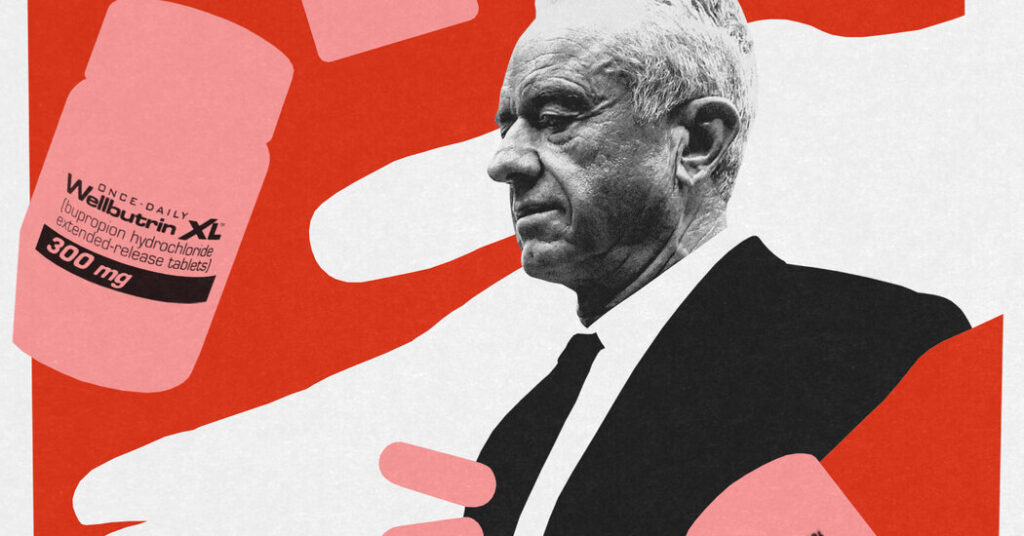
On May 4, something happened that might, just maybe, mark the start of a transformation in the way mental health is framed and treated in this country.
At the culmination of a daylong Mental Health and Overmedicalization Summit, Robert F. Kennedy Jr., the ever-polarizing secretary of the Department of Health and Human Services, pledged to put the power of his agency, which has one of the largest budgets in the federal government, behind fundamental psychiatric reform.
When he took the podium as the event’s closing speaker, Kennedy couldn’t resist mocking the “orthodoxy” of Covid policy before he transitioned to challenging psychiatric convention. Nor could he restrain himself from a loose, at best, comparison of withdrawal from selective serotonin reuptake inhibitors, the most commonly prescribed class of antidepressants, to going cold turkey off heroin, which he said he’d done around 100 times. S.S.R.I. withdrawal, he insisted, based on a family member’s experience, is frequently far rougher.
But about his commitment “to confronting overprescribing,” he was sharp. He acknowledged that “psychiatric medications have a role in care,” but added that “we will treat them as one option.” He declared that “too many patients begin treatment without a clear understanding of the risks,” that we must expand “nonpharmacologic treatments” and that psychotropic drugs should no longer be seen as “the default.”
The summit was hosted by the MAHA Institute, a Washington think tank founded a year ago by the Make America Healthy Again movement and led in part by Tony Lyons, a book publisher who blames a combination of Tylenol and a vaccine he hasn’t specified for his daughter’s autism. MAHA’s anti-vax effort, among its loudest campaigns as President Trump took office for the second time, has been derided by scientists and dismissed by much of the public. (Though Kennedy has denied it, the White House has reportedly asked him to mute his anti-vax arguments for fear of damaging the president’s candidates in the midterm elections.)
The mission to reform psychiatry, though, may prove to have more broad appeal. According to a large study conducted in 2025, one in six U.S. adults are presently on an antidepressant, but doubts about these drugs have been growing. Kennedy’s campaign comes after years of steadily accumulating critiques of psychotropic drugs and condemnation of pharmaceutical industry influence. Research comparing medications with placebos has repeatedly called the benefits of S.S.R.I.s into question, and lately the side effects of these drugs, including the possibility of irreversible sexual dysfunction, have stirred a surge of attention.
For a range of reasons, antipsychotics are also problematic. Because they act as sedatives, they are often added to drug treatment for mood or attention deficit problems in young patients who aren’t psychotic — and these drugs can cause major weight gain, breast growth in boys and in some cases debilitating movement disorders. The opioid epidemic, meanwhile, has sensitized the public to the power of pharmaceutical companies to corrupt practitioners and create patient trust when skepticism might be wiser.
Around 1980, mainstream psychiatry adopted a medical model. A new edition of the Diagnostic and Statistical Manual of Mental Disorders, U.S. psychiatry’s bible of diagnoses, published that year, enshrined the change. Ever since, troubles of the mind have been viewed mostly as physiological diseases of the brain, with treatments focused largely on pharmaceuticals.
The medical model was partly a reaction against psychiatry’s decades-long dominance by psychoanalysis and its offshoots. It was, too, an expression of hope in an early generation of medications. The discipline, meanwhile, was under attack in popular culture; the antipsychiatry movie “One Flew Over the Cuckoo’s Nest” won five Oscars in 1976. The field wanted to be viewed as a true science.
Then Prozac, an S.S.R.I., was released in the United States in 1987, with the promise of being both benign and all but miraculous in its impact on depression and anxiety. Psychiatry seemed to be reaching its medical and scientific ambitions. The idea of Prozac — and, soon, its close S.S.R.I. cousins — as an unmitigated medical advance was spread by a flood of pharmaceutical advertising. The ads presented readily comprehensible brain science: Mental illness boils down to an imbalance of chemicals, easily recalibrated with the right drug. The chemical imbalance theory has never been substantiated and has been supplanted by other hypotheses that are equally elusive to proof, given the mysteries of the mind.
By the ’90s, new antipsychotics were developed that were supposed to treat schizophrenia and related conditions without the tics and Parkinsonian distortions of movement caused by earlier medications — until formidable research published in The New England Journal of Medicine in 2005 found that the new and old antipsychotics weren’t all that different in the damage they frequently inflicted. Pharmaceutical companies nevertheless continued aggressively marketing the second-generation antipsychotics to practitioners.
None of this is to say — at all — that medication has no place in treating psychiatric conditions. And for the most part, the world of critical psychiatry — the movement that has suddenly and surprisingly found an ally in the Trump administration — recognizes this. But a group of doctors and activists has been pushing relentlessly for foundational change to the field.
This group’s core ideas are that mainstream psychiatry is too quick to see normal human suffering as a disease, that its diagnostic labels often crush a patient’s identity and sense of agency and that psychotropics, for many, do more harm than good. The movement draws from, yet is largely distinct from, writers of the mid-20th century like Thomas Szasz, the author of “The Myth of Mental Illness,” who dispensed with psychiatric disorders altogether as societal constructs. That position remains at the far edge of the movement. But closer to the middle, a nascent shift came a decade or so ago when Allen Frances, a self-defined “insider” psychiatrist who had led a central Diagnostic and Statistical Manual task force, became openly critical of the field, arguing that too many patients were being pathologized and sent down a road toward a cascade of medications.
Two key figures in today’s movement are Robert Whitaker, a journalist, and Laura Delano, an activist and former psychiatric patient. In 2012, Whitaker founded the website Mad in America, a leading platform for protest against mainstream psychiatry. Delano credits one of Whitaker’s books, “Anatomy of an Epidemic: Magic Bullets, Psychiatric Drugs and the Astonishing Rise of Mental Illness in America,” with rescuing her from conventional care.
In her memoir, “Unshrunk: A Story of Psychiatric Treatment Resistance,” Delano makes the case that her treatment by psychiatrists and institutions, from her early teens well into her 20s, had devastating consequences. Antidepressants, antipsychotics and mood stabilizers were piled one upon another for what was diagnosed as bipolar and a host of other disorders but might have been better understood as a reaction to life’s trials. The drugs’ side effects, she writes, robbed her of her sexuality, and the diagnoses destroyed her sense of self. Finally, at 27, she freed herself of the medications. She and her husband, Cooper Davis, now run an organization, Inner Compass Initiative, dedicated to informing people about how to taper off psychiatric drugs without the severe withdrawal symptoms that some endure.
At the Mental Health and Overmedicalization Summit, Delano and Davis shared the stage with a series of Department of Health and Human Services officials, and Davis warmly introduced Glenn Grothman, a Republican representative from Wisconsin and a steadfast Trump loyalist, who spoke heatedly about overprescribing to children. Delano and Davis had a strong hand in organizing the conference and contributed to a pair of important policy and strategy publications underpinning the event — publications bearing the name of Trump as a kind of imprimatur at the bottom of every page.
When Delano and Davis talk politics, they don’t sound like natural Trump allies. Delano describes her political perspective as “critiquing unchecked, unjust power,” and Davis summarizes his as a “mix of class-oriented thinking and classical liberalism.” Yet they perceive Trump and his administration as potential difference-makers on the issue they care about most.
A rush of respectful media coverage followed the summit, even from outlets that are often critical of Kennedy’s agendas. Yet many of the points made at the conference have stirred pushback. The American Psychiatric Association put out a news release stating that “we strongly object to framing the nation’s mental health crisis as primarily a problem of ‘overmedicalization’ or ‘overprescribing.’” The main issue, the A.P.A. maintained, is insufficient and unequal access to care.
The American Society of Clinical Psychopharmacology, perhaps anticipating the intensity of Kennedy’s mission, had already come out, in February, with guidelines for “deprescribing.” This was a first, though the A.S.C.P.’s president suggested to The Times that while the document was new, practitioners had long been acting responsibly in helping to taper patients off medication when the time came.
Then again, Awais Aftab, a clinical associate professor of psychiatry at Case Western Reserve University, who has a cautiously thoughtful and widely read Substack on psychiatry, wrote in open frustration recently that “for decades, mainstream psychiatry willfully blinded itself to the burden and severity of withdrawal and discontinuation-related difficulties from antidepressants and other psychiatric medications.”
Aftab, who is hardly a radical critic of his field, asserted that A.S.C.P. guidelines only “tinker” toward solutions and “generally recommend maintenance treatment for recurrent depression, bipolar I disorder and schizophrenia, ignoring controversies in these areas. They assume, for example, that most people are correctly diagnosed when the reality is that there is widespread diagnostic chaos and decisions about maintenance are made under considerable uncertainty.”
From corners far from the A.P.A., the A.S.C.P. and other psychiatric centrists, there have also been objections to the reform mission. “I don’t think serious reform is enough,” Whitaker told me. He made clear that he admires Delano’s effort to “open up a crack in the narrative.” But he faults language like “overmedicalization” for being limited in outlook, for its implied call for reduction rather than a true conceptual revamping and for, in effect, entrenching instead of displacing psychiatry’s medical model. Adding to the divisions between Delano and some of her usual activist allies is the fear that joining up with opponents of vaccines could taint their movement as anti-science. Others recoil from her willingness to work with the Trump administration at all.
Already, though, there are concrete accomplishments. At the summit, Kennedy announced that the Centers for Medicare and Medicaid Services, part of the Department of Health and Human Services, would be establishing a means for clinicians to be reimbursed for time spent on helping patients get off medications. In subtle or not-so-subtle ways, this could affect the treatment of millions, or even tens of millions, of patients. There will also soon be trainings on tapering widely available to thousands of practitioners — trainings provided by the Department of Health and Human Services with Delano as one of the presenters.
That the movement for psychiatric reform has reached this point, with allies in the federal government shaping policies built on the arguments that activists and dissident doctors have made for years, is remarkable. Delano and Davis seem to be capitalizing effectively on the administration and MAHA’s overall opposition to medical elites. But despite Delano’s strategic and incremental approach, her dreams of transformation are ultimately almost as sweeping as Whitaker’s. It’s hard to say her odds of success are high. The psychiatric establishment would have to turn away from a half century of claiming scientific authority. Society would have to quell its longing for easy solutions that come in pill form. And then there’s the pharmaceutical industry. A few hours spent watching TV news shows, with ads for psychotropic drugs cropping up repeatedly and promising marvelous results, are one sign of the forces — and resources — arrayed against Delano and her movement. The abundance of ads serves as a reality check.
Source images: Anna Moneymaker/Getty Images; Joe Raedle/Getty Images; Samuel Aguiar Dias/Getty Images
The post The Strange Alliance Trying to Remake American Psychiatry appeared first on New York Times.