Although tiny in size, Manhattan and San Francisco loom large in the American psyche. Think the Empire State Building and the Transamerica Pyramid, or the lush expanses of Central Park and Golden Gate Park. Both places have top museums, Michelin-starred restaurants and thriving waterfronts.
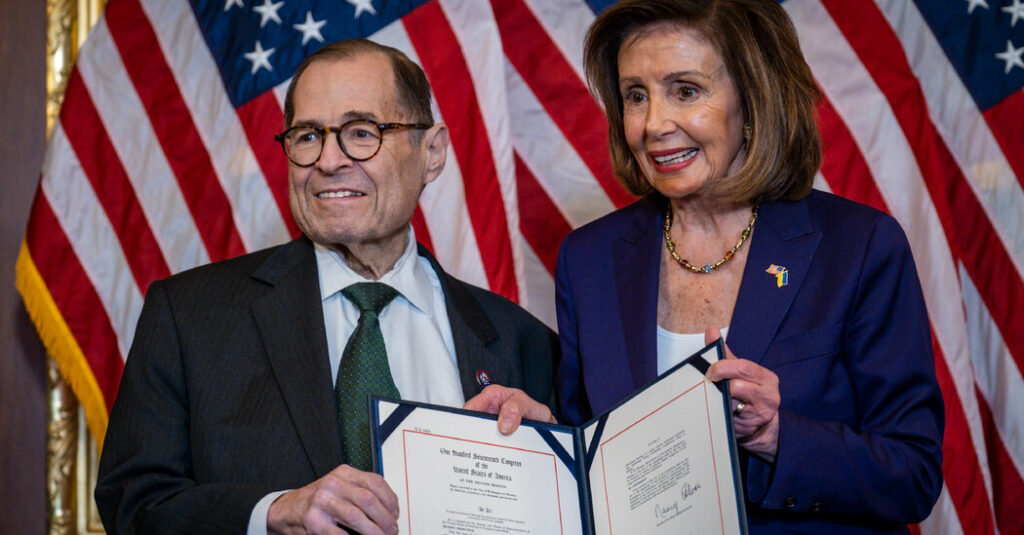
And now these communities, known for the liberal views and feisty politics of their residents, share another connection: The elections in their core congressional districts, New York’s 12th and California’s 11th, are wide open with the retirements of the Democratic stalwarts Jerrold Nadler and Nancy Pelosi.
The fiercely competitive primaries to succeed them are drawing national attention and could help shape Congress for decades to come.
These districts comprise some of New York’s wealthiest neighborhoods — the Upper East Side, the Upper West Side and Midtown Manhattan — and most of San Francisco, excluding its working-class pockets on the southern border.
The winners in these two small districts will gain national name recognition, a base from which to influence the trajectory of the Democratic Party and a bullhorn to share their views on the biggest issues in the country, such as the regulation of artificial intelligence companies and aid for Israel.
Winning would also bring access to the huge wealth in these cities, both of which sport Billionaires’ Rows and other prestige addresses where people are very pleased with themselves, thank you very much. Donations can be extracted over an iced brown-butter miso caramel latte with cold foam for $8.25 at San Francisco’s Sightglass Coffee or a smoked salmon benedict for $34 at the Loews Regency Hotel in New York, which claims to be the site of the first “power breakfast.”
“These aren’t normal congressional races,” said Ben Tulchin, a pollster in San Francisco who has worked in New York. “The stakes are extremely high, and the pressure is extremely intense.”
Ms. Pelosi, 86, who has represented San Francisco since 1987, was the first female speaker of the House and arguably the chamber’s most effective leader. She pushed through Obamacare and climate change legislation and was a persistent antagonist to President Trump, once ripping up the pages of his State of the Union address.
Mr. Nadler, 78, has represented Manhattan since 1992 as a leading liberal voice on Capitol Hill, championing civil rights and the two impeachments of Mr. Trump.
Who can replace these love-them-or-loathe-them figures of the Democratic Party? Many are trying, including longtime fixtures of local politics, television personalities, tech multimillionaires and even a Kennedy — specifically, Jack Schlossberg, the grandson of President John F. Kennedy. (Mr. Schlossberg had not even been born when Mr. Nadler and Ms. Pelosi were first elected.)
Four candidates have risen to the top of the crowded New York field — all Democrats and all straight white men. They are Mr. Schlossberg, a social media influencer; Micah Lasher, a state assemblyman who has Mr. Nadler’s support; Alex Bores, another assemblyman with ties to the tech industry; and George Conway, a lawyer who was once married to Kellyanne Conway, Mr. Trump’s former campaign manager, but is now a loud antagonist of the president.
Four Democrats are also leading the pack to replace Ms. Pelosi — although, it being San Francisco, none of them are straight white men. They are Scott Wiener, a state senator; Saikat Chakrabarti, an independently wealthy progressive; Connie Chan, a member of the board of supervisors; and Marie Hurabiell, who helped lead the successful recalls of the city’s school board and district attorney.
Scoring a win in either district, where the voters are highly educated and engaged, requires candidates to be present at local fixtures like Zabar’s, the Upper West Side food emporium, or the couches at Manny’s, the civic engagement space in the Mission District in San Francisco.
These are districts where many people consider attending Democratic club meetings and political debates both a sacred duty and a treasured social event. And these voters have opinions on absolutely everything.
Ms. Chan, who shares Ms. Pelosi’s ties to organized labor, said voters often ask, in the same breath, about the Great Highway, a road along the Pacific Ocean that is newly closed to cars, and the war in Iran.
“Is it a San Francisco race or is it a national race?” she said. “I say it’s both.”
Standing out takes some creativity. Mr. Wiener, known as a proponent of more housing and of gay and transgender rights, spent a recent Saturday morning knocking on voters’ doors, accompanied by drag queens, including one in a leopard print caftan.
The national interest in the contest has surprised Mr. Wiener, who reasons that it comes with replacing a seminal figure in such an important American city.
“Those are some big, powerful stiletto heels to try to fill,” he said, referencing Ms. Pelosi’s fondness for calf-busting footwear.
San Francisco’s open primary system means the top two contenders, almost certainly Democrats, will face off in November.
In New York, where Republicans are sparse, the June winner of the Democratic primary will most likely prevail in the fall.
For Mr. Bores, who vowed to campaign at every subway station in the district, a recent visit to the Q train stop at 72nd Street and Second Avenue elicited questions from voters about A.I., retiree health care and housing development.
“I can take the train to 15 events a night,” Mr. Bores said of the district’s compactness. “The problem is that I’m expected to show up at 15 events a night.” Several commuters recognized Mr. Bores from automated text messages they had received attacking him for his past employment at Palantir, a technology defense contractor that has aided Mr. Trump’s immigration agenda.
Those ads were paid for by a political action committee seeded with millions from technology executives — many from the Bay Area — who dislike how Mr. Bores has sought to regulate A.I. companies in Albany. At the same time, a cryptocurrency billionaire from California, Chris Larsen, recently said that he would spend $3.5 million supporting Mr. Bores.
Both districts have been likened to A.T.M.s for the Democratic Party, and big money is sloshing through the contests. In Ms. Pelosi’s district, one in 20 households makes $915,000 or more, and in Mr. Nadler’s district, one in 20 brings in at least $1.3 million.
In San Francisco, Mr. Wiener is supported by a PAC funded by Mr. Larsen and Garry Tan, another wealthy tech investor.
They have paid for mailers blasting Mr. Chakrabarti, who made hundreds of millions at Stripe, a payment processing company, before working for Senator Bernie Sanders’ presidential campaign and as chief of staff to Representative Alexandria Ocasio-Cortez.
The mailers argue that Mr. Chakrabarti is a carpetbagger. He has responded by saying that Mr. Wiener would be a typical politician, not someone with revolutionary goals like himself.
“San Francisco has a long history of being the place where the movements begin to fight to fix what the nation is getting wrong,” Mr. Chakrabarti said.
Ms. Pelosi hasn’t endorsed anyone in the race to replace her, but the former New Yorker has starred in an ad backing Mr. Schlossberg in Manhattan.
Michael Bloomberg, the billionaire media mogul and former New York City mayor, has endorsed Mr. Lasher, who worked for him at City Hall, and plans to put up to $5 million into a committee backing him.
Mr. Lasher said the fluency a candidate in Manhattan must exhibit on issues small and large “is probably greater than what is required to run in any other district in America.”
A recent environmental forum featuring Mr. Lasher, Mr. Bores and Mr. Schlossberg was held at the old Upper East Side home of Franklin and Eleanor Roosevelt.
Before the event, Mr. Schlossberg jumped up and down on the street with exuberant backers, many of them young women chanting, “Jack! Jack! Jack!”
It was scene similar to a recent San Francisco congressional debate hosted by the public radio station KQED that drew 1,600 people to a local theater. The real show was on the sidewalk.
Mr. Wiener’s supporters grooved to “Dancing Queen.” A supporter of Ms. Hurabiell cruised past in a car fashioned to look like the Batmobile to suggest that she is the superhero that San Francisco needs.
Down the sidewalk, other people shouted into their bullhorns about Israel. About ICE. About saving public transit. It was just another Tuesday evening in San Francisco.
Jeff Adelson contributed data research.
Benjamin Oreskes is a reporter covering New York State politics and government for The Times.
The post In New York and San Francisco, Fierce Fights to Replace the Old Guard appeared first on New York Times.