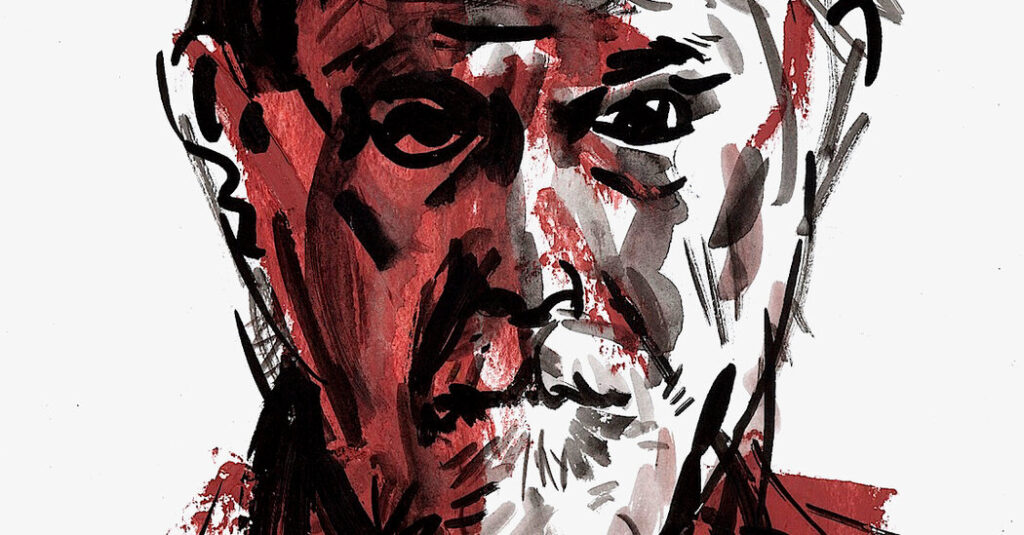
Frank Stack, an art professor and painter who secretly moonlighted as Foolbert Sturgeon, the satirical cartoonist who created “The Adventures of Jesus,” a chronicle of Christ’s encounters with sanctimonious hypocrites that is widely considered the first underground comic, died on April 12 in Columbia, Mo. He was 88.
The death, at a hospital, was confirmed by his daughter, Joan Stack.
Mr. Stack taught studio art at the University of Missouri and was well regarded for his intricate drawings, etchings and watercolor paintings, which he often composed alone, sitting cross-legged on a quiet riverbank.
As Foolbert Sturgeon — a persona he concealed for two decades to protect his day job — he lampooned religion, academia and the military, among other sacred tendrils of the 1960s and ’70s, signing his acerbic broadsides with his vaudevillian nom de plume.
“His comics were funny, well drawn and smart,” his friend the cartoonist R. Crumb said in an interview. “And he was a very, very fine watercolor artist and oil painter. He was the real thing.”
Mr. Stack was especially adept at nudes, once drawing Mr. Crumb’s wife, the feminist underground cartoonist Aline Kominsky-Crumb, in a state of total undress.
“He did a very fine job,” Mr. Crumb said. “He really knew anatomy.”
Mr. Stack did not become as famous (or notorious) as Mr. Crumb, a subversive and misanthropic character in San Francisco’s counterculture scene, whose heavily crosshatched, grotesquely sexual drawings came to define underground comics during the 1960s.
In contrast to Mr. Crumb, whose roguish demeanor was immortalized in the 1994 documentary “Crumb,” Mr. Stack worked secretively in the Midwest, his only notable behavioral quirk an ability to deliver astonishingly long monologues on seemingly any subject that occurred to him.
“Frank is an incredible story,” James Danky, a historian and co-author of “Underground Classics: The Transformation of Comics Into Comix” (2009), said in an interview, adding: “He’s not who you think he is. He’s more than that.”
Mr. Stack got his start in creative flippancy as a writer and then the editor of Texas Ranger, the humor magazine at the University of Texas at Austin, whose staffers, known as Rangeroos, have included the gossip columnist Liz Smith, the screenwriter Robert Benton and the comic book artist and publisher Gilbert Shelton.
After graduating in 1959 with a degree in fine arts, he worked briefly at The Houston Chronicle, one desk over from Dan Rather, and joined the Army Reserve. In 1961, he enrolled at the University of Wyoming for a master’s degree in art, but was called into active duty the same year following the Berlin Wall crisis.
Attached to a data processing unit on Governors Island in New York, he rented an apartment on West 94th Street and spent his evenings attending gallery openings, plays and art house movies with Mr. Benton and Mr. Shelton, who were also living in New York. He had no use for the Army.
“My entire company was constantly grumbling, grousing, growling, snarling, moaning and whining with discontent,” Mr. Stack wrote in “The New Adventures of Jesus: The Second Coming” (2006). “CBS actually sent a film crew to the island, but they were only allowed to speak with delegated individuals who, naturally, were hardly discontented at all.”
One day, Army officers distributed patriotic pamphlets titled “Why Me?”
“The gist was something about drawing a line in the sand to save the free world from communism. It didn’t go down well at all,” Mr. Stack wrote, adding that most, “if not all, of us thought it was ridiculous and insulting.”
He responded by drawing a cartoon on the back of a computer card depicting Christian martyrs being handed a pamphlet titled “Why Me?” as they entered an arena of hungry lions. He posted it on a bulletin board. A half-hour later, it had disappeared.
Undeterred, Mr. Stack continued drawing Jesus in a series of absurd situations — being arrested, registering to vote, attending faculty parties.
In one scene, a military police officer asks Jesus to produce his identification. “I don’t have one!” Jesus says. “I don’t have anything!” In another scene, Jesus walks on water by becoming a duck.
In 1962, the Austin gang in New York went their separate ways. Mr. Stack returned to Wyoming to finish his graduate studies in art. Mr. Shelton moved back to Austin for graduate school and to edit Texas Ranger.
Mr. Shelton loved the Jesus comics and had made copies for himself. He printed a few in a newsletter that he published locally. In 1964, with help from a friend who had access to a Xerox machine at the University of Texas law school, he made an eight-page book titled “The Adventures of Jesus.”
Scholars consider it to be the first underground comic. The cover credit went to “F.S.” because Frank Stack was now teaching at the University of Missouri, where demeaning Jesus, especially in comic-book form, probably wouldn’t have looked great on a curriculum vitae.
“I’ve always loved to see my stuff in print, but I was on the horns of a dilemma,” he wrote. “Did I dare to publish the cartoons under my own name when my job was at risk if the university ever noticed that I worked in the most disgraceful of all media — the awful COMIC BOOK?”
Instead, he created the ridiculous-sounding pen name Foolbert Sturgeon, which reminded him vaguely of Gilbert Shelton. Rising through the ranks of academia, he continued publishing Jesus strips.
“I kind of liked the anonymity of it — there wasn’t anything respectable about it, so you didn’t have to be careful about what you said,” he told The Comics Journal in 1996. “And of course, as a university professor, and as a painter, and as an ‘authority’ — as a role model — you do have to be careful about what you say.”
Frank Huntington Stack was born on Oct. 31, 1937, in Houston. His father, Maurice Stack, was an oil field supply salesman, and his mother, Norma Rose (Huntington) Stack, was a teacher.
Growing up, he drew constantly — on scraps of paper, the backs of envelopes, anything he could get his hands on. He loved newspaper comic strips, especially “Tarzan,” “Prince Valiant,” “Alley Oop” and “Krazy Kat.”
During high school, he visited an aunt who lived in Austin and worked at the University of Texas. There, he came across copies of Texas Ranger and decided to apply to the school, majoring in journalism before switching to fine arts. After he joined the humor magazine, one of the first artists he published was his classmate Mr. Shelton.
“He had something unusual at the time — an appreciation for things that made people laugh,” Mr. Shelton said in an interview.
Mr. Stack’s other books as Foolbert Sturgeon include “Dorman’s Doggie” (1979), about his dog, Pingy-Poo, and “Amazon Comics” (1972), an indecent retelling of Greek myths. He dropped the pen name in the late 1980s when he began collaborating with the underground comics writer Harvey Pekar on his “American Splendor” series.
In 1994, Mr. Stack illustrated “Our Cancer Year,” an autobiographical graphic novel by Mr. Pekar and his wife, Joyce Brabner, recounting Mr. Pekar’s battle with lymphoma.
The “narrative is by turns amusing, frightening, moving and quietly entertaining,” Publisher’s Weekly said in its review. “Stack’s brisk and elegantly gestural black-and-white drawings wonderfully delineate this captivating story of love, community, recuperation and international friendship.”
Mr. Stack married Mildred Powell in 1959. She died in 1998.
In addition to their daughter, he is survived by their son, Robert; six grandchildren; and his brother, Stephen.
Writing in “The New Adventures of Jesus,” Mr. Stack reflected on spending so many years as Foolbert Sturgeon.
“If I’d stuck by my guns maybe I’d be out of a job, disinherited, back in New York (not Texas, for sure) and dead by now,” he wrote. “But I ain’t apologizing. Who would I apologize to? God and Jesus? Why would they care?”
The post Frank Stack, Painter Who Secretly Drew ‘The Adventures of Jesus,’ Dies at 88 appeared first on New York Times.