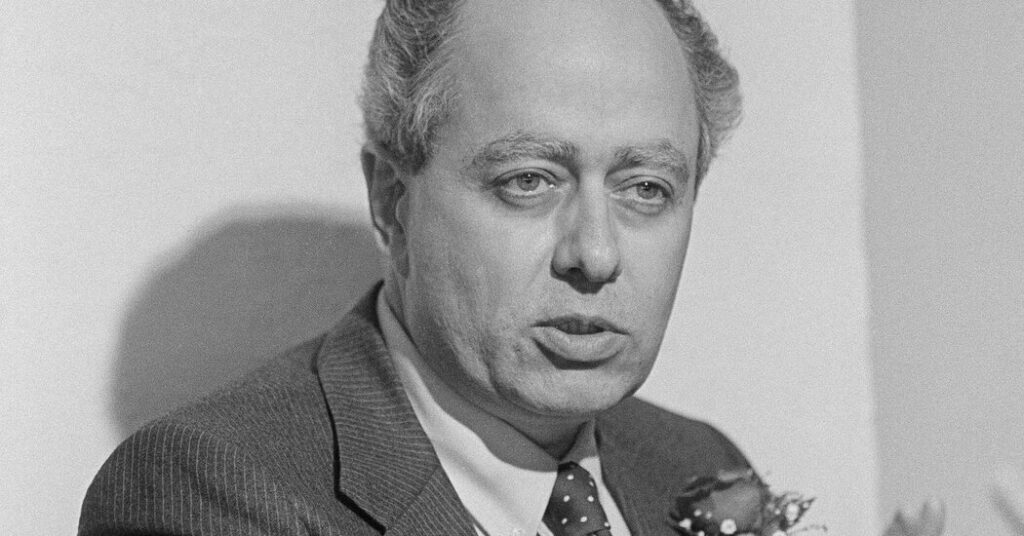
G. Robert Blakey, the principal writer of the federal Racketeer Influenced and Corrupt Organizations Act, known as RICO, a law that since 1970 has given prosecutors a cudgel to battle criminal conspirators like mob bosses instead of going after lower-level offenders for isolated crimes, died on May 1 in Oak Park, Ill. He was 90.
Mr. Blakey died at the home of his son John, a federal judge, where he had been living. His son confirmed the death.
During his career, Mr. Blakey moved between government service and teaching law, mostly at the University of Notre Dame, his alma mater. In the late 1970s, he served as chief counsel of the House Select Committee on Assassinations, which investigated the murders of President John F. Kennedy and the Rev. Dr. Martin Luther King Jr.
As a young lawyer at the Justice Department in the early 1960s, Mr. Blakey later told his son, he was prosecuting a case against a mobster in Pennsylvania when he encountered the defendant in the men’s room at the courthouse.
The mobster, he recalled, told him that he was “doing a good job, but you can’t win because the rules don’t work for you.”
In a 1985 interview with The New York Times, Mr. Blakey reflected on the difficulty of prosecuting the Mafia in those days. “Previously law enforcement was like a wolf to a herd of animals,” he said. “Prosecutors looked for single cases, they picked off the sick and wounded, and only made the herd — organized crime — stronger.”
In 1969, he was hired as the chief counsel to the Senate Judiciary Committee’s Subcommittee on Criminal Laws and Procedures. It was there that he worked on the RICO law, under Senator John L. McClellan, the Arkansas Democrat who chaired the subcommittee.
The law — Title IX of the Organized Crime Control Act of 1970, for which Senator McClellan was the driving force — says that a person or group of people who commit certain crimes as part of a conspiracy or criminal enterprise can be charged with racketeering. And it allows those hurt by the enterprise to sue for three times their actual damages.
Previously, prosecutors would charge people for committing single crimes like murder, extortion or gambling, or for conspiracy to commit those individual felonies. “Bob took conspiracy law and broadened it to describe a pattern of racketeering that is committed in furtherance of an enterprise,” Ed Stier, a former federal prosecutor in New Jersey, said in an interview.
The RICO statute lists 35 crimes as racketeering offenses, including gambling, murder, arson, drug dealing, kidnapping and bribery.
“He created a new form of jurisprudence,” Ronald Goldstock, a former director of the New York State Organized Crime Task Force, said in an interview. “It was such a dramatic change that prosecutors didn’t initially understand or use it.”
Mr. Blakey proselytized for RICO’s use for many years before it gained broad acceptance as a legal tool. In time, it would be wielded against unions, drug cartels, street gangs, police departments and, its original target, the Mafia.
In 1987, in a case prosecuted by the office of Rudolph W. Giuliani, then the U.S. attorney for the Southern District of New York, eight men convicted of being top leaders and key associates of the so-called commission that ran the Mafia in the United States received prison sentences of 40 to 100 years.
Some critics have argued that the RICO law is too vague, that it is too widely used and that its penalties are sometimes out of proportion to the crimes being prosecuted.
“It is sort of the white-collar equivalent of capital punishment,” Stephen Gillers, a law professor at New York University, told The Los Angeles Times in 1989 after the conviction of a New Jersey investment partnership for engaging in a racketeering conspiracy involving securities fraud.
George Robert Blakey was born on Jan. 7, 1936, in Burlington, N.C. His father, Lewis, was a bank president who died when Bobby, as he was known, was 9. His mother, Malatia (Horrigan) Blakey, went to work after her husband’s death, rising to become the manager and main fashion buyer for a local department store.
In 1957, Mr. Blakey graduated from Notre Dame with a bachelor’s degree in philosophy. Three years later, he earned his juris doctor degree from Notre Dame’s law school.
He had edited a law review article about a Mafia-families summit in Apalachin, N.Y., in 1957, and when he was hired by the Justice Department after law school, he was assigned to its Organized Crime and Racketeering section.
As a consultant to President Lyndon B. Johnson’s Commission on Law Enforcement and the Administration of Justice, Mr. Blakey helped draft a law that authorized court-supervised use of wiretapping and electronic surveillance by federal, state and local law enforcement agencies. He continued to work on the legislation when he moved to the Senate subcommittee, and it was signed into law in the same organized crime package that included RICO.
“The combination of the wiretapping and RICO laws resulted in the mob becoming unrecognizable,” Mr. Goldstock said.
While he was on the faculty of Cornell Law School from 1973 to 1980, Mr. Blakey took a leave to serve as chief counsel and staff director of the House Select Committee on Assassinations, chaired by Representative Louis Stokes, the Ohio Democrat.
In its report, issued in 1979, the committee agreed with the Warren Commission’s finding in 1964 that Lee Harvey Oswald had killed Mr. Kennedy. It also concluded that a second gunman had fired at the president’s limousine in Dallas on Nov. 22, 1963, and that elements of organized crime — possibly the well-known mobsters Santo Trafficante and Carlos Marcello — may have conspired in the shooting.
It did not dispute that James Earl Ray, who pleaded guilty and later recanted, had killed Dr. King but found that the murder “probably” evolved from a conspiracy of right-wing St. Louis businessmen.
Five of the 12 members of the House committee eventually dissented from the conspiracy finding about Mr. Kennedy.
In 1980, the F.B.I. released its own report, which disparaged the committee’s determination that a second gunman had shot at Mr. Kennedy from the grassy knoll in Dealey Plaza. It drew its conclusion from transmissions — recorded by a motorcycle police officer’s microphone — that included the sounds of four gunshots, not the three known to have been fired by Mr. Oswald from the Texas School Book Depository.
“It’s outrageous,” Mr. Blakey told the Gannett News Service. “The F.BI. put forth reasoning that even a sophomore in physics wouldn’t engage in.”
He doubled down on the committee’s conclusions in “The Plot to Kill the President: Organized Crime Assassinated J.F.K.” (1981), written with Richard N. Billings, the editorial director of the assassinations committee. “The president was not the victim of a nut gunman, Lee Harvey Oswald alone,” they wrote, “but of an organized crime conspiracy.”
Reviewing the book in Newsday, the author and journalist Michael Dorman, who had covered Kennedy assassination, wrote that Mr. Blakey and Mr. Billings had not made their case: “The authors make no claim that they know who took part in the hypothesized conspiracy or precisely what motivated it.”
In addition to his son John, Mr. Blakey is survived by another son, Michael; five daughters, Elizabeth and Marie Blakey, Katherine Cox, Christine Coury and Margaret Clarke; 18 grandchildren; and two great-grandchildren. His wife, Elaine (Menard) Blakey, died in 2002.
Mr. Blakey consulted with many states on drafting and implementing RICO laws. He also worked with lawyers from Florida and Texas, among the 46 states that used civil racketeering laws to reach a $206 billion settlement in 1998 against cigarette makers to recover Medicaid money spent treating diseases related to smoking.
“If you look at the structure of the national syndicate of organized crime,” Mr. Blakey said bluntly in an interview with the public television series “Frontline” for its 1998 documentary “Inside the Tobacco Deal,” “and look at the structure of the national syndicate of the tobacco industry, you’ll see how they are the same, hand in glove.”
Richard Sandomir, an obituaries reporter, has been writing for The Times for more than three decades.
The post G. Robert Blakey Dies at 90; Drafted the RICO Anti-Racketeering Statute appeared first on New York Times.