For a year now, the Chemical Safety Board, a small independent agency that investigates chemical spills and other disasters has faced elimination under President Trump’s budget cuts.
That hasn’t stopped the board from taking on the Trump administration. The agency is now opposing an attempt to roll back new chemical disaster rules that were introduced under former President Joseph R. Biden and aimed to prevent accidents at thousands of industrial facilities.
The board’s two remaining members — Steve Owens, the chairman, and Sylvia E. Johnson — warned publicly in a letter this week that the administration was taking “a significant step backwards” in preventing catastrophic chemical incidents. The letter urged the Environmental Protection Agency not to eliminate mandatory audits at plants with prior accidents or measures encouraging the use of safer chemical alternatives.
It also urged the administration to preserve requirements for sites to adopt new safeguards to prepare for storms, floods and other climate-related risks and to stick with a “stop work” provision that empowers workers to halt operations they perceive to be unsafe.
Rick Engler, a former member of the chemical board, called the move brave. “It’s very much a David and Goliath situation,” he said. “The E.P.A. clearly needs oversight, because it’s taking steps that will do nothing but endanger worker and public safety.”
Brigit Hirsch, the E.P.A. press secretary, said that the agency welcomed input from the CSB. “America has seen decades of progress in reducing and preventing chemical accidents, progress made without the excessive regulatory burdens imposed” by the Biden-era rule, she said.
Mr. Trump’s 2027 budget proposal requested no funding for the Chemical Safety Board, which would effectively eliminate the agency, just as his 2026 budget did. The administration has argued that the C.S.B.’s work duplicates the work of other agencies like the E.P.A. and Occupational Safety and Health Administration, which oversees worker safety.
Congress, which controls government spending, has continued to fund the agency, though. Lawmakers approved $14 million for the board this year, which will keep it running through September.
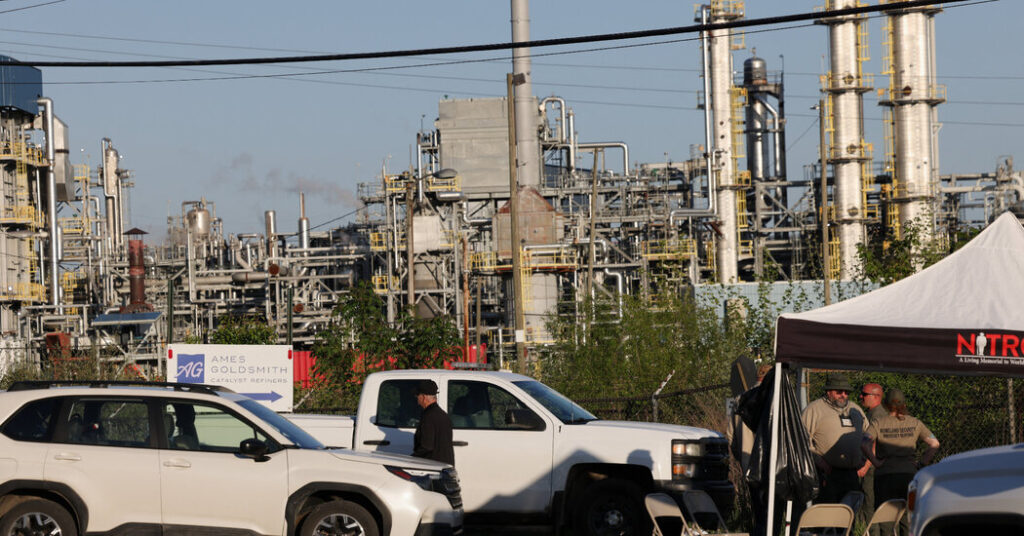
The Chemical Safety Board has been taking the lead in investigating accidents, including a chemical leak at a plant in West Virginia last month that killed two people.
Maya Nye, who grew up about a mile from the plant and whose family was forced to shelter in place as the emergency unfolded, described the accident as one of many over the years across the industrial corridor along the Kanawha River near Charleston, a hub for chemical manufacturing that residents call “Chemical Valley.” “We’ve been kicking and screaming for years calling for improvements, protections under these rules. And now it feels like we’re taking 10 steps back,” said Dr. Nye, who is federal policy director for Coming Clean, a nonprofit organization that advocates for policies to prevent disasters and reduce toxic pollution.
At a House Energy and Commerce Committee hearing last month, Lee Zeldin, the E.P.A. administrator, said he supported the Chemical Safety Board’s investigation into the West Virginia chemical leak.
In response to questions from Rep. Nanette Barragan, a Democrat from California, Administrator Zeldin, also said he backed the president’s budget.
“What he just said is contradictory,” Rep. Barran said.
Asked about the exchange, Ms. Hirsch, the E.P.A. spokeswoman, said there was “no contradiction between supporting CSB’s investigation and supporting a responsible budget that would maintain the necessary work of the CSB within other agencies.”
The American Chemistry Council, an industry group that has supported the Trump administration’s changes to the chemical safety rules, said it respected the CSB’s work. It also appreciated Mr. Trump’s efforts to “ensure taxpayer dollars are being used wisely.” said Scott Jensen, a spokesman for the group.
Jordan Barab, a former deputy assistant secretary at O.S.H.A., the worker-safety agency, who was part of an interagency group that responded to a deadly 2013 explosion at a Texas fertilizer plant, said the chemical-safety board was uniquely qualified to guide policies that went beyond the E.P.A.’s focus on the environment or O.S.H.A.’s focus on workplace safety.
The chemical board’s letter challenging the Trump administration was significant, he said, noting that it was once considered routine for an independent agency like the chemical board to weigh in on proposed government policies.
“But under this administration, writing honest expert comments that you’re authorized to do by Congress has somehow become an act of courage,” he said.
The Trump administration’s proposal to eliminate the agency is the latest in a prolonged policy tussle over what is known as the Risk Management Program. Introduced in 1996, the program regulates nearly 12,000 facilities that handle hazardous chemicals, including factories, wholesalers, refineries, wastewater treatment plants and fertilizer distributors.
Many of those facilities are critical infrastructure and backbones of their local economies. They can also pose a risk to nearby communities, storing large quantities of hazardous substances like chlorine, anhydrous ammonia and vinyl chloride. More than 130 million people live within three miles of these sites, the Biden administration estimated.
Former President Barack Obama tried to strengthen the rules after the 2013 explosion at a Texas fertilizer plant killed 15 people. The first Trump administration halted the tougher requirements before they took effect. Mr. Biden then reintroduced tougher rules, finalizing them in 2024.
The same year, chemical industry groups sued to stop the rules, along with a number of attorneys general from Republican-led states, arguing that they imposed undue burdens on companies with little safety benefit.
Hiroko Tabuchi covers pollution and the environment for The Times. She has been a journalist for more than 20 years in Tokyo and New York.
The post Federal Chemical Safety Board Sends Warning on Trump Disaster Policy appeared first on New York Times.