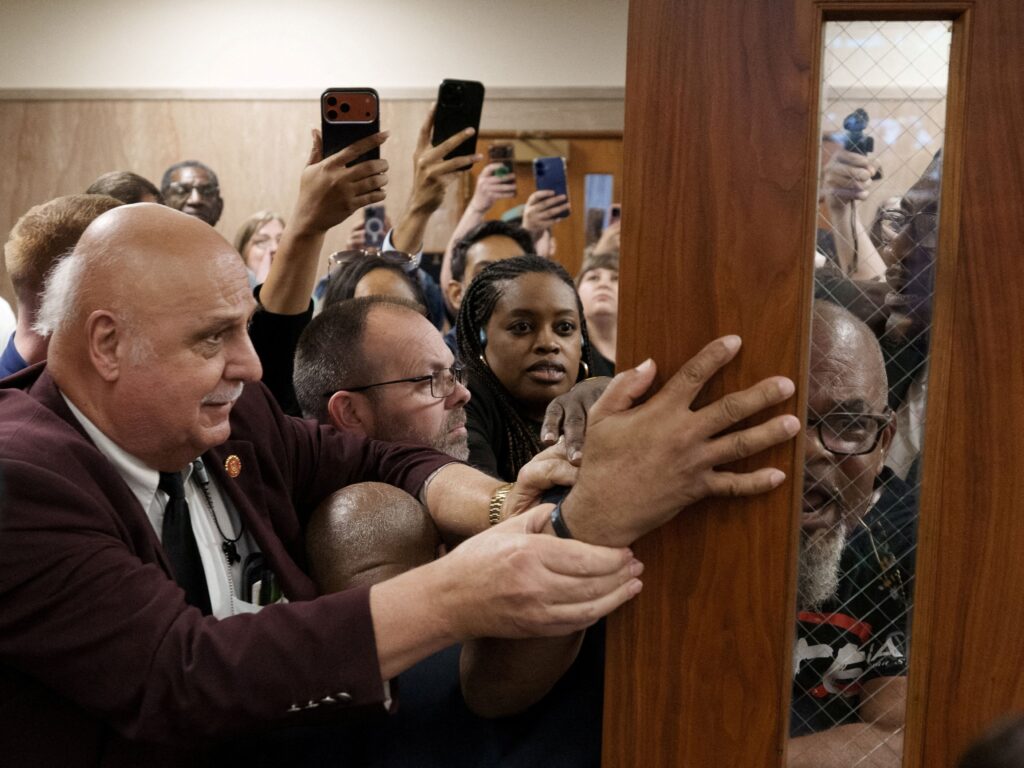
Republican state senators in Louisiana approved a congressional map Thursday designed to give the party another seat, continuing the GOP’s sprint to remake districts to protect its fragile House majority.
The 27-10 approval of the map came as Republicans in South Carolina sought a path to redraw the districts there after a setback this week. President Donald Trump, who has said he fears being impeached if Democrats take over the House, has called on Republicans to give themselves an edge with new maps.
Louisiana’s map has been the subject of years of litigation that culminated last month in a Supreme Court ruling that watered down the Voting Rights Act. Republicans cheered the ruling for giving them a political advantage, while Democrats denounced it as a vehicle for diminishing Black representation in Congress.
The proposal in Louisiana will next go to the state House, where it is expected to pass. That would bring to 16 the number of districts where Republicans have given themselves more favorable lines since last year.
Republicans were blunt about their goals.
“I did want to maximize Republican representation in Congress to the extent I could,” said state Sen. John Morris III (R), the lead sponsor of the new map.
Democrats decried a plan that is expected to give Republicans control of five of the state’s six congressional districts by breaking up one with a large Black population.
“I respect that your position is that we should have five Republican districts, but I do not agree that it’s fair,” said state Sen. Katrina Jackson-Andrews (D).
Trump last year began urging states to redraw their lines to help Republicans keep their narrow hold on the House in the midterms. The effort picked up steam last month when the Supreme Court weakened the Voting Rights Act and gave states a freer hand to draw maps for partisan gain.
The case came out of Louisiana, and Republicans there responded to it with their new map. Republicans now hold four of the state’s six districts, and the new map could pit Louisiana’s two House Democrats — Troy A. Carter and Cleo Fields — against each other.
Nationally, Republicans are on track to obtain more favorable lines in 16 or 17 districts. That compares to more favorable lines for Democrats in six districts. Not all of the districts are guaranteed for either side, and Republicans face a difficult political environment this fall as they try to hang on to their 217-212 margin.
In South Carolina, state lawmakers prepared for Gov. Henry McMaster (R) to call a special session so Republicans could adopt new congressional boundaries. Earlier this week, members of McMaster’s party blocked an effort to give themselves one more House district in their favor.
Republicans there have eyed redrawing the seat held by Democratic Rep. James E. Clyburn. Clyburn was first elected in 1992, becoming the first Black representative from the state in about a century. The longtime power broker played an essential role in securing the Democratic presidential nomination for Joe Biden in 2020.
A contingent of South Carolina Republicans has opposed redrawing districts, and on Tuesday the state Senate thwarted a proposal to extend the legislature’s regular session to consider a new map. That vote gave Clyburn a reprieve, but a special session would revive the effort.
Republican opposition has been spearheaded by state Senate Majority Leader A. Shane Massey, who warned his colleagues on the floor this week that redrawing the map could backfire and result in Democrats winning two House seats instead of one in the state. He argued that carving up a district with a large Black population for partisan gain would infuriate voters and cause some state lawmakers to lose their races.
“You’re going to motivate Black turnout, and there will be repercussions for that,” he said Tuesday in his floor speech. “There will be Republican losses in the state House of Representatives because of this.”
For Tuesday’s vote, supporters of redrawing the map needed a two-thirds majority. Four other Republicans joined Massey in opposing the measure, keeping the vote below that threshold.
In a special session, a new map would need just a simple majority, though Massey could use his control of the chamber to put up obstacles. Trump has made redrawing districts a priority, and this year he backed seven GOP challengers to state senators who rejected a plan to redistrict Indiana. Five of the seven incumbents lost their primaries this month, and a sixth’s race is too close to call.
Fights over political boundaries are expected to continue well past this year. In the latest sign, Georgia Gov. Brian Kemp (R) on Wednesday called a special legislative session to redraw the congressional map there in time for the 2028 elections.
The post Louisiana, at center of voting rights fight, moves to redraw Black House district appeared first on Washington Post.