A practice known as surveillance pricing — in which people are charged different prices for the same things, based on personal data — has been used to increase prices for everything from ride shares to plane tickets to health care. Shoppers have also figured out that online grocery delivery services may charge some people more than others for the same items.
With rising food prices straining budgets across the country, especially in high-cost cities like New York, local lawmakers are taking action.
On Thursday, Julie Menin, the City Council speaker, and Shaun Abreu, a councilman from northern Manhattan, will each introduce bills geared toward curtailing these practices.
Ms. Menin’s bill would broadly ban surveillance pricing within the five boroughs, while Mr. Abreu’s measure would prevent dynamic pricing by restricting retail food stores, such as grocery stores and bodegas, from raising prices more than once in a 24-hour period.
“It’s actually hard to detect if you’re the victim of surveillance pricing,” Ms. Menin said. “Which then makes it more imperative than ever that we legislate this practice, because this is very difficult to detect for consumers.”
The city legislation follows the state-level One Fair Price Package, which includes a bill that would, with some exceptions, ban surveillance pricing online and in stores. It is expected to pass before the end of the legislative session. The package has the strong support of the state’s attorney general, Letitia James.
“These predatory pricing schemes use algorithms to analyze where you live, your spending habits, and even whether or not you’re in a hurry,” Ms. James said at a rally in the Bronx on Friday morning. “Then they charge you that price — not a fair price, not one price — but the highest price.”
The practice of basing prices on customers’ data has been around at least since the 2010s. But the Federal Trade Commission began investigating companies’ use of data in this way two years ago, culminating in a January 2025 report that found widespread use of these tactics.
Proponents of surveillance pricing argue that those same individualized prices can be used to offer consumers discounts. Businesses use data, such as information from loyalty program enrollment, to determine the size of discounts and rewards offered to customers.
Both the state and city bills would still allow retailers to reduce prices and offer discounts for shoppers based on their personal data.
The second bill in the state package would ban electronic shopping labels at larger grocery stores and pharmacies.
At a quick glance, the labels seem like normal price tags, made out of paper. But they are actually small, digital screens. To some, they are a harmless technological innovation that can be used to quickly offer discounts to shoppers. To others, they are a looming threat because of their potential to be used in surveillance pricing and because they could cost jobs.
Union workers are worried about losing their jobs, since they are the ones who replace paper tags, said Deborah Wright, the political director for the Retail, Wholesale and Department Store Union.
“We have members who have dedicated themselves to stores for years and years and years, and take real pride in their work, and then are left without any work left to do,” Ms. Wright said.
As for the link between surveillance pricing and electronic shelf labels, it’s mostly hypothetical at this point, experts said, but there is still cause for concern.
Tom McBrien, a lawyer with the Electronic Privacy Information Center, an internet privacy nonprofit in Washington, said prices are not spontaneously changing on the shelf tags in accordance with algorithms. But retailers are investing a lot in surveillance pricing, he said, and in general, pricing practices are murky and can be hard to track.
In the case of Westside Market, a family-owned grocery chain, the use of digital shelf labels is a vestige of a dynamic pricing pilot program it ran in 2024 and 2025, said George Zoitas, the grocery’s chief executive.
Mr. Zoitas said that the program was only for offering discounts, never for raising prices, and worked by tracking shoppers as they moved around the store. For example, if a customer lingered in front of the pasta sauces for 28 seconds, as shown by a tracking device in their shopping basket, the store could cause a coupon to pop up on a larger display screen that would offer a discount for a specific brand. Westside Market could then send a rebate for after the customer checked out.
“We’re doing it for the right reasons,” Mr. Zoitas said, adding that the pilot wound down last year, but he is looking into bringing it back. “It’s no cost to me if my customers are getting things cheaper through manufacturer rebates.”
Michael Wang, the chief executive of Sirl.io, a location services company, who ran the pilot with Mr. Zoitas, said that dynamic pricing is challenging to run in physical stores — “the holy grail” of retail. The margins are so low for brick and mortar stores, he said, that very few will pay for all the technology required. At Westside Market, the digital shelf labels are made by VusionGroup, Mr. Wang said, the same entity providing labels for Walmart, which has announced that the use of the labels will be chain-wide “within the next year.”
“I don’t think there’s anything to hide here, honestly,” Mr. Wang said. “We never, ever got to the point where we’re going to go do these things to change the price.”
Nick Glenis, the manager of the Westside Market at West 110th Street and Broadway, said that his location had stopped using the digital labels because they were too expensive. One label could cost $50, he said, and they did not always last long. But Mr. Glenis stressed that the prices on the electronic labels were set once in the morning and did not change throughout the day based on any kind of dynamic algorithm.
Mr. Abreu, who said his bill about price changes applied only to price increases, said he was concerned about the use of digital shelf labels, especially at larger chains. But, he added, his measure was intended to be preventive more than punitive.
“If you are a business that is not changing your prices of food items more than once in a 24-hour period, then you have nothing to worry about under this bill,” Mr. Abreu said.
State Senator Michael Gianaris, who wrote the bill under the One Fair Price Package that would ban the digital labels, cited their potential use in surveillance pricing.
“It’s inevitable that if we don’t regulate this, it’s going to be everywhere, and it’s going to be used for malicious purposes against customers,” Mr. Gianaris said. “I mean, cellphones were once prohibitively expensive. Now they’re in everybody’s pocket.”
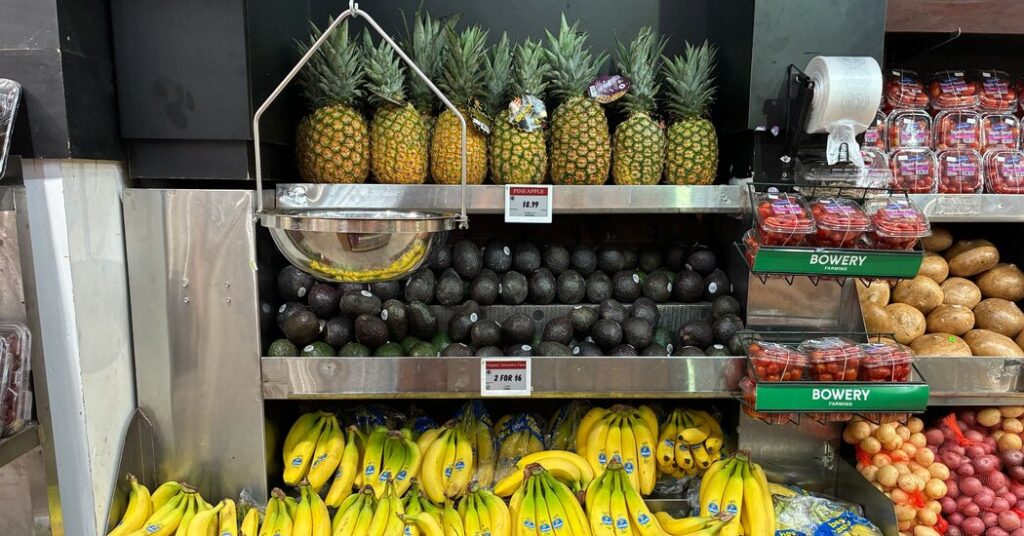
The aisles of the Westside Market on West 23rd Street in Manhattan are orderly, lined with digital price tags advertising two bottles of fruit drinks for $8, protein bars for $4.99 and bananas at 89 cents a pound.
Elliot Sterk, 33, a Chelsea resident, bought two bags of coffee beans from the market on Friday. As a tech worker, he said, he thought the electronic shelf labels were a cool advancement, but not if they could be used in surveillance pricing.
“Of all the things to surge-price, food seems like probably one of the worst things,” he said.
Serena Diliberto, 57, who bought a loaf of bread at the market, said that groceries were already getting too expensive without having to worry about inconsistent pricing.
“It’s already such a struggle,” she said. “Looking at prices is becoming an obsession, especially in New York.”
Grace Ashford contributed reporting.
Claire Fahy reports on New York City and the surrounding area for The Times.
The post What Could One Banana Cost? $10? Maybe for You, Some Fear. appeared first on New York Times.