Secretary of State Marco Rubio, a fierce China critic, was banned in 2020 from entering the country. On Thursday, however, he sat across from Chinese officials in Beijing — with a nameplate displaying a new Chinese spelling of “Rubio” that perhaps made his visit possible as part of President Donald Trump’s entourage.
The change predated Trump’s summit with Chinese President Xi Jinping. Chinese state media and official records began using a different transliterated character for the “Ru” or “Lu” in Rubio’s name after Trump named him secretary of state in 2025.
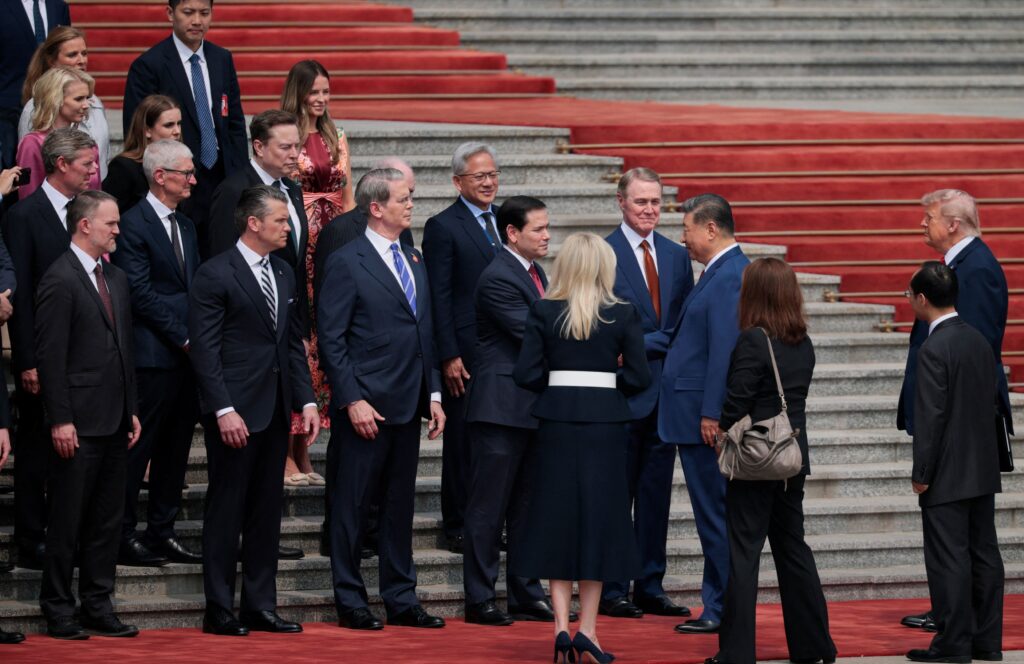
Beijing made the tweak without fanfare. But this week, it has been a buzzy topic on Chinese social media, with Rubio in Beijing as one of the top officials in the U.S. delegation. During the elaborate welcome ceremony, he stood in the first row of the group of American visitors and shook hands with Xi.
Chinese transliteration of English names matches characters phonetically to English syllables. There can be multiple Chinese characters that sound similar to the English. There are two different Chinese spellings for “Trump,” for example.
In Rubio’s case, the change may be a clever diplomatic tool. Because Beijing placed sanctions on him under a different spelling, the new name allowed the U.S. and China to avoid conflict over his entry ahead of the high-stakes summit.
“China is giving itself a way out of the awkward situation,” said Zhang Jiadong, a former Chinese diplomat.
“We can’t cancel the sanctions, because they were announced for a reason, but banning a secretary of state from entry could further damage bilateral ties,” Zhang added. “So we found a middle ground.”
Beijing said this year that the 2020 sanctions target Rubio’s “words and deeds when he served as a U.S. senator” — drawing a distinction between his former position and his current one. (Rubio is also Trump’s national security adviser.)
When asked about the name change last year, a foreign ministry spokeswoman said: “It’s his actual name in English that is more important.”
“As secretary of state, Rubio plays an indispensable role in China-U.S. relations. With that in mind, old sanctions are not a big issue for Beijing,” said Zhao Minghao, deputy director of the Center for American Studies at Fudan University in Shanghai.
It is unusual for Beijing to officially revoke or reverse a target, but some U.S. scholars who had been considered unwelcome were later allowed entry into China when relations improved or when the scholar’s views turned more neutral.
Beijing now views Rubio’s messaging on China policy as softer, shifting from his previous hawkish stance to being relatively open to pragmatic cooperation, Zhao said.
Rubio, a Cuban American, has been a vocal critic of communism. He has long criticized Beijing’s actions against pro-democracy protesters in Hong Kong, its treatment of the ethnic minority Uyghur population in the Xinjiang region and its other alleged human rights abuses.
In 2020, China twice imposed sanctions on then-Sen. Rubio, alongside other U.S. officials and organizations, as bilateral relations deteriorated and the nations adopted tit-for-tat penalties. In response to U.S. sanctions on Chinese officials, which included travel restrictions and a freeze on assets, China retaliated with counter-sanctions.
During his confirmation hearing as secretary of state, Rubio described China as the “most potent and dangerous” nation the U.S. has confronted.
But since taking office, Rubio has supported Trump’s efforts to stabilize relations with Xi, whom he calls a “great leader” and a friend. Trump has not been particularly forceful on China’s alleged human rights violations.
This week, Rubio struck a more balanced tone, saying China is “both our top political challenge geopolitically and it’s also the most important relationship for us to manage.”
In practice, the old sanctions don’t apply to a “new and friendlier” Rubio, Zhao said. “When China issues him a valid visa and allows him entry, it literally means he could be no longer under sanctions,” Zhao said.
Still, the change may also reflect how China really feels about Rubio.
The old Ru/Lu (卢) was a neutral character typically used for surnames. The new one (鲁) carries a different meaning: rash, rude and clumsy.
The post Officially, Marco Rubio is still banned from China. So how is he in Beijing? appeared first on Washington Post.