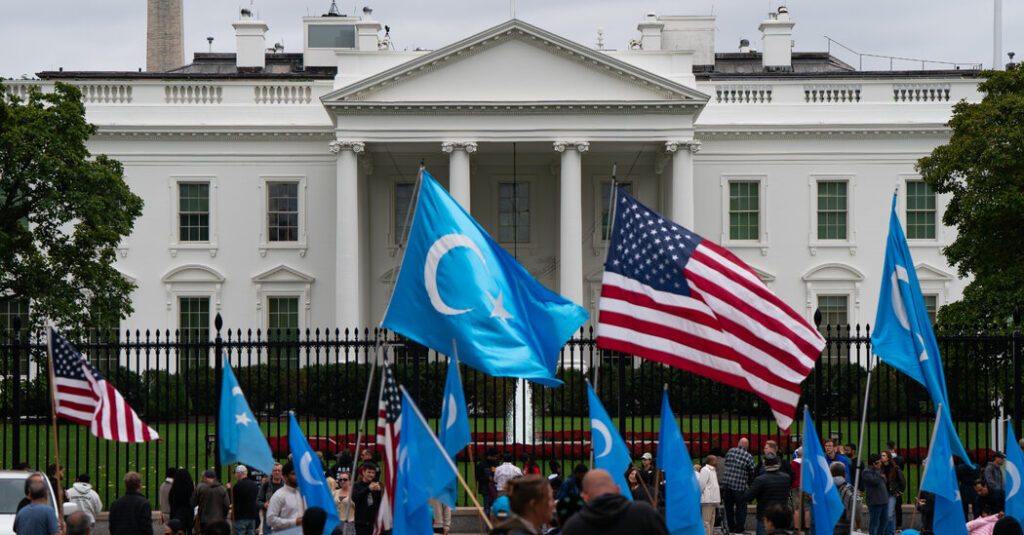
During President Trump’s first term, the United States led the way in pressuring China over its mass detention and surveillance of Uyghurs. It imposed sanctions on Chinese officials, blocked some imports thought to be linked to forced labor, and, on Mr. Trump’s last full day in office, officially declared China’s crackdown on the Uyghurs a genocide.
Now, the Trump administration rarely mentions Uyghurs, or Xinjiang, the far western region in China where the repression is occurring.
At this week’s summit in Beijing with Mr. Trump and China’s leader, Xi Jinping, the systemic repression of the Uyghurs is unlikely to appear on the agenda, which is expected to focus more on trade, the U.S.-Israeli war with Iran and relations with Taiwan.
But some advocates are hopeful that Mr. Trump will mention several high-profile Uyghur political prisoners during his meetings with Mr. Xi.
Many Uyghurs in the diaspora — including the 12,000 or so estimated to be living in the United States — will be watching the summit closely for any sign that the Trump administration is still willing to press the issue.
“The attention on the Uyghurs has been fading,” said Yalkun Uluyol, a China researcher for Human Rights Watch, whose father has been detained in China since around 2018. “Especially now under Trump, we have seen a decrease in overall attention to human rights.”
The United States still formally designates the situation in Xinjiang a genocide, though the nature of the crackdown has changed over the years.
Many of the one million or so Uyghurs and other ethnic minorities who were subject to “re-education” in detention camps for practicing their religion or visiting a Muslim-majority country, among other reasons, have been sentenced and transferred to Chinese prisons. Other detainees have been sent to regions around the country to work under what many experts and activists believe to be forced labor schemes.
Xinjiang itself remains under heavy surveillance, and journalists are still restricted from traveling there freely.
Beijing has denied any persecution of people in Xinjiang and has described its programs as necessary to alleviate poverty, as well as combat terrorism and separatism. But Beijing has also continued its efforts to silence Uyghurs abroad by harassing their relatives in China and pressuring governments to repatriate asylum seekers.
The Trump administration still enforces the Uyghur Forced Labor Prevention Act, a bipartisan 2021 bill that effectively banned most imports from Xinjiang and established a blacklist of companies whose supply chains have been found to involve forced labor.
But no new entities have been added to that list since Mr. Trump’s return to office.
The administration has also cut funding for international aid organizations and human rights groups, including some that investigated state-sponsored abuses in Xinjiang. It has rolled back support for outlets like Radio Free Asia, whose Uyghur-language service was one of the few sources of on-the-ground information for Uyghurs abroad.
And Immigration and Customs Enforcement has detained and sought to deport some Uyghurs. While some people have been released, a handful still remain in ICE detention and face deportation to other countries, according to Rushan Abbas, executive director of Campaign for Uyghurs, a Washington-based nonprofit.
Some advocates are still optimistic that Mr. Trump’s unconventional diplomatic approach could ultimately secure the release of at least a few high-profile Uyghur political prisoners.
Those prisoners include Ms. Abbas’s sister, Gulshan Abbas, a Uyghur doctor who was detained in 2018, in connection with Rushan’s political advocacy in the United States. There is also Ekpar Asat, a Uyghur entrepreneur who was detained in 2016 after participating in a U.S. State Department program.
“I don’t think giving up human rights is a priority for the administration,” said Rayhan Asat, who is Mr. Asat’s sister and a human rights lawyer at the Atlantic Council, a nonprofit that promotes international engagement. “I just think its style and approach are very different.”
Amy Qin is a national correspondent for The Times, writing primarily about Asian American communities.
The post Uyghurs Hope Trump Returns to First-Term Toughness at Summit appeared first on New York Times.