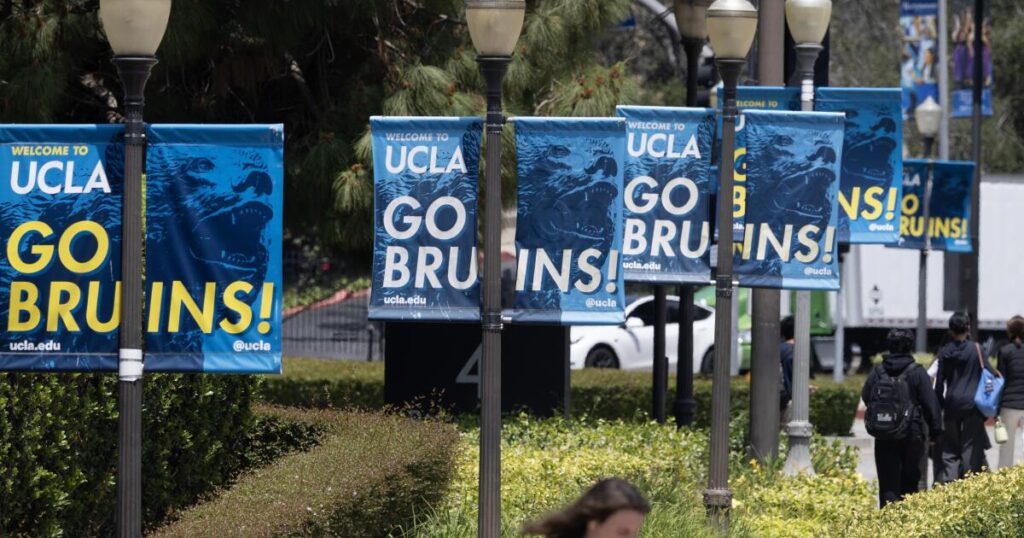
The University of California is bracing for a massive strike Thursday that would disrupt services at all campuses, hospitals and medical centers as more than 40,000 workers — patient transport staff, nursing aides, custodians, campus dining hall employees — are prepared to walk out if an agreement is not reached.
The threatened strike could halt or delay scores of medical appointments, although hospitals and medical offices will remain open, and it would limit campus dining operations. UC campuses and hospitals are making contingency plans and communicating with patients, students, faculty and staff about potential disruptions.
Late Thursday afternoon, the American Federation of State, County and Municipal Employees Local 3299 remained deep in contract negotiations and had not reached an agreement with UC. The union is poised to launch an open-ended strike that its leaders say would not end until its demands are met for better wages, lower healthcare costs and opening talks with UC over how the university can help alleviate ballooning housing costs.
UC has said it has offered to increase salaries, give contract ratification bonuses and cap some healthcare premium increases. When the union announced the strike nearly a month ago, a UC spokesperson said the university was “disappointed” by the decision “despite the significant progress made at the bargaining table.”
The union said picket lines and rallies would begin 8 a.m. Thursday at every UC campus and medical center, including Ronald Reagan UCLA Medical Center. The threatened strike would culminate more than two years of contract negotiations after several one- and multi-day strikes
What jobs do AFSCME members hold?
AFSCME’s members include custodians, gardeners, dining hall food service workers, transportation workers and skilled craft workers such as plumbers and electricians. At UC hospitals, union members work in cafeterias, as radiology technologists, nurse’s aides and patient transporters, among other roles.
UCLA Health and the David Geffen School of Medicine were “developing plans to minimize disruptions to campus and clinical operations,” and all UCLA Health hospitals and clinics “will remain open and operational,” officials said in a Monday announcement.
The message did not specify whether procedures, surgeries or imaging will be rescheduled, or detail how work including custodial services would be carried out.
At UC Santa Cruz, Interim Campus Provost Paul Koch said in a campus statement the strike would have “noticeable impacts” on health services, transportation and dining, with dining halls operating under “minimized staffing” and the Student Health Center having “reduced appointments and services.”
When the union staged a two-day strike in November, multiple UCLA dining halls closed, some offered only takeout service amid long student lines, and students turned to food trucks for meals.
Union demands
The union is asking for higher wages, lower healthcare costs and the right to bargain over housing assistance. Leaders says some members are sleeping in their cars to be close to work, falling behind on rent or commuting hours because they cannot afford housing near campuses, particularly in Los Angeles and the Bay Area.
In a Monday update on bargaining posted to its website, UC said it had offered a “further sweetened” deal to give members up to 34% in pay increases over a three-year contract. The proposal offered a $2,000 ratification bonus and caps on HMO premium increases that UC said could save members up to $3,000 each year on healthcare costs.
“We know employees are looking for certainty, stability and meaningful economic support, and UC remains committed to reaching an agreement that puts additional money in employees’ pockets and provides long-term support to address affordability,” Missy Matella, UC’s associate vice president for systemwide labor and employee relations, wrote in a statement.
The union contends UC is misrepresenting who would receive the raises and by how much, arguing the examples are not representative of a membership with an average salary of $62,000. It says that rising healthcare costs would erode any wage gains. It also says UC has not responded to its requests to open up discussions on how to help members struggling with housing.
The wage increase “doesn’t apply to a third of the members,” said AFSCME 3299 spokesman Todd Stenhouse. Stenhouse said UC’s offers would leave members “falling behind.”
“In real wages, they are making 10% less than they were 10 years ago. So you’ve got people that are already living on a razor’s edge making less,” Stenhouse said, citing inflation and healthcare costs among other areas.
The threatened walkouts come after the union filed two labor practice complaints with the state’s Public Employment Relations Board.
One accuses UC of refusing to bargain over its housing demand, arguing workers “should not be living out of their cars” while UC offers “low-interest mortgages and cash for down payments to its much more affluent senior executives and faculty.”
The second accuses UC of imposing “unilateral changes to the terms and conditions of employment,” including a July action automatically raising employees to $25 per hour or granting a 5% wage increase — whichever was higher — after the university issued its “last, best and final offer.”
The union said the rollout was done “in a scattershot manner,” with hundreds either not receiving the raises or waiting months, and alleged UC also imposed new healthcare rates without bargaining.
The labor board has not determined whether UC engaged in wrongdoing.
‘Going on … strike is a sacrifice’
Union members said the strike is a last resort.
“I deserve long-term stability. Not short-term tricks and ploys,” Rosalba Montoya, a medical assistant at UCLA, said in recent statement posted on the union’s social media. “Going on an open-ended strike is a sacrifice, but it’s one that will pay off in the end.”
At a recent UC Board of Regents meeting at UCLA, another AFSCME member told the board: “You guys keep offering us crumbs. I don’t have a home of my own. I’m one emergency away from being on the streets and yet you tell us that there’s no money, no solution, no real effort to address the housing crisis, or provide livable wage.”
The union has also received supportive messages from several elected officials.
U.S. Sen. Adam Schiff, in a video this month on AFSCME 3299’s X account, urged UC to “bargain in good faith.”
In another social media video addressed to union members, Assemblymember Cecilia Aguiar-Curry said she hoped UC would reach a deal that “honors the work you do and the patients you look after every day.”
The post 40,000 UC workers gird for a strike, disrupting medical services, cafeterias at all campuses appeared first on Los Angeles Times.