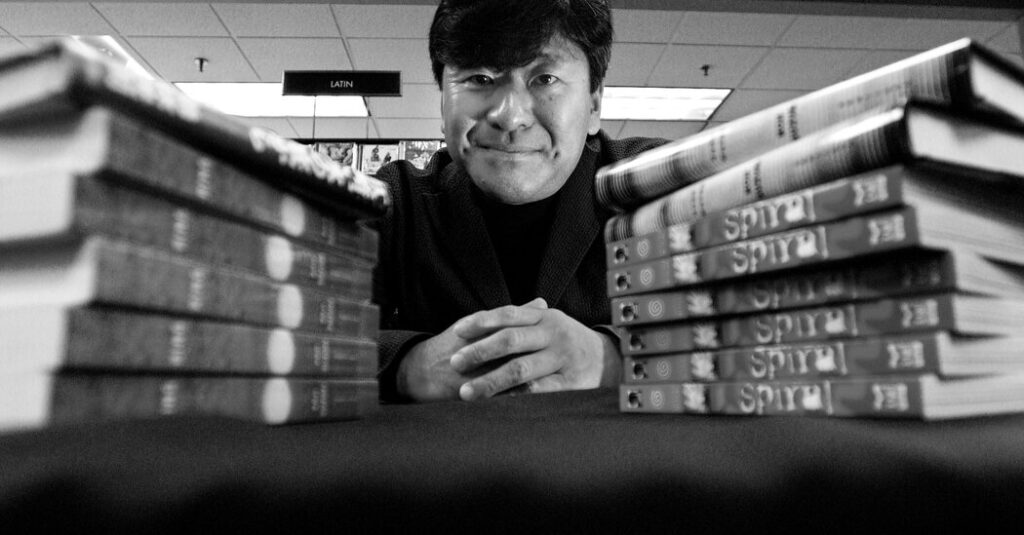
Koji Suzuki, the novelist and short-story writer sometimes called the Stephen King of Japan, whose best-selling “Ring” series helped create a genre known as J-horror that relied more on psychological suspense than on gore, spawning a multimedia franchise that included a 2002 blockbuster Hollywood movie, died on Friday in Tokyo. He was 68.
His Japanese publisher, Kadokawa, confirmed the death, at a hospital, but provided no details.
Mr. Suzuki, who received a degree in French literature from Keio University in Tokyo, was primarily interested in literary fiction — particularly the works of Jean-Paul Sartre, Albert Camus and Thomas Mann. He made it clear in interviews that he was not a fan of the horror genre.
“I actually don’t like all that supernatural stuff,” he told The New York Times in 2004. “I really dislike most horror writing.”
With “Ring” (1991) — the first book in his trilogy, which sold nearly three million copies in Japan — he told the British tabloid Metro in the early 2000s that his viewpoint shifted when he felt he could write “an epoch-making story” and create something unique in the horror genre because he was an outsider. “I managed to write a good horror story,” he said, “because I don’t actually like horror. If I liked it and was always reading it, I would have written typical horror.”
The novel centers on a cursed videotape whose viewers die unless they copy and pass it on to someone else within seven days. It introduces a vengeful intersex ghost called Sadako, who also appears in the other two books in the trilogy, “Spiral” (1995) and “Loop” (1998).
In “Spiral,” in which a diabolical videotape activates a virus-like substance in the bodies of viewers, Mr. Suzuki explored how physical health is affected by a person’s mental state. In “Loop,” which he described as a repudiation of the paranormal horrors in the first two novels, he offered a more hopeful story about a hero confronting self-replicating life in a sophisticated computer simulation.
“I didn’t want to end it by giving readers the creeps,” he said of the trilogy.
“Ring” and its sequels permeated popular culture in Japan, “becoming a boogeyman used to scare children,” The Times wrote in 2004, “and, for adults, a metaphor for everything corrupt, cruel and frightening about modern society.”
Mr. Suzuki expanded his “Ring” franchise to include the story collection “Birthday” (1999) and the novels “S” (2012) and “Tide” (2013). There was also a 1998 Japanese film titled “Ring,” as well as a 2002 American remake, “The Ring,” and other movie spinoffs, along with television series, manga adaptations and video games. By 2004, Mr. Suzuki’s books had sold more than 10 million copies in Japan alone.
The scene of the ghost climbing out of a well and then crawling out of a television screen, its face shrouded by a long veil of black hair — in both the 1998 film “Ring,” directed by Hideo Nakata, and in the 2002 American version, directed by Gore Verbinski — has been included on lists of the scariest moments on film.
The remake grossed nearly $250 million worldwide — including about $129 million in North America — making it one of the most commercially successful horror films ever made. In a 2022 retrospective, the New York Times critic Beatrice Loayza described it as “surprisingly restrained, unfolding like a waking dream shot through with dread,” one that tapped into “a familiar feeling of ambient anxiety and inexplicable unease that remains omnipresent to this day.”
She added that it “might even be considered a classic of millennial horror,” noting that, along with the 1999 hits “The Sixth Sense” and “The Blair Witch Project,” it represented a “shift from the fascination with teen-slasher fare that had dominated the previous three decades.”
Another movie of similar timbre was “Dark Water,” directed by Mr. Nakata in 2002 and based on Mr. Suzuki’s 1996 collection of stories. Remade in 2005 by the Brazilian filmmaker Walter Salles, it starred Jennifer Connelly and was filmed primarily on Roosevelt Island in New York City. The familiarly unsettling movie involved a supernatural water leak and the vengeful ghost of a missing girl.
Koji Suzuki was born on May 13, 1957, in Hamamatsu, Japan, a city on the Pacific Coast between Tokyo and Osaka.
Mr. Suzuki’s wife, a high school teacher, supported the family and cared for their two daughters while he wrote “Ring.”
His writing made them wealthy. His wife quit teaching, and he was able to buy a yacht, practice martial arts and ride motorcycles, one of which he used on a road trip from California to Florida.
At one point, he vowed never to write horror fiction again, but that decision came to feel too “constricting,” he told The Times in 2004.
In 2008, he published “Edge,” a novel blending horror and science fiction, about a world in which, among other troubling developments, the value of Pi begins to change, suggesting that the structure of the universe is breaking down. The book won a Shirley Jackson Award for best novel in 2012.
Michael Morrison, an emeritus physics professor at the University of Oklahoma who has written extensive critiques and essays about horror and science fiction, was intrigued by the premise, but found fault with the writing and the comparisons to Mr. King. In a review for the university’s magazine, World Literature Today, he wrote that some of Mr. Suzuki’s works lacked “King’s gift for weaving seamless stories peopled with multidimensional characters.”
In Mr. Suzuki’s final work, “Ubiquitous,” published last year, he returned to classic J-horror with a novel about plants ruling the earth, intended to be the first volume of a tetralogy.
The theme of the four books, he said in a 2023 interview with the Horror Writers Association, would be simple: If the universe had free will, “what kind of life would it wish for the human race?”
Kiuko Notoya contributed reporting from Tokyo.
Jeré Longman is a Times reporter on the Obituaries desk who writes the occasional sports-related story.
The post Koji Suzuki, Sometimes Called the Stephen King of Japan, Dies at 68 appeared first on New York Times.