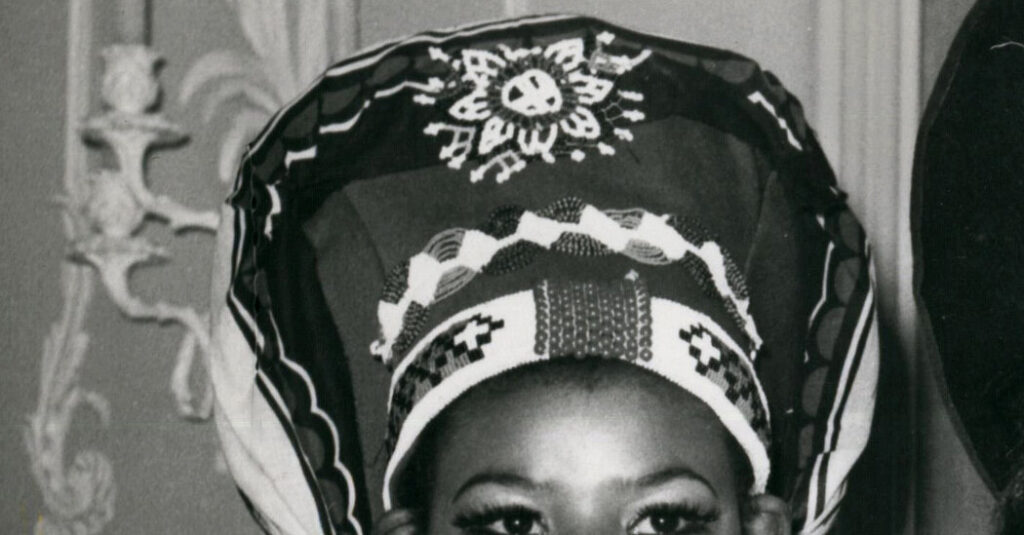
Cynthia Shange, who at the height of apartheid was the first Black woman from South Africa to compete in the Miss World beauty pageant, placing in the top five at the 1972 contest and becoming an enduring symbol of glamour and resistance, died on April 20 in KwaZulu-Natal, South Africa. She was 76.
Her death, in a hospital, from complications of diabetes, was confirmed by her daughter Nonhle Thema.
President Cyril Ramaphosa of South Africa, in a statement after Ms. Shange’s death, praised her charisma and the boldness of her ambitions “in an era when apartheid segregation was at its peak and Black women were the most disadvantaged citizens in our country.”
After her appearance at Miss World, Ms. Shange (pronounced SHAN-gay) went on to a long career as an actress, appearing in films and popular TV series like the historical drama “Shaka Zulu” (1986), which traced the rise of an early-19th-century leader of the Zulu kingdom, and the long-running family soap opera “Muvhango,” which first aired in 1997.
It was her improbable rise to the world stage as a beauty queen, though, that turned Ms. Shange into a beloved figure in a country with an outsized fascination with beauty contests.
She well understood the reverberations of her participation in Miss World. When she arrived at the Royal Albert Hall in London, where the contest was held, in December 1972, Ms. Shange, then just 23, raised her fist in the air in a Black power salute, she later said.
Even so, the moment was bittersweet. South Africa’s official Miss World contestant that year was Stephanie Reinecke, who was white and blonde. Ms. Shange was in London representing “Africa South,” a country “that did not exist,” she told The Times of London in a 2010 interview.
Two years before, a white Jewish clothing manufacturer in Johannesburg named Harry Solarsh had created a beauty contest for mixed race or Black women to be able to compete globally on behalf of “Africa South.” By admitting both South African contestants, pageant organizers hoped to avoid the criticism and boycotts that were then often directed at the country’s apartheid government and those representing it.
In 1970, the first Miss Africa South, Pearl Jansen, who was mixed race, nearly won the Miss World title, placing as runner-up, while her white South African counterpart came in fifth.
The next year, Mr. Solarsh canceled the competition as a protest, arguing that a single candidate should represent the entire country. When the Africa South contest was reinstated the following year, Ms. Shange became the first Black woman to wear the crown.
For Ms. Shange, who had grown up in modest circumstances in one of Durban’s segregated Black townships, the trip to London was heady. It was her first plane ride, and she reveled in the unexpected, everyday respect she received, like in restaurants and taxis.
“When she entered Miss World, she was treated as an equal,” Ms. Thema, her daughter, recalled in an interview. “She thought, ‘Wow, it’s possible for me to be treated like everybody else.’’’
But then returning to a rigidly segregated South Africa was a stark letdown. When she traveled across the country for modeling work, she said in the 2010 interview, she had to “stop at roadhouses to eat and ask for food through the back door.”
Sometimes she stood her ground. At the John Orr department store in Kimberley, where she worked part time, she insisted on using a whites-only toilet, in spite of co-workers who complained.
“I had confidence, loads of it,” she told the Mail & Guardian newspaper in 2000.
That attitude was fit for a leading lady, and she soon landed a starring role in one of South Africa’s first feature films with a Black cast, “u’Deliwe” (1975), about the tragic destiny of a country girl who comes to Johannesburg.
In the decades that followed, Ms. Shange became a recognizable and respected presence in film and television. In “Shaka Zulu,” she played Queen Mkabi, the title character’s aunt, and in “Muvhango” was MaNkosi, the mother of one of the main characters.
“At a time when people of color didn’t have hope, she shaped a generation of women to have their voice,” Ms. Thema, who is also an actress, said.
“Her beauty,” she added, “allowed her to have access to places and things.”
Cynthia Philisiwe Shange was born on July 27, 1949, in Lamontville, South Africa, one of four daughters and two sons of Ivy and Dick Shange. Her father did odd jobs around Durban, Ms. Thema said.
As a teenager, Ms. Shange was spotted by a scout and encouraged to compete in local beauty pageants. “My mum won every pageant around,” Ms. Thema said.
She came first in a provincial pageant and was crowned Miss KwaZulu-Natal. In 1972, when she competed in Miss World, she also became the first Black woman to be profiled in the popular South African magazine Fair Lady.
In the 1970s, Ms. Shange married a well-known South African journalist, Derrick Thema, whom she divorced in the late 1980s. In addition to her daughter Nonhle, she is survived by her other daughter, Sihle Thema, and her sons, Ayanda and Benele Thema.
In 2009, she was given a lifetime achievement prize at the South African Film and Television Awards. A few years ago, she retired to a farm that she had purchased outside Durban — where, her daughter said, she “was very happy breathing fresh air.”
The South African Parliament, in a statement after her death, recognized the significance of Ms. Shange’s 1972 appearance at the Royal Albert Hall.
“At the height of apartheid,” the statement said, “when Black people were excluded from mainstream recognition and representation, Shange’s presence on that stage asserted the beauty, worth and humanity of Black women in a society that sought to erase them.”
Adam Nossiter has been bureau chief in Kabul, Paris, West Africa and New Orleans and is now a writer on the Obituaries desk.
The post Cynthia Shange, Who Defied Apartheid at a Beauty Pageant, Dies at 76 appeared first on New York Times.