The Georgia governor’s race has been upended by a message delivered in 30-second bursts, during the ad breaks of local newscasts and Atlanta Braves games and soapy dramas streamed on Hulu.
Rick Jackson, the ads say, grew up in foster care and could not afford college, and yet he pulled himself up and built a business empire. He was no entrenched politician. As governor, he would run Georgia like one of his businesses, stamp out illegal immigration and be an unfailing partner to President Trump.
Just a few months ago, Mr. Jackson, a billionaire health care executive with no government experience, was largely unknown to Georgia voters. Now, he appears to have a decent chance of succeeding Brian Kemp, the popular two-term governor who is leaving office at the end of the year.
His campaign has tested a strategy that is fairly straightforward, if available only to candidates who have the vast resources necessary to pull it off: Buy enough airtime to try to set the terms of the race.
Until Mr. Jackson entered the race in February, a trio of well-known Republicans dominated the primary field: Burt Jones, the lieutenant governor; Brad Raffensperger, the secretary of state; and Chris Carr, the attorney general. All had high-profile roles in the chaotic aftermath of the 2020 election in Georgia, when Mr. Trump sought to overturn his loss there; Mr. Jackson, 72, had no such baggage.
His upstart candidacy has been a striking display of the power that extraordinary wealth can have in rapidly transforming the dynamics of an election. By leveraging his personal fortune to elevate his profile, he has forced his Republican opponents — especially Mr. Jones, who secured Mr. Trump’s endorsement months before Mr. Jackson entered the race — to supercharge their own spending to remain competitive.
“Hundreds of millions of dollars are being spent, and this is just the primary,” said Rick Dent, a political strategist in Georgia who has worked for Democrats and Republicans. Both parties’ primary elections will take place in the state on Tuesday, with runoffs scheduled for June 16 if no candidate wins a majority of the vote. Polls have suggested a tight race between Mr. Jones and Mr. Jackson.
Mr. Jackson’s prolific campaign spending and surge in the polls seemingly runs counter to the nation’s growing resentment of the ultrarich, but his ads have emphasized his childhood of penury and neglect. And wealth generally has appeared to be less of a taboo subject with many Republican primary voters. While he is by far the richest candidate, financial disclosures peg Mr. Jones’s net worth at $10.9 million, Mr. Carr’s at more than $4 million, and Mr. Raffensperger’s at more than $91 million.
Democratic voters in Georgia are also trying to sort through a packed field, which includes Keisha Lance Bottoms, a former mayor of Atlanta; Geoff Duncan, a former Republican lieutenant governor who became a Democrat after running afoul of Mr. Trump; Jason Esteves, a former state senator; and Michael Thurmond, a former chief executive of DeKalb County.
Democrats have relished the infighting among Republicans, believing it will leave the primary winner with a bruised reputation and depleted resources heading into the general election. Even as their party has gained ground in Georgia, the governor’s mansion — and indeed most statewide offices — have remained elusive targets. And if Mr. Jackson wins the primary, he has the deep pockets to sustain a general election fight.
Beyond his own campaign ads, Mr. Jackson has also benefited from a parallel onslaught against Mr. Jones, financed by a dark money group that he has consistently denied having ties to. The group has run ads painting Mr. Jones as a career politician who has used his time in office to advance his own financial interests. Mr. Jones, who insists that Mr. Jackson is behind the group, has responded with ads attacking Mr. Jackson’s conservative credentials and business practices.
“The ones I feel almost sorry for are the injury lawyers,” Tom Williams, a long-shot Republican candidate from the Macon area, said in a recent televised debate. “They can’t get any time on TV to run their ads because of these two guys.”
At the outset, Mr. Jones had significant competition from Mr. Raffensperger and Mr. Carr. Still, political observers in Georgia believed that Mr. Jones — a former captain of the University of Georgia football team who was twice elected lieutenant governor — was in the strongest position to win.
Then, in a surprising move, Mr. Jackson announced in February that he was entering the race. He had long been prominent in the state’s business circles and a big donor in Republican politics. He runs Jackson Healthcare, a company based in the Atlanta suburbs with an expansive portfolio of medical businesses, including staffing services for physicians, nurses, physical and occupational therapists and pharmacists.
“His name recognition six months ago would be 0 percent or 1 percent,” said Charles S. Bullock III, a political scientist at the University of Georgia. But Mr. Jackson was ready to pour more than $65 million of his own money into making up for it.
Voters have also seemed eager for a fresh face, one with no ties to a turbulent stretch for Georgia Republicans. Mr. Trump’s loss in Georgia in 2020 — the first for a Republican presidential candidate in the state in nearly 30 years — and his scheming to overturn it caused deep rifts that still endure.
Some Republican voters have been unwilling to forgive Mr. Raffensperger for withstanding pressure from Mr. Trump to find enough voters to flip the outcome, and hold a similar grudge against Mr. Carr, who stood with Mr. Kemp in defying the president.
Mr. Jackson has cast himself as an outsider in the mold of Mr. Trump, arguing that his wealth insulates him from the pressures that face elected officials who have to rely on large donations to be competitive.
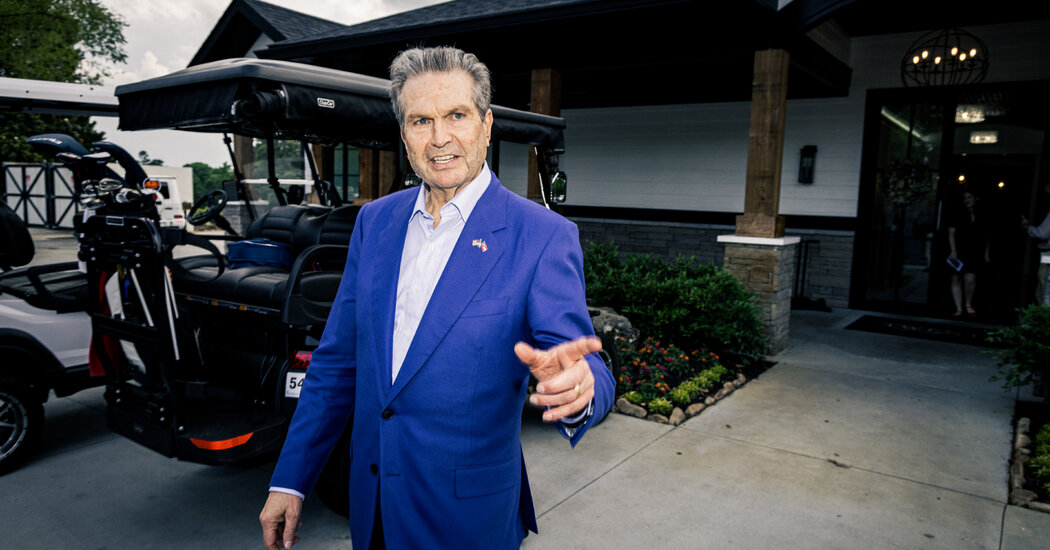
“I mainly want to solve problems,” Mr. Jackson said in a brief interview after a campaign stop in Jefferson, northeast of Atlanta. “I don’t mind taking on the establishment, or what I call the cartel. I’m here to actually make a difference instead of making a point.”
The message is clicking with Republican voters like Denice and Tim Gilbert, who appreciated his business experience, his support of Mr. Trump and his promise to cut income taxes. Mr. Gilbert, 70, said he also respected the affluent life that Mr. Jackson had built for himself, after learning about his childhood struggles — like being raised in poverty by an alcoholic mother — from his ads.
“Nothing was going to get in his way,” Mr. Gilbert said.
Mr. Jackson has gained a narrow edge over Mr. Jones in some recent polls. But even if he has the most votes in the election next week, it most likely will not be enough to avoid a runoff next month.
The influence of Mr. Jackson’s fortune on the race has been undeniable, political analysts say. But they also argue that wealth can carry a candidate only so far.
“You need enough money to compete so you can be viable, but having the most is not necessarily a determining factor,” said Brendan Glavin, the director of insights at OpenSecrets, a nonpartisan watchdog group.
The campaign has brought scrutiny to Mr. Jackson’s finances and business dealings that will probably intensify if he progresses. His limitations as a campaigner could also become more apparent, especially when he has to venture into less friendly spaces to try to woo the moderate and independent voters needed to win a general election in a swing state like Georgia. Some of his critics pointed to his halting performance in a recent debate; there were no notable gaffes, but he was not exactly electrifying, either, they said.
Mr. Jones and other opponents have questioned the authenticity of Mr. Jackson’s self-proclaimed conservatism, noting that his earliest donation to Mr. Trump — $1 million to his campaign’s political action committee — came late last year, just before Mr. Jackson entered the governor’s race. Mr. Jones has also repeatedly accused Mr. Jackson of bankrolling the shadowy group called Georgians for Integrity that funded the ad campaign relentlessly attacking Mr. Jones.
“He’s been spending millions of dollars telling lies about me,” Mr. Jones said in the debate last month. “But what’s even worse than that is he’s been spending millions of dollars telling lies to you about himself.”
Jana Kane, who lives in Jackson County and has yet to settle on a candidate in the Republican primary, had heard claims that Mr. Jackson had donated money to Jon Ossoff, Georgia’s Democratic senator, and to Planned Parenthood, and that he had supported gender-transition surgery for young people.
“I’m seeing all these negative ads for both going back and forth,” she said of Mr. Jackson and Mr. Jones, “and I’m like, OK, what’s true in that?”
She came to Mr. Jackson’s campaign event at a golf course in Jefferson, about 60 miles from Atlanta, in search of clarity.
“I’d like to see something that clearly spells out just how much money you’ve given away and to what,” Ms. Kane, 62, told Mr. Jackson, “because your competitors are out there showing your mansion and making it like it’s a sin to be successful.”
He denied the accusations she had heard, adding that most of his charitable donations had been anonymous.
Ms. Kane still had not made up her mind, she said afterward, but she liked what she had heard.
“It’s like Trump — Trump could have just gone off and minded his own business and not gotten put through hell,” she said. But she believed that both men had been drawn into politics out of a desire to serve.
Still, she said: “I think he has a lot of ground to catch up on. Because who the heck heard of Rick Jackson three months ago?”
Rick Rojas is the Atlanta bureau chief for The Times, leading coverage of the South.
The post A Billionaire’s Ad Barrage Has Upended the Georgia Governor’s Race appeared first on New York Times.