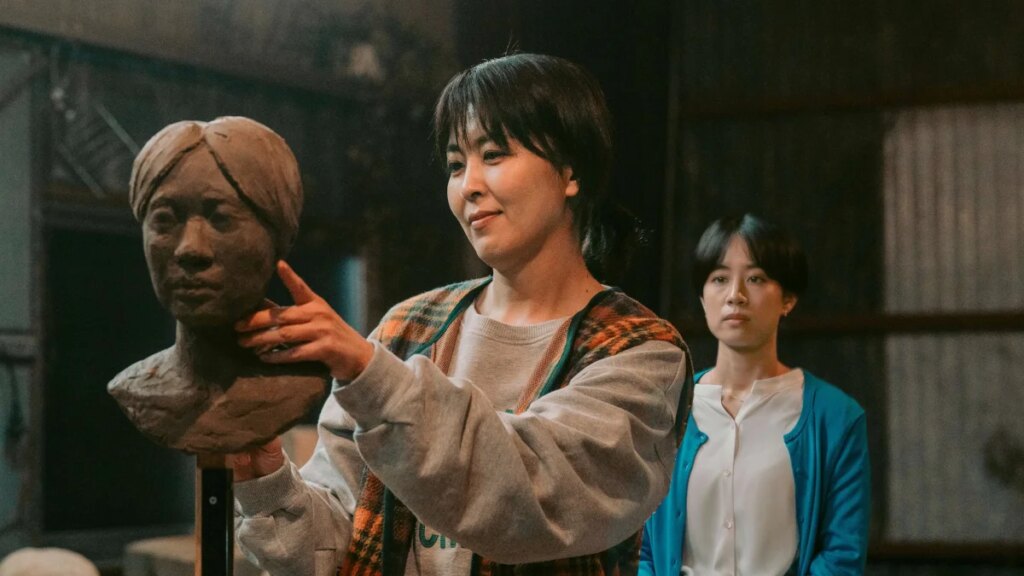
Much like the central sculptures that become the focal point of its best scenes, Kôji Fukada’s “Nagi Notes” is a film defined by a sense that the filmmaker is trying to chip away at something.
At times, he does so with deep cuts, laying bare something profound about his characters in what can otherwise be a rather distancing work. In others, he merely cuts around the edges, leaving much of his vision feeling slightly unsure of itself and what it wants to become. It’s like he’s working something out, exploring the contours of each of his characters without being fully certain about what shape they’ll take. And yet, despite “Nagi Notes” proving to be less fully-formed and impactful than Fukada’s more focused recent film “Love Life,” there’s still something here that you can’t fully dismiss. Though it’s a low-key drama about finding home that can feel a bit slight, it comes to life in the moments where it homes in on the labor of making art and the connection that came from it. Namely, in each of the film’s more intimate sculpting scenes where all of the noise (which often takes the form of literal explosions) fades away, you start to hear something more resonant and true.
The film, which premiered in competition at the Cannes Film Festival on Wednesday, centers on the architect Yuri (Shizuka Ishibashi), who is visiting her friend and former sister-in-law Yoriko (Takako Matsu). The former lives in a bustling Tokyo and the latter in the rural community of Nagi where she works as an artist. It’s a place so small that the local radio mournfully broadcasts the death announcements of each and every person who dies.
At the same time, the broader world is always on the margins as we hear the boom of recurring military exercises taking place in the area and catch glimpses of how the ongoing war in Ukraine is causing impacts on this small community. Yet life goes on, and it’s against this backdrop that the two women begin to open up, reflecting on past pains just as they ponder what is coming next for both of them.
With Yuri serving as the muse for Yoriko to make a sculpture, the film settles into being a series of unhurried and gentle scenes where the two speak to each other about how they’ve both ended up here. They poke fun and occasionally rib the other, though rather than feel like a sparring match between two artists like the recent Steven Soderbergh film “The Christophers,” “Nagi Notes” often feels closer to something like Kelly Reichardt’s “Showing Up” in how it explores the process of creating.
There aren’t moments of creative spark as much as there is the authentically riveting experience of something being molded out of nothing that still creates its own emotional charge. The sculptures are meticulously crafted, but it’s the two women who are the most engaging to watch. Even as the film holds them at a bit of a distance from us, it’s they who may be undergoing the greatest transformation.
The rhythms of their conversations, which gently float between the duo, increasingly merge with the sounds of sculpting. Even when the narrative foundation is a little lacking, it’s the way these scenes are executed that makes the film rise to something more incisive. Both the naturalistic performances and great sound design make it all feel like you’re peeking in on a real conversation between two people building themselves back up.
As one day fades into the next, Fukada does unnecessarily hold our hand with the recurring cuts to shots of calendars reminding us that what was meant to be a short trip has grown longer. It makes it feel more confined and less free-flowing, robbing us of the chance to feel time passing rather than be told about it. Yet even as these parts of “Nagi Notes” are less naturalistic, with Fukada also underserving two younger characters on their own similar path of self-discovery, whenever we return to the sculpting scenes, the film slides into a graceful little groove.
The film is far less overtly tragic than the aforementioned “Love Life,” but there is still a sense of melancholy throughout. It’s not a film of life-changing events, instead playing like the end of one potentially life-changing experience and the beginning of another.
Like the sculpture that never gets fully finished, it leaves much pointedly incomplete and unresolved. But the fragments you do get, each precious in its own way, ensure you’re still more than glad to have taken a seat to watch Fukada chip away at it all.
The post ‘Nagi Notes’ Review: Kôji Fukada Sculpts a Fragmented, Fascinating Portrait appeared first on TheWrap.