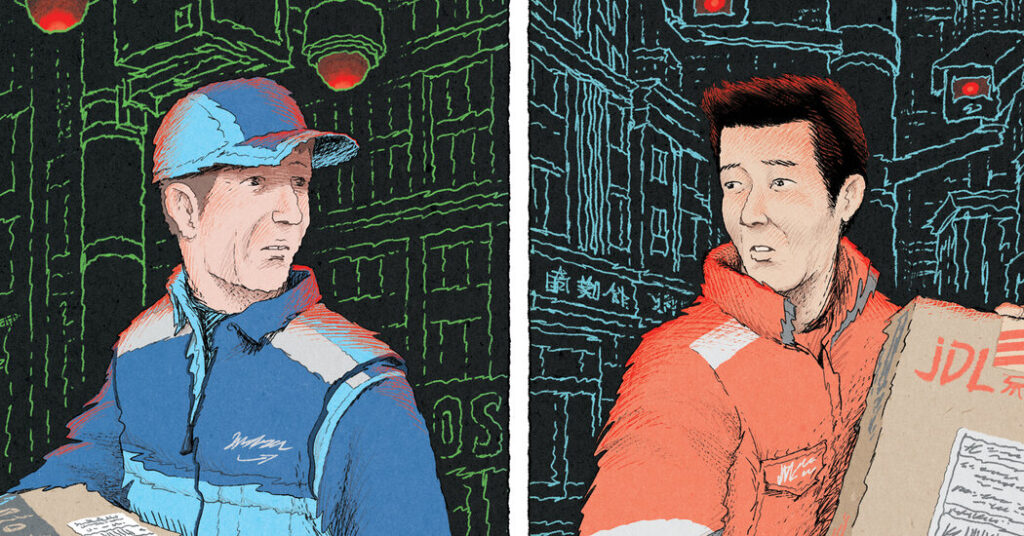
Within an hour of landing in Shanghai, I was sitting in the back of a Didi cab while the driver pleaded with me to game the company’s algorithm. Didi is the “Uber of China” and has a ubiquitous footprint in the country, dispatching tens of millions of rides per day. Could I cancel the ride and pay him directly through WeChat?
There was an oversupply of drivers competing for too few fares, he explained. After dropping me off, he would be sent straight back to the airport, where he would have to wait for hours for another pickup. If I canceled, he could take a place near the front of the line. “I hope you understand,” he said. “I’ve got an older and a younger generation to support.”
The driver’s plight reminded me of the DoorDash workers in the United States whose earnings are controlled by optimized dispatch systems, or the Amazon Flex workers who compete for scarce delivery blocks, never certain when the next job will come.
I have spent years reporting and living in both the United States and China and wrote a book chronicling the history and evolution of the Chinese internet. Moving between the two countries, I’ve been struck by how they have come to mirror and resemble each other. There is a shared sense of precarity that lies beneath the envy and distrust: the technological future is taking shape at vertiginous speed yet its promise is not shared by all.
The growth of artificial intelligence has been presented as a rivalry between two fundamentally different systems. America commands capital and chips while China marshals engineering talent and manufacturing prowess. America holds an edge in building software — enterprise tools and cloud platforms. China leads in hardware — humanoids and autonomous vehicles. America pushes ahead with frontier models, with its artificial intelligence labs making moonshot bets to build a superintelligence. China focuses on scale and diffusion, with its tech firms embedding A.I. as quickly as possible in every sector of society.
We’ve been told that the ultimate prize in A.I. is the achievement of artificial general intelligence, or A.G.I. The country that figures this out, the theory holds, will establish world dominance through turbocharged economic and military power. In podcasts and political speeches — shaped by Silicon Valley executives and Washington policy wonks — the United States and China are almost always “battling,” “competing,” or “locked” in this race. China is years behind, no, months behind; it’s pulling ahead; it’s winning; it’s losing, it’s racing toward A.G.I., not racing toward A.G.I.; or it’s racing on a different track.
The story of the race blew up last year after the introduction of DeepSeek R1, a Chinese open-source model that reportedly rivaled U.S. frontier models at a fraction of the cost. A wave of “China envy” overtook U.S. tech leaders who marveled at China’s speed in building bridges, high-speed trains and advanced prototypes. Marc Andreessen warned that the United States must reindustrialize or fall behind a world of “Chinese robots.”
The leftist influencer Hasan Piker traveled to China in 2025, a copy of Mao Zedong’s quotations in hand, to see what America might “adopt and emulate.” The popular YouTuber Darren Watkins, known as IShowSpeed, streamed his trip to Shenzhen, where he danced with humanoids and ordered KFC by drone. Just as Chinese people were once transfixed by American consumer abundance — its shopping malls and sprawling suburbs — Americans have become obsessed with China’s robots and manufacturing power.
But looking past the headlines and the highlight reels, you can see the sharp divide in both countries brought on by A.I. Those who build and bankroll the technology speak of the future as a promise to be profited from, an opportunity to be exploited. In Silicon Valley, college dropouts talk of A.I. tackling climate change and curing disease. Researchers are courted with nine-figure salaries like N.B.A. stars, and roadside billboards call on residents to “Supercharge your A.I.” and “Stop Hiring Humans.” Tech workers have earnestly adopted China’s infamous “996” work schedule: 9 a.m. to 9 p.m., six days a week. They are hustling hard and “locking in” to ensure that they emerge as the rich and powerful victors of the A.I. gold rush.
China’s tech hubs are driven by a similar sense of urgency. In Beijing’s Zhongguancun, known as China’s Silicon Valley, office towers stay lit deep into the night as A.I. lab employees hustle to beat their rivals across the road. Companies poach one another’s star engineers while freelance coders burn through tens of thousands of Claude tokens to vibecode products. The start-up founders hunt for what they call the fengkou or “wind vent” — an opportunity that, if seized at the right moment, can propel an entrepreneur straight to fortune. They study translations of Peter Thiel’s “Zero to One” and lionize Elon Musk because, as one tech worker told me, “He moves quickly, his execution is crazy and he can really deliver stuff.”
China’s most recent wind vent was “raising lobsters” — a shorthand for training the free, open-source A.I. agent OpenClaw. Nearly 1,000 people, from amateur coders to housewives, lined up outside the tech giant Tencent’s headquarters to install the software on their devices. Users claimed that OpenClaw could kick-start side hustles and double stock returns; parents bought “lobster installation services” for their grade school children to keep up with their peers. Tech companies raced to monetize this anxiety, charging users for cloud servers and software access. “This is not ‘embracing the future,’” one disillusioned user on RedNote described the OpenClaw craze. “It’s ‘being harvested by the future.’”
Farther south in Shenzhen, China’s hardware capital, start-ups boast of operating at “Shenzhen speed” and have been embedding A.I. into everything from coffee makers to construction cranes. At a high-tech fair in the city, hosted in 20 halls the size of airport hangars, I walked by stalls advertising A.I. pianos, A.I. beef noodle makers, A.I. holographic tour guides and A.I. English tutors. I sat down in front of an A.I.-powered traditional Chinese medicine doctor that scanned my tongue and delivered a diagnosis. A crowd gathered around a boxing ring, cheering on a pair of sparring humanoids made by the robotics giant Unitree.
“It’s a highly competitive environment right now,” a Shenzhen software engineer told me. “I feel like if I stop, I’ll be left behind.” His anxiety is not new. Unstable work situations and economic insecurity long predate the current A.I. boom. But A.I. has supercharged those anxieties and made them much harder to contest.
A parallel set of memes has emerged to capture the sense of powerlessness. In the United States, the Silicon Valley tech elite identify as “high agency,” while the rest of us are “bots” condemned to the “permanent underclass.” In China, ordinary workers describe themselves as shechu (“corporate cattle”) and jiabangou (“overtime dogs.”) These same workers have long used the viral term “involution” to capture the feeling of being trapped in a cycle of meaningless competition. In both countries, those disaffected by A.I. identify with the gaming meme of the “NPC” or “non-player character.” They feel like the background role in someone else’s video game, existing only to fill the world but not to shape it.
In 2025, a group of A.I. researchers from the United States, Canada and Europe coined the term “gradual disempowerment” to describe a future in which ever more capable A.I. would quietly erode human agency. The technology would steer our core institutions with little regard for human values. Though framed as a future risk, to someone who has been observing the United States and China closely, it already felt like a diagnosis of the present day.
The knowledge workers of both countries feel the surveillance presence of the technology. A.I. is now used in decisions to hire and fire employees. It tracks attendance at work, predicts an employee’s growth potential, flags “idle hours” and enforces discipline.
Outside the office, both Chinese and Americans have become enamored with A.I. as a source of frictionless companionship and emotional validation, with companies now monetizing emotional intimacy at scale. Over 70 percent of American teenagers report using chatbots as companions, nearly one in eight for mental health support.
Similarly, in China, one survey found that nearly half of young Chinese had used an A.I. chatbot to discuss their mental health. In a country where living alone is quickly becoming the norm — with single-person households expected to possibly reach 200 million by 2030 — A.I. companions have emerged as a quick fix to a growing loneliness epidemic.
This year, the app “Are You Dead?” — which alerts a contact if a user fails to check-in — has been wildly popular. (Its Chinese name, Sileme, is a morbid play on the name of the popular food delivery app Ele.me, meaning “Are You Hungry?”) But “Are You Dead?” addresses a serious need: the growing number of people who are living solo, far away from family and deprived of social support, and who are afraid of disappearing without being noticed.
The people of both countries are turning toward the spiritual for solace and agency in a world accelerating out of their control. The 20-somethings of America check astrology apps like Co-Star, part of a $3 billion dollar industry. Some in Gen Z are rediscovering Christianity, and religious conservatism has re-entered public life. In China, fortunetelling bars have popped up in cities, astrology apps like Cece are going viral and young people are consulting DeepSeek to predict their futures.
Last fall in Beijing, I found myself at a dinner with a group of women in their 20s and 30s whose conversation circled familiar anxieties: shrinking job prospects (and recruitment horror stories), disenchantment with dating (none of them wanted to get married or have children), and a growing fascination with bazi, tarot and the occult. When I asked one guest about tarot’s rising appeal, she answered simply, “No one turns to tarot when times are good.”
When the future loses its promise, the past becomes a refuge. Both societies have seen a surge of nostalgia, a longing for a time remembered as simpler and more stable. Many Chinese idolize rural vloggers such as the celebrity YouTuber Li Ziqi, who rose to viral fame during the pandemic by sharing videos of her self-sufficient, pastoral life in the Sichuan countryside. You can see the same dynamics in the popularity of the tradwife Instagrammer known as Ballerina Farm, who documents her Utah homestead, milking cows and making doughnuts from scratch for her eight children. Both of those women live off the grid and embody an imagined idyll where chatbots and corporations do not exist.
Nostalgia also has a dark side, encouraging the rise of once fringe, illiberal ideas into the mainstream. This has been underway in China for years, with its influencers and ideologues rejecting liberal ideas and drifting toward a conservative centralized authority. In the United States, we see the growing influence of pundits like Curtis Yarvin, who argues that liberal democracy should be dismantled in favor of a C.E.O.-led monarchy and whose ideas have found an audience among both America’s tech and political elite, from Peter Thiel to JD Vance.
Faced with such a system, the simplest response is to surrender: accept one’s fate, sink into the apathy of inevitable decline and, in the words of Chinese netizens, “let it rot.” It’s easy to flee the friction of the real world for the comfort of our feeds and to confide in chatbots rather than friends. In doing so, we enable our leaders to leverage our fears and displace our anxieties onto the meme version of a foreign country.
Instead of addressing A.I.’s challenges in isolation, why not bring together people from all sectors of society to reclaim agency over our own lives? We can pursue collaboration, as scientists and policymakers have already begun to do. On the sidelines of the World A.I. Conference in Shanghai last summer, scientists from across the world met to address critical A.I. risks, calling for international cooperation to ensure that advanced A.I. systems remain aligned with human values.
Workers can band together to resist toxic work cultures at Big Tech firms that sacrifice human dignity for profit and competition. It was only in 2019 that Chinese programmers launched the 996.ICU campaign on GitHub, to protest grueling work hours. They drew support from U.S. tech workers and hundreds of tech employees worldwide, from Spain to Singapore, one of the largest online mobilizations of tech workers in history.
Once you step back, it’s easy to see the warping effect of the U.S. vs. China race. It’s a story used to justify sprinting ahead without guardrails in the name of beating the other. By focusing on our rivalry, we have become blind to our vulnerability. Instead of fixating on who crosses the finish line first, we must work together to lift up the people that both countries have left behind.
Yi-Ling Liu is a journalist-in-residence at the Tarbell Center for AI Journalism and the author of “The Wall Dancers: Searching for Freedom & Connection on the Chinese Internet.”
The Times is committed to publishing a diversity of letters to the editor. We’d like to hear what you think about this or any of our articles. Here are some tips. And here’s our email: [email protected].
Follow the New York Times Opinion section on Facebook, Instagram, TikTok, Bluesky, WhatsApp and Threads.
The post The U.S. and China Are Hurtling Toward a Shared A.I. Future appeared first on New York Times.