In 2016, Geoffrey Hinton, one of the pioneers of modern artificial intelligence, made a bold prediction: “We should stop training radiologists now,” he told the crowd at an industry conference in Toronto. “It’s just completely obvious… it might be ten years, but we’ve got plenty of radiologists already.”
Well, it’s 10 years later, and the Mayo Clinic, to take one example, employs 55% more radiologists than it did at the time of Hinton’s prediction. The number of radiologists in the U.S. has increased by roughly 10%. Hinton’s prophecy is just one of history’s many “completely obvious” forecasts that never came to be.
Flip through cable news, and within minutes, you’re bound to stumble across an expert projecting certainty about AI’s impact on jobs, whether the Democrats will flip the House, or when the war in Iran will end.
Alas, as psychology professor Philip Tetlock, who evaluated decades of expert predictions in politics and economics, famously found, “the average expert was roughly as accurate as a dart-throwing chimpanzee.”
In times of great uncertainty, certainty is ever more alluring. Believing that we can predict the future gives us a sense of control as the ground shifts beneath us. And yet, it is precisely in these times of precarity that leaders must trade their hubris for humility.
Too often, we underappreciate the value of uncertainty. We tend to assume that expressing unwavering conviction breeds credibility, but several studies have found that those who admit what they don’t know are perceived as more credible.
The most effective leaders are not, in fact, know-it-alls. They acknowledge their lack of certainty, accept their inability to control all outcomes, and persist nonetheless. “Becoming more intellectually humble requires us to acknowledge the absolute impossibility that everything you believe is correct,” Mark Leary, a Duke researcher who studies intellectual humility, tells me. “The best way to get to the truth is actually to admit what we don’t know for sure.”
And yet, despite the overwhelming evidence of how poor even the world’s leading experts are at making predictions, it rarely stops them from trying. For example, in 2016, The Economist analyzed 15 years of economic forecasts from the International Monetary Fund, covering 189 countries. Over that period, there were 220 instances of countries entering recession. The IMF produces forecasts twice a year, once in April and again in October, reflecting the economic data from the first half of the year.
Not one of these 220 recessions was correctly predicted in an April forecast, and the October forecasts, which had access to six months of real-world data, only got it right about half the time. “All social scientists know a secret that we rarely discuss openly,” the political scientist Brian Klaas wrote about the findings. “Even our best minds don’t really understand how our social world works.”The late Harvard economist John Kenneth Galbraith put it more irreverently: “The only function of economic forecasting is to make astrology look respectable.”
So what should we make of the fact that our predictions about the future are reliably bad? And how should leaders respond?
No one wants a leader who throws up their hands and says, “I have no idea what’s to come.” Instead, we need leaders who admit what they don’t know. General Stanley McChrystal, who commanded special operations forces in Iraq, provides a telling example of how the war changed his view of leadership.
“The temptation to lead as a chess master, controlling each move of the organization, must give way to an approach as a gardener, enabling rather than directing,” McChrystal wrote in his book Team of Teams. For McChrystal, the lesson of Iraq was that leaders who grip too tightly to a single plan become fragile when the landscape shifts.
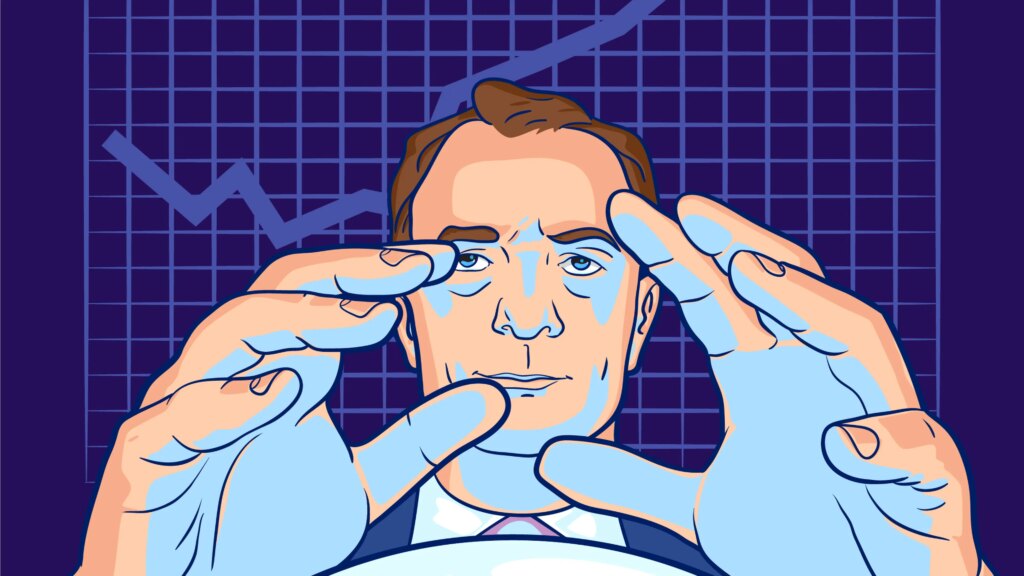
Today’s leaders do not need crystal balls. They don’t need to be certain about the percentage by which AI will increase GDP growth over the next five years or the exact date when the market will crash.
What they need is the humility to admit what they don’t know and the conviction to act anyway. According to the late psychologist Rollo May, “Commitment is healthiest when it is not without doubt, but in spite of doubt.”
A decade later, when confronted about his earlier prediction, Hinton admitted that he spoke too broadly and was wrong about the timing. In the future, he believes the medical images will be interpreted by a combination of AI and human radiologists.
In the end, Hinton’s willingness to say he was wrong and that he had changed his mind may be more instructive than the prediction itself.
The post Leaders Need to Stop Pretending They Can Predict the Future appeared first on TIME.