America’s allies, particularly but not exclusively the Europeans, have very good reasons to be furious with the Trump administration. Quite apart from Donald Trump’s gratuitous insults and shocking threats (particularly to take Greenland), they are rightly incensed that the United States, together with Israel, launched the latest campaign against Iran without consultation or forewarning. Their first reaction to requests for help escorting ships through the Strait of Hormuz has been some version of “You made your bed, now lie in it.” Even the Saudis, no friends of Iran, are reported to have temporarily cut off access to American air bases out of anger at getting no heads up from the Americans about the latest decision to guide American ships through the strait.
All understandable, but a serious error from the point of view of their own interests. The fundamental situation is this: The American blockade of the strait, though belated (it began only on April 13, six weeks into the war), is effective. Despite its paucity of mine-clearing vessels, and probably using previously unknown or secret systems, the U.S. Navy has enough confidence that it has guided two American commercial vessels and sent two of its valuable destroyers through the strait. Iranian pot shots at those vessels failed. The question is now which side will yield most in a complicated and chaotic negotiation.
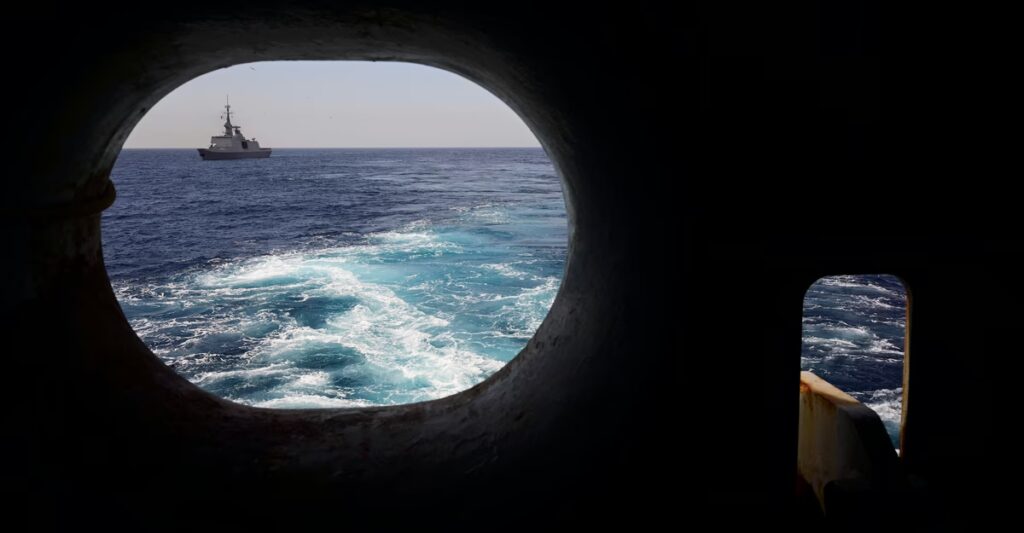
The United States would like its allies to provide frigates to escort oil tankers through this cleared passageway. Frigates, the equivalent of the destroyer escorts of World War II, are usually smaller than destroyers. An American Arleigh Burke-class destroyer can displace nearly 10,000 tons, the equivalent of a cruiser before World War II, where a European FREMM frigate might displace just more than 6,000 tons. Escorting convoys has been a mission for that class of warships for generations indeed, in some ways back to the age of sail. And improvidently, the U.S. Navy has failed to keep acquiring frigates.
Why should the Europeans help? One crude reason is that Trump, who has no sense of guilt about having failed to consult with allies, will come out of this episode angrier than ever at them, particularly the Europeans. Unfair and unjust, no doubt, but that is who they are dealing with. An enraged Trump, particularly if he feels humiliated in some way, is likely to do even more rash and stupid things than he has in the past, including withdrawing more forces from Europe, or effectively if not legally blowing up the NATO alliance.
[Isaac Stanley-Becker: Europe without America]
There are other reasons for sending the frigates, however. All seafaring nations have a deep interest in maintaining freedom of navigation through international waterways, of which the Strait of Hormuz is one of the most important. If Iran gets away with charging any kind of toll or fee for passing through it, that principle is shot, and that is a dangerous thing. The allies may not like how Trump is addressing that problem, but addressed it must be.
Moreover, European and Asian nations have a greater interest in securing this strait than does the United States. Yes, oil is fungible, and yes, Americans are already feeling the result of the shut off of oil flows from the Persian Gulf. But the fact remains that the United States is a major exporter of oil and natural gas, that it is exporting ever greater quantities, and that it is quietly facilitating tremendous growth in the export of Venezuelan oil as well. Trump’s bet that the strait’s shutdown hurts other countries more than the U.S. will probably not hold in the long term, but thus far, it has proved correct.
Finally, hate Trump if you wish, but the Iranians are much more of a problem than the Americans. Negotiations, compromise, limited strikes, sanctions, temporary deals—none of them stopped, or could stop, Iran’s drive for nuclear-weapons capacity, its incessant efforts to subvert neighbors, or its attempts to destroy the state of Israel. The longer-range missiles under development in Iran can hit European capitals. Nor is it the case that there has ever been a group of moderate Iranian leaders willing to break with the Islamic Republic’s fundamental policy of hostility to the West and Israel, and its desire to extend its imperial reach through violent means. The differences have been between the more and the less patient, the cruder and the subtler, the slightly more compromising and the hard-core fanatics. The underlying ideology, however, has been constant.
Would it be dangerous to send in the frigates? Yes. But here we run into one of the ways in which the West’s strategic culture has been vitiated by the Cold War habit of confusing strategy with deterrence. Many advanced states understand the need for some kind of violent reaction to terrorists or insurgents, usually as a task for special-operations forces. For the bulk of the armed forces, their main purpose has been preventing war by looking imposing rather than winning wars by fighting. That rationale for military power no longer suffices.
[Robert Kagan: Checkmate in Iran]
The Ukraine war has convinced many in Europe that deterrence may not be enough. The Iran conflict should as well. Navies have to be built to sail into harm’s way. The notion advanced by France and Britain, in particular, that a European flotilla should exercise a role only when the shooting is definitively over, is futile. The shooting will not end conclusively for quite some time, and indeed the most recent fighting is just one more round, if an exceptionally intense one, in a conflict that has gone on since the early 1980s. There will probably be others.
In the dark world that we have entered, the free maritime nations of the world have to be willing to take risks that in the past they might not have accepted. In this case, the United States’ having done most of the heavy lifting means it would be wise for America’s angry and badly treated allies to support it. Wagging a finger and curling one’s lip is emotionally satisfying in some ways, but it is a luxury affordable only before one has reentered history, not now. Pique is not policy, and sometimes statecraft requires swallowing hard and assisting someone whom you have every reason to despise.
The post Send the Frigates appeared first on The Atlantic.