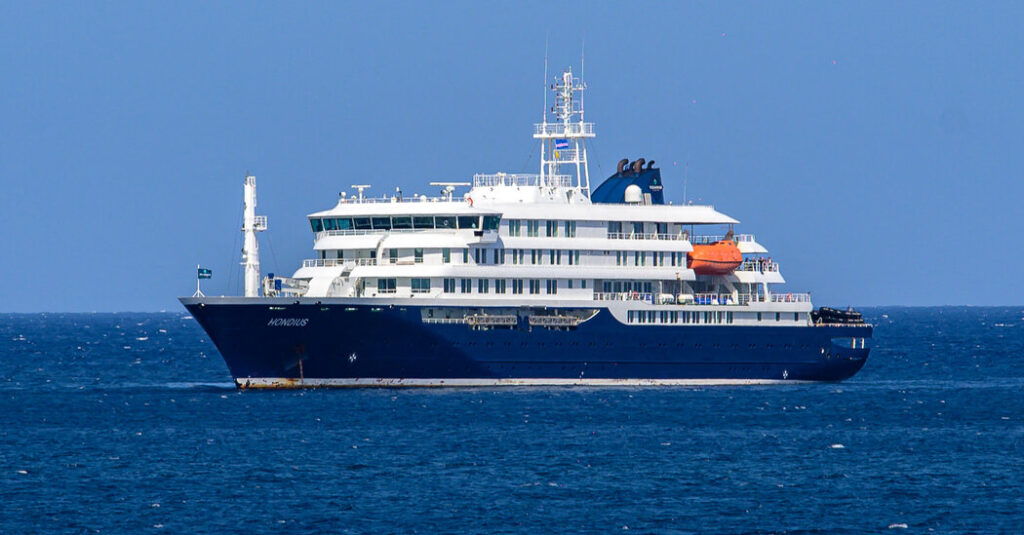
The health authorities were evacuating people from the ship hit by a deadly hantavirus outbreak for a second day as health officials announced that two more people tested positive for the virus on Sunday and Monday.
About 150 people were on the ship, the MV Hondius, when the evacuations began, after it anchored off Spain’s Canary Islands on Sunday. The World Health Organization has said that the risk to the general population is low, but health officials around the world are trying to calm fears and control potential spread by monitoring people who were aboard or in close contact with those who were.
Stéphanie Rist, the French health minister, said on Monday that one French passenger had tested positive after being evacuated on Sunday. The patient’s condition is deteriorating, she said.
On Sunday, the U.S. Department of Health and Human Services said that one of 17 Americans who had been returned to the United States from the ship on Sunday “tested mildly” positive for the Andes strain of the hantavirus, while another had “mild symptoms.”
Three people have died in the nearly six weeks since the ship began its adventure cruise from Argentina to remote islands in the southern Atlantic Ocean and now to the Canary Islands. Hantavirus is a rare family of pathogens carried by rodents.
There is no major risk to the wider public.
Human-to-human transmission of the hantavirus is rare. The type that infected patients from the ship, the Andes strain, was the only one known to spread among humans, affecting those who are in prolonged, close contact.
Global health officials are taking steps to stop the virus from spreading. Countries are working to trace people who may have been exposed to it. National health officials will monitor people who were aboard for signs of disease over the next few weeks.
There are no targeted treatments or widely available vaccines for the virus, which can result in severe illness and death. Symptoms can be treated with oxygen therapy, fluid replacement and medication, according to the Centers for Disease Control and Prevention.
Hantavirus is most commonly caught by breathing in particles of dried rodent droppings or urine. Early symptoms can look like those of the flu and include fever, chills, body aches and headaches. As the illness progresses, it can cause shortness of breath and, in severe instances, lung or heart failure. The C.D.C. cited a case fatality rate of up to 15 percent in Asia and Europe and up to 50 percent in the Americas.
Several people are sick or have tested positive.
Three people have died. At least seven other people who were on the ship have fallen ill or tested positive, health officials said.
-
One is in France. The person tested positive and their condition is deteriorating, the French health minister said on Monday.
-
Another person who tested positive is in Nebraska, the Department of Health and Human Services said late Sunday.
-
One man is in intensive care in Johannesburg, the World Health Organization said on Friday.
-
The ship’s doctor was “stable in isolation” after being evacuated to the Netherlands, according to the W.H.O. on Friday.
-
A man who was a guide on the ship was also stable and in isolation in the Netherlands, the W.H.O. said.
-
A man who disembarked at St. Helena, a remote island in the South Atlantic Ocean, on April 22 then flew to Switzerland through South Africa and Qatar in late April. He started experiencing symptoms on May 1 and tested positive on May 5. He is hospitalized and in isolation in Switzerland.
-
The health authorities in Britain said on Friday that a British citizen, who had been onboard and disembarked on Tristan da Cunha, another British territory in the South Atlantic, was suspected to have the virus. The W.H.O. has also called his illness a “probable case” and said on Friday that he was stable and in isolation. On Sunday, the British military executed a parachute mission to bring oxygen and experts to the remote island.
Three passengers have died.
The first passenger died less than two weeks after the MV Hondius, which is registered in the Netherlands, left Ushuaia, an Argentine city, on April 1.
-
A 69-year-old Dutch man developed symptoms on April 6 and died onboard on April 11. On April 24, his body was taken off the ship at St. Helena to be repatriated to the Netherlands. The W.H.O. considers him to have a “probable case.”
-
A 69-year-old Dutch woman, the man’s wife, became ill after leaving the ship with his body on April 24 with “gastrointestinal symptoms,” the W.H.O. said. She collapsed at an airport in Johannesburg, where she had briefly boarded a flight to the Netherlands. She was taken to a health facility, where she died on April 26. She later tested positive, the W.H.O. said. The W.H.O. said it believed that the Dutch couple who died had been infected with the hantavirus before boarding the ship.
-
A German woman had “fever and general malaise” on April 28, and then had symptoms of pneumonia, the W.H.O. said. She died aboard the ship on May 2. Her body later tested positive for the virus.
The ship will continue to the Netherlands.
Most of the evacuations were completed on Sunday. On Monday, the last plane will depart, said Mónica García, Spain’s health minister. It will take 22 remaining passengers and crew members, while another 32 will stay on board, she said.
Oceanwide Expeditions, the cruise operator, said on Sunday that once all guests and some of the crew had left, the ship “will bunker and take on necessary supplies” before heading to Rotterdam in the Netherlands.
That trip was expected to take around five days. The ship will be disinfected there, Spain’s interior minister, Fernando Grande-Marlaska, said on Saturday.
Americans are being monitored in the U.S.
Seventeen Americans who were on the ship when it anchored off the Canary Islands returned to the United States on Monday, according to the C.D.C.
They were taken to the University of Nebraska Medical Center/Nebraska Medicine in Omaha, the Health and Human Services said. It is unclear for how long the passengers will be quarantined.
Health officials in other states, including Georgia, California and Arizona, also said they were monitoring people who departed the cruise ship in late April, before the outbreak was identified, and returned home.
Other passengers have gone home, too.
Nearly two dozen countries have also moved to repatriate their citizens from the ship after it anchored off the Canary Islands. Once they are home, health officials plan to monitor them for symptoms as they stay isolated.
In late April, about 30 people from at least 12 countries also left the ship in St. Helena. That was more than a week before the first confirmed case of the virus was reported, according to Oceanwide. The company has said it contacted the people who disembarked in St. Helena.
Reporting was contributed by: Carlos Barragán, Aurelien Breeden, Emma Bubola, Lynsey Chutel, Rylee Kirk, John S.W. MacDonald, Apoorva Mandavilli, Aimee Ortiz, Alexandra E. Petri, Neil Vigdor and Ceylan Yeğinsu.
Amelia Nierenberg is a Times reporter covering international news from London.
The post What to Know About the Hantavirus Outbreak on a Cruise Ship appeared first on New York Times.