Hundreds of thousands of soccer fans are expected to descend on Kansas City, Mo., next month for the World Cup, many arriving from countries where people routinely take buses and trains.
Their Midwestern hosts are ready to impress with burnt ends and jazz and new soccer facilities. But officials knew Kansas City’s limited public transit system was not going to wow guests from Europe, South America and elsewhere.
So they built a new one.
It’s temporary, just for the World Cup. But public money is covering part of the tab to move visiting fans around a diffuse, car-centric two-state region, with a temporary transit system beyond anything in Kansas City’s modern history.
FIFA, soccer’s governing body, which is projected to make billions from the tournament, doesn’t pay for the extensive improvements to transit, security and infrastructure often needed to host World Cup matches.
That means cities, states and corporate donors are spending millions on the games, with officials relying on economic returns to justify the cost. Most of the 11 U.S. host regions initially embraced the event, accepting its high price tag as the cost of being in the global spotlight.
Host cities have spent big to expand rail service, buy police equipment and craft traffic plans for the five-week soccer spectacle, often amid uncertainty about how much will be reimbursed. But in recent weeks, as the impending disruption to daily life has become clear, there has been more pushback.
New York City commuters face a partial shutdown of Pennsylvania Station on days when matches are played at MetLife Stadium in nearby East Rutherford, N.J., where parking will be tightly curtailed. Soaring security costs prompted NJ Transit to initially set round-trip train fares at $150 for World Cup matches, while Boston is charging $95 for express buses.
“As I have said repeatedly, FIFA should cover the cost of transporting its fans,” Gov. Mikie Sherrill of New Jersey said about the high fares, which were reduced this week to $105.
Other places have balked at the costs. Town officials in Foxborough, Mass., the Boston suburb that will host matches, refused to foot the bill for security, creating a standoff that resolved only when the stadium’s owners and the local host committee stepped in to cover costs.
Officials and residents in Kansas City, the least populous U.S. metro area hosting matches, seem to have mostly embraced the opportunity — and accepted the cost of satisfying the transit and other needs that come with it. The states of Kansas and Missouri have chipped in a combined $70.5 million to the organizing committee. The local government in Kansas City, Mo., added about $15 million.
Six World Cup matches will be played at the revered but aging Arrowhead Stadium in Kansas City, and four teams, including some of the sport’s biggest, are making the region their base for the summer. There are worries, though, about whether the visitor boom will live up to expectations. In a report published last week by the American Hotel & Lodging Association, 85 to 90 percent of hotels surveyed in the Kansas City region reported lower-than-expected World Cup bookings, the worst rate among U.S. host sites.
The local organizing committee will deploy a fleet of 220 buses to shuttle spectators from the airport to downtown, and then from downtown to hotels, entertainment districts and other spots in both Missouri and Kansas. Ticket prices will remain far lower than in New Jersey or Massachusetts.
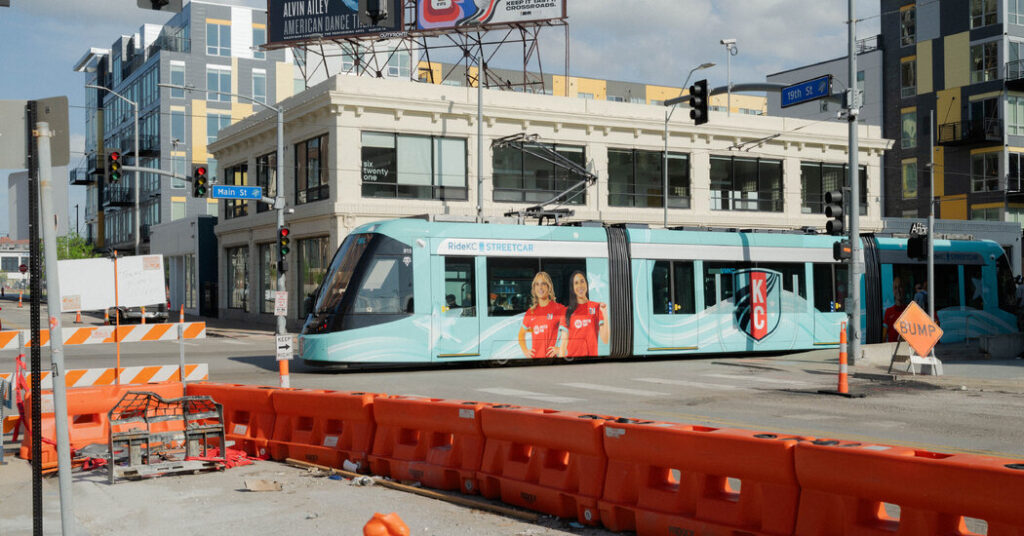
In the Kansas suburbs, local governments are spending hundreds of thousands of dollars on their own temporary bus line. Even a long-planned extension of the city’s streetcar system will be along for the ride.
The World Cup will be by far the biggest event in the city’s history, officials say, and a chance to introduce the region, with about 2.3 million people, to the wider world. Organizers are fond of equating the six matches planned there to six Super Bowls — a sporting event that Kansas City has won but never hosted.
“I think we’ve always kind of had a little bit of an underdog to us, in terms of being labeled a flyover city or a small city,” said Mike Kelly, the chairman of the Board of Commissioners in suburban Johnson County, Kan., and a member of the World Cup organizing committee board. “We feel proud of what’s going on here, so I think a lot of folks are excited to showcase that.”
Aside from the bus fleets, there are smaller expenses, like traffic cones and bollards for a local sheriff’s office, and around $116,000 for a mobile surveillance trailer and traffic barrier system in the tree-lined suburb of Prairie Village, Kan.
England’s national team, which is known to draw hordes of fans and journalists, has rented out a boutique hotel in Prairie Village for the duration of the tournament. “It will be a demand on the Prairie Village Police Department the likes of which I don’t know that we’ve ever seen before,” said the suburb’s mayor, Eric Mikkelson.
Mr. Mikkelson expects federal funding to reimburse his city for those purchases, as well as for expenses like officer overtime and police escorts to England’s training site in Missouri.
The Federal Emergency Management Agency set aside $625 million for security grants across the U.S. host cities, with about $59.5 million earmarked for the Kansas City area. State officials in Missouri are managing those federal funds, and requests for reimbursement will be funneled through them. FEMA also awarded Missouri $14 million to counter potential drone threats.
Some spending in Kansas City has faced pushback. After the City Council approved more than $20 million last year to build a modular jail, some residents protested the facility, and questioned what it said about the city.
“I think a lot of folks on the ground would tell you that, just based on where the city’s funding priorities are, they care more about sports events than they actually care about their citizens,” said Amaia Cook, the executive director of Decarcerate KC, a group that seeks changes in criminal justice policy.
Sherae Honeycutt, a city spokeswoman, said “the purpose of this work is broader than the event,” and that the jail “will improve how detainees serve their time in our care.” She said the city expected to begin using the facility on June 1, about two weeks before Algeria and Argentina meet in Kansas City’s first World Cup match.
Other U.S. cities, even those with experience hosting Super Bowl-size games, have also spent big on World Cup infrastructure. Houston is planting trees and improving trails. Officials with Atlanta’s transit system plan to have additional trains and a new payment system in place before the tournament.
None of the U.S. host cities are building new stadiums for the tournament, which makes it far more likely that they will recoup their World Cup investments. But sports economists say the projected economic impacts of mega-events like the World Cup are often overblown.
Victor Matheson, a College of the Holy Cross professor who studies the economics of large sporting events, said host cities might expect to see a modest economic bump, but not a trajectory-changing boom.
“You’re talking about a net positive, but not a net positive for everyone,” said Dr. Matheson, who is planning to attend one of the Kansas City matches. “And certainly not such a net positive that cities should be falling over themselves to be covering all of FIFA’s expenses.”
The Kansas City region’s existing bus network has limited service outside the city core, presenting one of its main challenges to hosting. The city’s newly rebuilt airport is 28 miles from its football stadium, which is seven miles from FIFA’s fan festival downtown.
Fans staying on the Kansas side of the state line can ride a bus 15 miles from the fan festival to the Overland Park Convention Center. But those visiting the Algerian team’s training site in Lawrence, Kan., face a 40-mile trek.
The bus rides will be cheaper than in the Northeastern cities. A round-trip ride to the stadium costs $15 in Kansas City. A day pass for unlimited rides to other spots will cost $5, while a tournament-long pass costs $50.
To make things easier, officials in the region also scheduled some road construction projects around the tournament, and worked to ensure that the long-planned extension of the streetcar system, which opened its first stops downtown about a decade ago, was ready for visitors.
Tom Gerend, the executive director of the Kansas City Streetcar Authority, said his agency was ramping up staff to run as many cars as possible, while putting finishing touches on a new stop by the riverfront hotel where Argentina’s team is expected to stay.
Still, Mr. Gerend said, the authority is thinking about scenarios where the number of fans overruns the streetcar’s capacity. “How do we plan for contingencies,” he said, “if we don’t have enough vehicles and staff?”
Mitch Smith is a Chicago-based national correspondent for The Times, covering the Midwest and Great Plains.
The post Kansas City, a Car Town, Spends Millions on World Cup Transit appeared first on New York Times.