Roger Bennett walked onto Alex Rodriguez’s podcast a few months ago and delivered the news with the calm of a man who had been waiting decades to say it. A-Rod kept asking some version of the same question — “When’s this soccer thing finally going to take off?” — and Bennett, Liverpool-born, Everton-supporting, and Lower-Manhattan-dwelling for the past 30 years, had to break it to him gently: it already has.
Soccer is now America’s third most popular sport, behind football and basketball, per a Q4 2024 research from Ampere Analysis cited by The Economist. A-Rod’s sport trails, the same study shows. “I don’t mean to be that guy coming onto your show, A-Rod, you icon,” Bennett said, “and be the person to bring the news to you that baseball has been pushed to number four in the list, but I am that guy.”
It is very much that moment. The 2026 FIFA Men’s World Cup kicks off this summer across American stadiums, followed by the Women’s World Cup in 2027 — back to back — and Bennett, co-founder and CEO of Men in Blazers, the podcast that became a 100-person media empire, is in full prophet-vindicated mode. “Football, for so long the sport of the future,” he said, “is finally the sport of the now.” The Women’s World Cup alone, he argues, will be “a cultural phenomenon” — Netflix has signed an exclusive U.S. broadcasting deal with FIFA for the 2027 and 2031 Women’s World Cups. “Football doesn’t sleep,” he says, “and now neither will we.”
The business case for why that matters is staggering. Roughly 200 million people watch the Super Bowl. Five billion will watch the World Cup, while NBC Sports’ opening weekend of the 2025-26 Premier League season averaged 850,000 viewers across six matches — the most-watched opening weekend on record in the United States — with the Manchester United-Arsenal match drawing 2 million viewers across NBC, Peacock, and digital platforms. For any media executive, brand strategist, or advertiser still filing soccer under “emerging,” Bennett would like a word.
“When two teams take the field,” he says, “their nations, histories, politics, cultures, take the field alongside them.”
That is the ethos of his new book, We Are The World (Cup): A Personal History of the World’s Greatest Sporting Event, and it is also, he argues, why the World Cup will be a seismic commercial success regardless of what happens to the two teams American fans care about most — the USMNT and England — whose combined exit from the tournament, history strongly suggests, is not a question of if but when.
From Liverpool to Lower Manhattan
Bennett arrived in America in 1994, the same year the U.S. last hosted the Men’s World Cup — the tournament that was supposed to ignite the sport here overnight. It didn’t, quite. What followed instead was three decades of slow, organic growth: a Major League Soccer that initially struggled to draw crowds, the rise of cable and streaming, the internet knitting Minnesota to Manchester and Los Angeles to Liverpool, the U.S. women’s national team winning everything in sight, and eventually the Premier League becoming the dominant cultural export. “England used to have an empire,” Bennett said drily. “That was kind of transformed to having a royal family, which is self-immolating … And now they’ve just got the football. It’s the biggest cultural export.”
He grew up in Liverpool as a third-generation Everton fan — the club was, he said, “in my blood” — which means he came of age understanding football not as entertainment but as identity, as civic religion. He is still baffled by the polygamous, fickle nature of American sports fandom.
That loyalty without geography gave Bennett his mission. The American soccer audience, according to Bennett, has matured into something unprecedented: a fan base that is passionate, global in its loyalties, and no longer dependent on the home team’s performance for its engagement. A Men in Blazers survey found that 54% of American soccer fans follow three or more teams globally — a habit essentially unheard of in Europe, where identity is geographic and generational. Europeans, Bennett notes, find this genuinely incomprehensible. Americans, meanwhile, don’t understand why the habit is remarkable. American fans make choices, Bennett said, without inherited obligation. “They weren’t born as third-generation Everton fans like I was, so it’s in my blood. So you choose afresh.”
The result is that Liverpool and Arsenal — clubs defined by authenticity, history, and a certain romantic suffering — are the two best-supported teams in the United States, while Manchester United, which arrived on American television screens largely after its glory years had ended, is regarded with bemused indifference. “Most American fans never saw them win the league,” Bennett explained, a major contrast to the club’s powerhouse status in, literally, the rest of the world.
That willingness to start from scratch is, paradoxically, what makes the American fan so receptive to the backstory — and backstory is exactly what Men in Blazers has always traded in. Early in Men in Blazers’ life, when it was a podcast, he and co-host Michael Davies received an innocent emailed question: What part of London is Newcastle in? “Why would an American know that Newcastle is a proud, northern, post-industrial, post-coal, post-steel, post-shipbuilding region, which has been hollowed out since the ’70s and the ’80s, the miner strikes, and football has become the everything of national pride?” he said. “We realised our mission was to talk about the football week to week, I think with an emotional intelligence, but also to backstory, the dreams, the yearning, the subtext, the context, the geography, the history, the sense of wonder.”
‘The American Century for Football’
All of which means this World Cup will be enormous whether the U.S. team goes deep or goes home early — and Bennett is bracingly honest about which outcome is more likely. The USMNT has won exactly one knockout-round game in World Cup history. Four years of automatic qualification as host nation have produced a diet of meaningless friendlies, despite the cursed moniker of a “golden generation” of players. “We have the best individual players we’ve ever had,” said Bennett, who offered a diagnosis of something off with the American soccer psyche. “When we play a big team, we still have an inferiority complex. An imposter syndrome.”
Bennett points out that he became an American citizen after vowing to do so and live on ESPN if the US were able to get out of the World Cup group of death in 2014. “They did. And I did.”
Bennett is bracingly honest about his birth country’s prospects, too. He said he holds the Three Lions with the particular dark tenderness of someone who has watched them exit on penalties for his entire sentient life. He referenced his shelf copy of a history book called 40 Years of Shite and compares England’s annual World Cup cycle to an analogy favored by his friend, the (Liverpool fan) John Oliver: “England is like Charlie Brown kicking a football with Lucy holding. Apart from the English people, almost liking the pain.” The English, he said, invented the sport and have spent nearly 60 years persuading themselves that divine right will deliver the trophy. They’ve won it once — controversially, at home, in 1966, a day that Bennett notes is as distant from now as Uranus, yet discussed as if it happened last Tuesday. His verdict: “I can imagine England winning the World Cup no more than I can imagine the New York Jets winning the Super Bowl.”
And yet — the party will be enormous. “The World Cup will be a massive success whether this U.S. team gets grouped, eliminated in their group, or goes deep,” Bennett said. What he calls “the hybrid identities of America,” which make the country such a vivacious, incredible mosaic, mean that many Americans will be, say, cheering for Korea, Japan, Colombia, and even Mexico. “That is the crazy place where we are.”
Bennett calls this the dawn of “the American century for football,” and the evidence is hard to dispute. A majority of Premier League clubs are now at least co-owned by Americans. The same is true across European leagues. Ryan Reynolds may be on his way to the top flight with Wrexham FC. But Bennett is clear-eyed about the tension this creates — what he calls the defining fault line of modern football: the collision between the profoundly local, historically rooted culture of the game and the global cash grab that American ownership often embodies.
The smartest owners, he argues, are those like Fenway Sports Group, who arrived at Liverpool, quickly learned what they didn’t know, and delivered two league titles and a Champions League. The cautionary tale is the owner who charges in, “openly talking about turning football clubs from underperforming content platforms into high-performing content platforms.” That framing, Bennett said, “shows a profound misunderstanding of what they’ve bought — and the fans will let them know that mistake almost instantly.”
The tension is playing out at the World Cup itself, where ticket prices have been set according to American sports-market logic — supply and demand, courtside Madison Square Garden-style — in a sport whose working-class roots run deep. “Football is a working-class game and the fans rebel against such a mindset. Two cultures are colliding, and that reaction and counter-reaction will define the future of the sport.”
Building the Backstory Machine
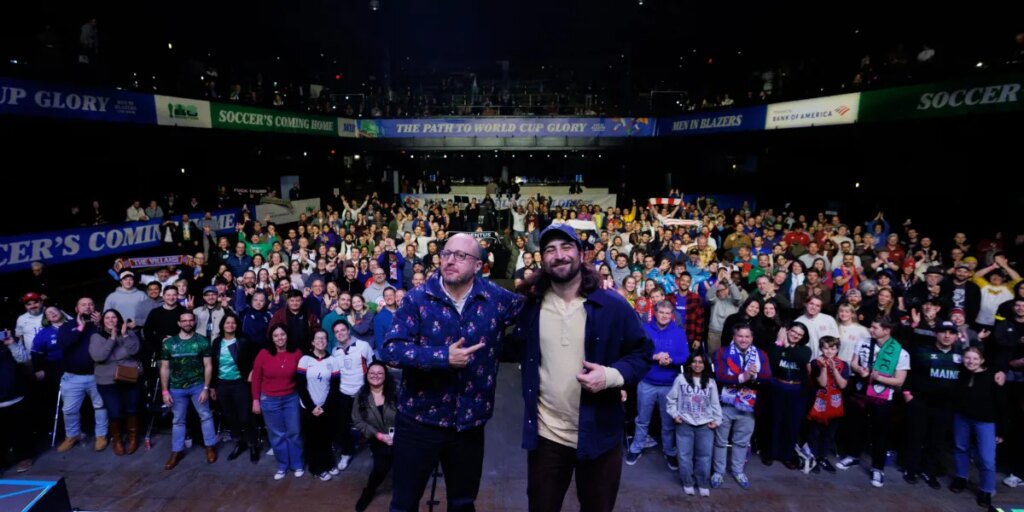
This summer will be big for Men in Blazers, too. In partnership with The Home Depot, the network will traverse the country from Los Angeles to Seattle to Texas in a custom-built, co-branded bus, broadcasting live from a first-of-its-kind traveling mobile studio every day of the tournament.
The network has grown from two men recording in a closet to an over-100-person operation with platforms for the Premier League, the Champions League, the USMNT, the women’s game, and the Hispanic soccer audience — each serving as a distinct community, not a monolith. Men in Blazers launched The Women’s Game in 2024 and Vamos in 2025 for the Latin American soccer audience, with the broader network seeing 44% year-over-year growth in overall impressions in 2025. The women’s game, Bennett says, is “one of the greatest stories of my lifetime to witness.” There is no other football nation in the world, he argues, whose football identity has been as shaped by its women’s success as America’s.
What he dreams of, ultimately, is simpler than all of it: “A dream of the US winning the World Cup in my lifetime on the men’s side is probably the thing I think about most.” He paused. “We can dream.”
Either way, the world is coming. And for the first time in the 30-odd years since Roger Bennett arrived on these shores, America is genuinely ready.
The post Roger Bennett’s message to A-Rod is one for the country: Soccer has already overtaken baseball in America appeared first on Fortune.