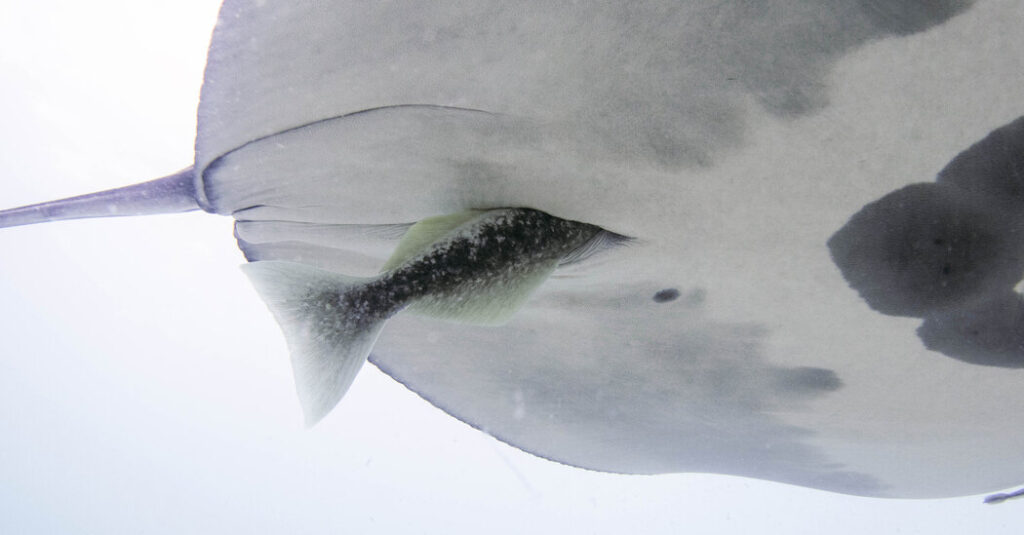
When danger calls, some animals bare their teeth. Others take to the sky, or curl into protective balls. But the remora — a fish that often hitches a ride on larger marine animals like sea turtles, whales and sharks — sometimes follows a less dignified strategy: It disappears inside a manta ray’s rear end.
In a study published on Monday in the journal Ecology and Evolution, a team of researchers referred to this newly observed behavior as “cloacal diving.” While many questions about this fishy practice remain, there is one thing the team feels sure about.
“It does not look like the manta ray likes it,” said Catherine Macdonald, director of the shark research and conservation program at the University of Miami and senior author of the new study.
While remoras, also known as suckerfish, have been observed diving into the safety of whale-shark cloacae in the past, this is the first time anyone has documented the behavior in manta rays.
The paper uses seven instances of cloacal diving that took place between 2010 and 2025 across all three known species of manta ray. What’s more, the observations, which were gathered by the Marine Megafauna Foundation, occurred in three separate ocean basins, suggesting that this previously unobserved behavior could be common among rays and the remora species that associate with them.
In some cases, the remora forces itself so far inside the ray’s cloaca that only the very tip of its tail can be seen protruding from the exterior. In others, the ray is not large enough to accommodate the remora’s entire body, and half of the suckerfish hangs out of the ray, like a toddler playing peekaboo beneath a blanket.
“The remoras are pretty much as wide as the cloaca is,” said Emily Yeager, a Ph.D. student at the University of Miami and the lead author of the study. “So it’s fully filling that opening.”
To the researchers’ knowledge, no one has studied how sensitive manta ray cloacae are specifically, though Dr. Macdonald said that her lab would often swab the cloacae of sharks for fecal DNA to better understand what they’d been eating.
“They don’t especially like us sticking a swab up there,” she said. “And that swab is a big Q-Tip compared to a remora.”
While all of this may seem as if it’s a lark — News flash: Fish hides inside another fish’s backside — the findings contribute new information to a topic already hotly debated by scientists: the type of impact remoras have on their hosts.
Traditionally, experts have seen the interaction between remoras and manta rays as either commensal or mutualistic. In a commensal relationship, one animal benefits while the other is neither benefited nor harmed. In a mutualistic relationship, both creatures benefit: The remora gets a free ride and food, while the manta has its skin cleaned of parasites.
But cloacal diving almost certainly changes the equation, said Eleanor Caves, a sensory biologist at Brown University who was not affiliated with the new study. While the remora’s presence inside the ray is most likely brief, it could interfere with waste discharge or reproduction, or even damage the cloaca’s lining. This may mean the relationship between remoras and manta rays sometimes tilts into a parasitic interaction, in which one species benefits and the other is harmed.
While the researchers provide just seven instances of remoras using manta-ray cloacae as their own personal panic rooms, the fact that the animals are so difficult to see once inside suggests that the behavior is under-documented, at the very least.
“It’s really challenging to study these highly mobile relationships in marine systems,” Ms. Yeager said. “Oftentimes when researchers interact with these organisms, it’s just for a second in time, when we’re scuba diving in one location and one passes over us, or we’re fishing in a site and we bring one to our boat.”
“But these relationships persist 24/7, all of the time,” she added. “And we’re seeing just a snapshot.”
The post A Fish That Hitches Rides Where the Sun Doesn’t Shine appeared first on New York Times.