The war in Iran has become a profound stress-test for the long-term economic futures of wealthy Gulf monarchies that have built reputations as global financial centers and, increasingly, tourism hubs and tech powerhouses.
Even if the United States and Iran are able to soon strike a deal to reopen the Strait of Hormuz — the contested, narrow waterway that is a chokepoint for one-fifth of the world’s oil and gas — economists warn the conflict will have profound effects on the region’s plans.
“The official narrative in these countries is that this economic crisis will be like covid, and climbing out of it will be quick,” said Frederic Schneider, a senior fellow at the Middle East Council on Global Affairs. “But there are structural breaks that cannot be easily undone. Both the oil and non-oil sectors are getting hit equally hard and are facing damage that is potentially long term.”
The same structural security weaknesses and challenging geography that have darkened the outlook for the region’s fossil fuel economy now threaten its emerging sectors. The prospect that Iran can shut down the Strait of Hormuz on a whim could shake the confidence of foreign investors and unravel the reputation of wealthy Gulf states as safe harbors for business.
Economies in Asia are already enduring serious fuel shortages, factory shutdowns and soaring prices for fertilizer as a result of the shutdown of the strait. It is pushing leaders there to rethink their reliance on Gulf states for trade, driving up costs globally, and raising questions about whether Western firms will be able to tap oil-rich monarchies for investment the way that they have in the past.
Financial companies are questioning the wisdom of expanding operations in a place where their office space could become a drone strike target. Tourists are canceling trips, with the World Travel and Tourism Council estimatingthat the war cost the region $600 million a day in lost revenue during the first weeks of the conflict. Tech firms are at risk of losing the government investment bankrolling giant data center projects. The real estate sector is reeling as the foreign workers driving its growth rethink whether to move to the region.
The outlook for restoring the oil and gas revenue that is still badly needed to fund the area’s economic makeover grows murkier every daythe conflict is not resolved. Both the United Arab Emirates and Saudi Arabia have pipelines that allow them to avoid the Strait of Hormuz. But Kuwait, Qatar and Bahrain find themselves “with no path out,” said Andrew Leber, a nonresident fellow at the Middle East program of the Carnegie Endowment for International Peace.
“They are economically under more pressure,” he said.
Kuwait and Bahrain have seen what was once billions of dollars in monthly revenue evaporate. Bahrain was hit with a major downgrade of its credit outlook by Moody’s, dropping from “stable” to “negative,” as key exports from the country grind to a halt. Qatar’s plan to use its immense natural gas exporting infrastructure to buttress its economy is in doubt, as exports are blocked and production facilities are badly damaged from Iranian attacks.
Even as Gulf nations have scrambled for solutions to export their oil and import other goods — including via the pipelines in Saudi Arabia and the UAE, and trucking networks across Saudi Arabia and Oman — the war has made clear “how vulnerable these countries are,” said Yoel Guzansky, a senior researcher and head of the Gulf Research Field at the Institute for National Security Studies, a research group at Tel Aviv University. As it maintains control of the Strait of Hormuz, Iran has also targeted both the East-West pipeline and Fujairah Port in the UAE, which caught fire on Monday amid a barrage of attacks. Analysts warn that such threats could be hanging over the region for years, as a durable peace deal that removes any risk that hostilities reignite seems increasingly unlikely.
At the same time, countries reeling from the war’s price shocks have scrambled for alternative energy sources, which could permanently suppress the global appetite for oil and gas.
“There is so much that is going to need to be rethought in the Gulf,” Guzansky said.
Gulf state leaders are projecting confidence that they will be able to carry out their blueprints for growth. In a statement, the UAE government said the country “has adopted forward-looking economic strategies that enhance its capacity to absorb any geopolitical and economic pressures.”
“In this regard, there is no change to investment plans or long-term economic priorities,” it added.
Yet pain is already spreading through Gulf economies.
Billions of dollars in infrastructure damage, heightened security threats from Iran, and loss of oil revenue already have countries diverting funds that once would have gone to foreign projects toward domestic needs, said Rebecca Patterson, a senior fellow at the Council on Foreign Relations. Those needs include repairing oil and gas production facilities, building expansive new pipelines that diminish reliance on the Strait of Hormuz and boosting military spending.
They are not short-term projects. They are a fundamental, and potentially permanent, shifting of priorities. Saudi Arabia has already scaled back its Vision 2030 initiative — an elaborate investment plan inked in 2016 to spur the transition into a more diverse economy. Optional investments are getting cut, including a $200 million gift to the Metropolitan Opera in New York that was withdrawn last month. The Saudis also plan to stop funding the LIV Golf tournament.
More consequentially, Patterson said, big tech companies that have relied on the Saudis to help bankroll their multibillion-dollar data center projects in the Middle East and the U.S. may need to start looking elsewhere for cash.
It is not just foreign companies that will feel the squeeze. In Kuwait, fallout from the war is underscoring how the practically free electricity that citizens and businesses take for granted may be unsustainable. Outages have taken hold as demand for power outstrips supply, with the government reluctant to build more plants because it costs so much to subsidize them.
“They lose money on every kilowatt of electricity they sell,” said Jim Krane, an energy scholar at Rice University’s Baker Institute for Public Policy. “Now the world is in an energy crisis, and citizens in Kuwait are shielded from those price signals.”
He said some Gulf states are going to need to rethink the extravagant subsidies and free services that are a hallmark of the region. At the same time, the burgeoning tourism and real estate sectors that are the pride of Gulf state leaders are under serious strain.
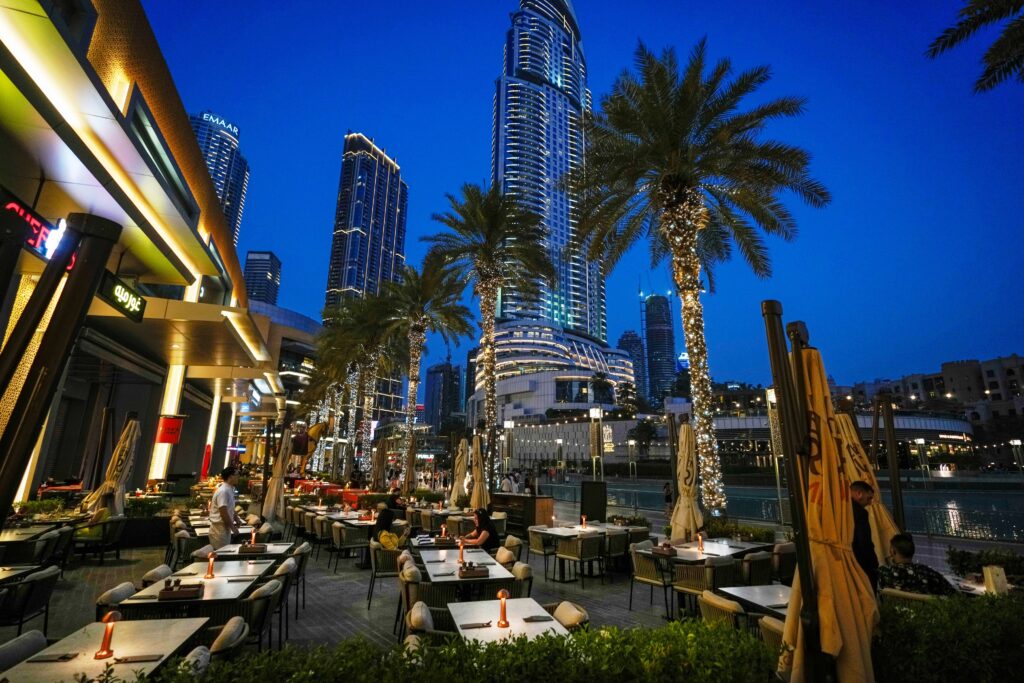
“We are all feeling it,” said Reza Namazi, a restaurant owner and food critic in Dubai. “There is pretty much no one coming in terms of tourists.” He said everyone in the area, especially in the hospitality sector, “is really struggling.”
Hotels that were once buzzing with expats and vacationers are being mothballed. Restaurants risk closing, and those able to stay afloat are having to remove from their menus foreign-sourced ingredients. Emirati residents and foreigners who have remained in Dubai are trying to step up their spending locally to fill the void.
“There’s a concerted effort by residents to spend — even if they are not spending what they once were,” Namazi said. “There’s a spirit of resilience that I love seeing.” But the region relies heavily on tourists and a massive immigrant workforce that risks quickly eroding as opportunities for blue-collar employment diminish, and white-collar executives from abroad contemplate if it is safe to live and work there.
Azad Zangana, who leads macroeconomic analysis of the Gulf for the research firm Oxford Economics, said this could cause a real estate crash that may ultimately rattle the UAE’s banking sector.
“There is a lot of concern about the real estate situation,” he said. “If they don’t see growth in migrants, who will buy all these properties?”
After the U.S. and Israel attacked Iran in late February, the number of people searching on Property Finder — a company akin to Zillow in the U.S. — dropped by 70 percent, said Cherif Sleiman, the company’s chief revenue officer. While searches have since bounced back to 80 percent of prewar levels, the number of transactions is about 60 percent of what it had been before the conflict. “Demand did not go away, but people are still sitting on the bench, waiting to see what happens,” he said.
Still, some argue the region has already cemented its place as a key global economic hub that has become too big to fail. “People are hungry to be here,” Sleiman said. “Whether it’s because of the weather, or the taxation platform or the stability in day-to-day life.”
Patterson points to another factor: “If you need capital to make new investments, where else do you go?” she said. For decades, investment firms looked to China to back big projects such as office complexes, golf courses and data centers. But amid today’s political tensions with that country, it’s less attractive in many cases.
And companies in the West seeking cash, Patterson said, are aware that sovereign wealth funds in the Middle East still control trillions of dollars in assets.
“They need the money,” she said.
The post Iran war threatens the dream of a post-oil economy in the Gulf appeared first on Washington Post.