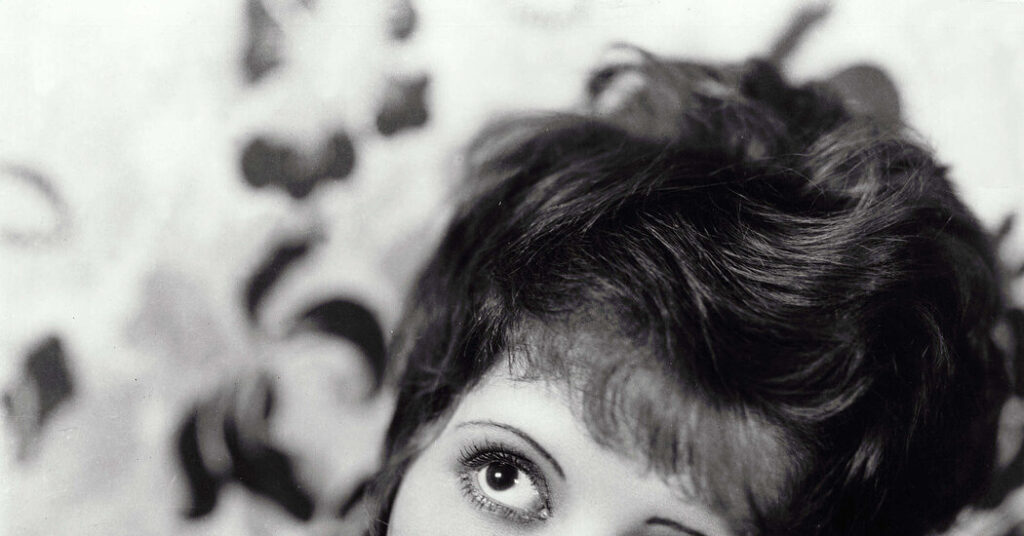
Clara Bow may be known to younger generations largely because of a 2024 Taylor Swift song. Yet the style Ms. Bow popularized in her silent films — particularly the 1927 film “It,” which gave rise to the term “It girl” — continues, consciously or not, to influence fashion today.
With her cropped hair and shorter hemlines, Ms. Bow defined the original flapper: an independent woman who earned her own living and, having survived World War I and the 1918 flu pandemic, embraced the 1920s dancing freely to the unfettered rhythms of jazz.
In the years following the Covid pandemic, there has been frequent talk of a Roaring Twenties revival. While the parallels are imperfect, fashion has nevertheless returned to 1920s codes. A pre-fall 2026 jacket by Dior is festooned with wide bands of fringe, while a pre-fall sleeveless dress from Chanel is constructed as layers of fringe that fall just above the knee. And judging from the latest fine and high jewelry pieces — from established houses such as Chaumet and Graff to independent designers including Carolina Bucci, Melanie Georgacopoulos and Nikos Koulis — the trend is taking hold in jewelry as well.
“It’s tempting to draw a direct line to the 1920s,” said Vivienne Becker, a jewelry historian and author, “but what we’ve seen over the past decade is a move away from a singular influence; today, it’s about freedom, individuality and, above all, comfort.”
Comfort is indeed a guiding principle for the London-based designer Carolina Bucci, whose fringed necklaces and bracelets are made from woven silk and gold threads, introducing what she described as “a sense of fluidity to parts of the body that naturally lend themselves to softness and drape.”
Speaking by phone from Florence, Italy, where she is originally from, Ms. Bucci pointed to the city’s textile heritage as a key source of inspiration. Her fringed necklaces feature an upper section woven on an antique Renaissance loom, combining silk and gold threads, from which dangle the tassels composed of fine gold chains.
Designed to sit like a second skin, Ms. Bucci’s fringed necklace can work as a base for layering. Achieving the right length for the fringes, she said, involved considerable trial and error, guided as much by comfort as by aesthetics. Was the 1920s a conscious reference? “It’s more about the spirit — that sense of freedom, of having no rules, of carefreeness,” she said. “That’s always been central to my design.”
The sentiment is echoed by the Athens-based designer Nikos Koulis. “I’ve been creating fringed pieces for the Oui collection since 2016, and I never thought of the Jazz Age,” he said over the phone, referring to his streamlined, diamond-set designs. “What draws me to fringes is their kinetic energy, the way they move and create a sense of sensuality.” In his workshop, he added, particular attention is paid to how the fringes fall, ensuring they achieve the right balance of movement and structure.
Similarly, Anne-Eva Geffroy, the design director at Graff, considers fringe an enduring archetype within jewelry design. In a recent necklace, she used it to organize diamonds of varying cuts into irregular bands that cross over and under a circular structure centered on a yellow diamond. “It was about creating the right architecture, almost a stage to showcase the stones,” she said during a video call. “The idea was to let light move through the diamonds of various cuts in the piece to enhance the presence of the central yellow diamond.”
A fringed foundation also proved apt for the London-based designer Cora Sheibani, who arranged round and elongated moonstone beads fanning out from a modernist collar that she presented at TEFAF Maastricht in March. “It’s sculptural, but the movement of the elongated beads brings suppleness,” Ms. Sheibani said in a phone interview.
Beyond aesthetics, fringe is also used as a functional element. The London-based pearl specialist Melanie Georgacopoulos incorporated fringe into her Cascade collar to anchor the piece in place. “I imagined strands of pearls hugging the back of the neck and resting on the shoulders, so I needed an element that would add weight,” she said in a phone interview. “Fringes felt like a natural choice, they are beautiful, but also tactile.”
In Ms. Georgacopoulos’s design, the fringes are composed of oxidized and polished silver beads that catch the light and add luminosity to the piece. They also introduce an element of versatility: The wearer can play with them and use them to style the necklace in ways that extend beyond the designer’s original intention, by tying knots, for instance.
In Place Vendôme, Paris, the historical references are more deliberate. “The elegance and style of the 1920s continue to fascinate us,” said Olga Corsini, director of the creative studio at Chaumet, by phone. “This collection draws on that era’s energy and audacity.”
Ms. Corsini pointed to the Café necklace, the focal point of which is a swaying, ribbonlike tassel anchored by a deep blue sapphire. “Fringes still express freedom,” she added, “but also audacity and self-affirmation.”
According to Alexandrine Maviel-Sonet, patrimony and exhibitions director at Van Cleef & Arpels, the spirit of freedom embodied by fringe is not confined to the 1920s, but resurfaced in the late 1950s and 1960s, when women again became more vocal about their rights. It was around that time that the house released its Cheveux D’Ange design. Rooted in textile-inspired techniques, the necklace is defined by intricate goldwork, as thin as “angel hair,” or “cheveux d’ange” from which it takes its name. “This is jewelry that is supple, comfortable, and can be worn day and night,” Ms. Maviel-Sonet said by phone.
Regardless of whether jewelry designers have been consciously influenced by Ms. Bow or not, “tassels and fringe pieces are definitely experiencing a resurgence in popularity,” Marion Fasel, a jewelry historian and author, wrote in an email. “The shimmy and shake, the sense of movement that tassels and fringes bring to jewelry, are delightful, and I think people are trying to find joy wherever they can these days.”
The post In Jewelry, a Resurgence of Fringe Echoes Freedom of 1920s appeared first on New York Times.