In the early to mid-2010s, many designers were producing jewelry so delicate, it “almost disappeared against the body,” said Liza Urla, the founder of the jewelry blog Gemologue.
In contrast to those days, Ms. Urla and other experts said, jewelry has become bigger, bolder and more sculptural — and when it comes to the wrist, barely there bracelets have given way to bangles and cuffs.
“Sculptural bangles mark a shift,” Ms. Urla, who has been documenting jewelry styles since 2009, wrote in an email. “Women are seeking pieces that feel assertive, tangible and grounding — objects that read as both armor and statement.”
Bangles have shown up lately on wrists and on runways (for fall collections from Roberto Cavalli and Ulla Johnson, for example) in multiple forms: as mixed-metal bracelets inlaid with jewels and enamel; as chunky bands of natural materials like amber and wood; and as sleek silver cuffs embedded with gemstones.
And celebrities such as Tessa Thompson and Rosie Huntington-Whiteley have even been seen wearing them over shirt and blazer sleeves.
For the bangles in her Echo collection, the Iran-born, New York City-based designer Halleh Amiralai embedded bands of 18-karat gold with white diamonds and spirals of black or white enamel that “mimic the depiction of an echo,” she said in an email.
While Ms. Amiralai creates jewelry in multiple sizes, working with larger, sculptural forms allows her, she said, “to emphasize line, proportion, and presence in a more expressive way.” (Bangles in the Echo collection start at $30,800.)
Bigger, more sculptural jewelry has been quietly reasserting itself in the high and fine jewelry sector for some time, Juliet Hutton-Squire, a founder of the jewelry consultancy Adorn Global, wrote in an email.
The shift back to bolder designs can be explained in part, she said, by a growing acceptance in high-end metal jewelry of alternative materials like precious stones, unconventional metals, wood and other organic substances.
“Boucheron has for some time led the way in this material innovation under the guidance of designer Claire Choisne,” she wrote. (Ms. Choisne joined the French jewelry house as its creative director in 2011.)
“Designers are cleverly integrating these materials into their design repertoire and in so doing are elevating the concept and perceived value of these previously disregarded materials,” Ms. Hutton-Squire said.
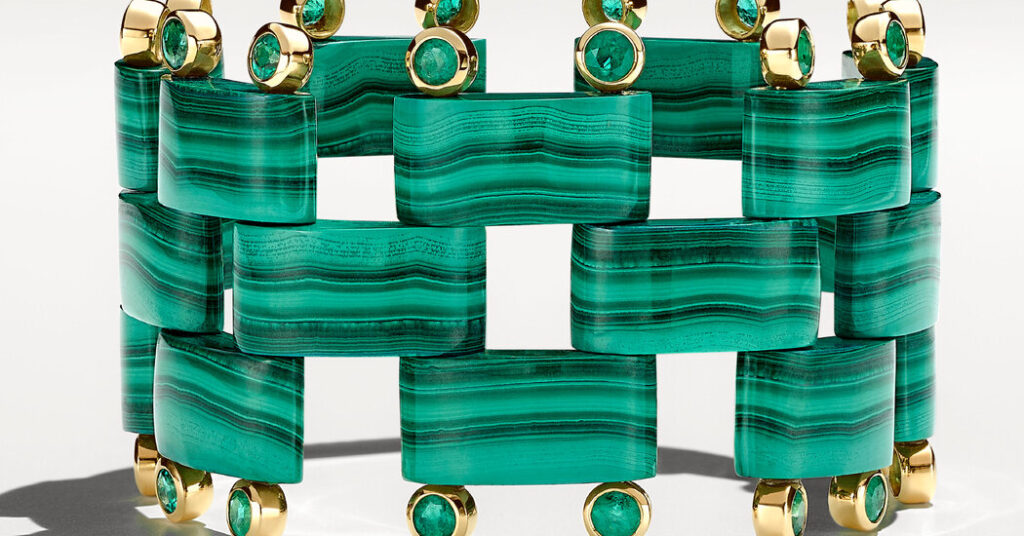
She cited as examples the Stream Wave Wood bracelet by the London-based Brazilian designer Fernando Jorge, who paired red louro wood and 18-karat yellow gold in a curvy bangle. (Price available upon inquiry.) And the cufflike Veridian bracelet by Sauer, also of Brazil, includes small rectangular malachite blocks accented with emeralds and 18-karat gold ($23,100).
Some designers had turned to alternative materials in response to rising metal prices and U.S. tariffs, Ms. Hutton-Squire added, while the growing presence of processes like electroplating had also enabled “bigger, bolder, more sculptural bangles.”
The German high jewelry house Hemmerle has been pairing diamonds and other jewels with rare wood varieties and alternative metals for over 30 years in its Harmony bangle, which the label introduced in 1991.
The open-ended bracelet has a rounded, robust silhouette and houses a clasp mechanism enabling it to be twisted open. It is designed in-house, and no two pieces are alike. (Prices are available on inquiry.)
While the first Harmony models were constructed from traditional metals and jewels, the company expanded its material repertoire to include alternative metals, rare wood varieties and even pebbles and marble.
Yasmin Hemmerle, who owns and runs the label with her husband, Christian — his family founded it in 1893 — said in an interview via video call that the Harmony bangle had become a signature of the brand since its release 35 years ago.
“What we are finding is that people want to buy things that they will wear and enjoy,” she said. “Sometimes it’s a bigger scale, sometimes the smaller scale, as long as it’s light and fits with their everyday lives.”
As for Ms. Hutton-Squire, the founder of Adorn, “it comes down to confidence and freedom of expression,” she wrote. “What is more empowering than accessorizing a pair of jeans, a white shirt with cuffs loosely turned up and loafers with a curated stack of bangles?”
The post The Return of the Statement Bangle appeared first on New York Times.