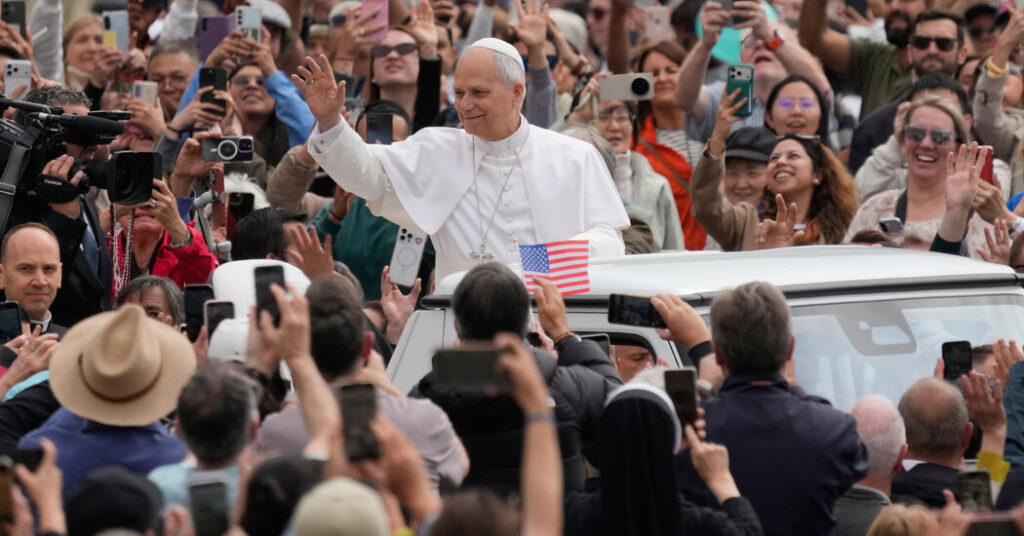
Pope Leo XIV’s moral voice has resounded in global politics during the first year of his papacy, on war, immigration and artificial intelligence.
But in quieter, more personal ways, the first pope from the United States has also been shaping the future of the Roman Catholic Church in his home country — one bishop at a time.
So far, Leo has made roughly 30 announcements involving new bishops, elevated bishops or retiring bishops in the United States, offering an early look at what the American church hierarchy will become under his leadership.
He appears to be naming bishops not primarily as political statements, but rather as leaders who, like him, have focused on pastoral care and local management, and who reflect the changing composition of Catholic pews and priests.
Last week, Leo appointed Bishop Evelio Menjivar-Ayala to be the next bishop of Wheeling-Charleston, the diocese that covers West Virginia. The first Salvadoran bishop in the United States, Bishop Menjivar-Ayala became a citizen 20 years ago after a period as an undocumented immigrant, an experience that resonates with many Catholic families in the country.
In his own story, Bishop Menjivar-Ayala sees the story of Leo, who as a young priest moved to Peru from the United States to be a missionary and then became both a bishop and a citizen of his new country. Leo’s appointments have a global perspective, he said.
“Those decisions are not taken from political points of view, but what are the needs of that community?” he said. “Jesus said if you want to be great, you should become the servant of all.”
The same day Bishop Menjivar-Ayala was appointed, Leo also named Father John Gomez, a Colombian-born priest who became a U.S. citizen five years ago, to lead the Diocese of Laredo on Texas’ border with Mexico.
Father Gomez, currently the vicar general of the Diocese of Tyler in East Texas, felt a call to ministry after completing his military service in Colombia. He went to seminary in Miami and continued his theological studies in Texas and Rome. In Tyler, nearly half of Catholics are Spanish speakers, he said.
“That was the reason I came to the United States, to serve the growing Spanish-speaking population in the Catholic Church,” he said.
“Now I am a bilingual, bicultural man, and I love to serve both communities,” he said. “But there is a great need for us here in the church, for priests.”
Many of the most prominent U.S. cardinals and archbishops are reaching retirement age, meaning Leo will have an opportunity to make personnel changes at the highest levels. Bishops are required to offer the pope their resignation at age 75, but the pope can choose whether to accept it for five years.
In Chicago, Cardinal Blase Cupich turned 77 in March, and in Newark, Cardinal Joseph Tobin turned 74 last week. Archbishops in Las Vegas, Miami and Santa Fe are all turning 76 this year.
Before Leo was elected pope, he ran the influential Vatican office responsible for choosing bishops. That expertise has allowed him to move quickly, and his relative youth means that he could significantly remake a generation of the church hierarchy, similar to the legacy of Pope John Paul II, said Christopher White, a senior fellow of the Initiative on Catholic Social Thought and Public Life at Georgetown University.
In December, Leo replaced Cardinal Timothy Dolan of New York, who turned 75 shortly before Francis died, and appointed Archbishop Ronald Hicks, 58, who also had a similar biography to Leo’s, with shared ministry experience and administrative skills.
A notable number of Leo’s new bishops, like many American priests and parishioners, were born in other countries.
Last June, Leo appointed Bishop Simon Peter Engurait, who was born in Uganda in 1971, the seventh of 14 children, to the Diocese of Houma-Thibodaux in Louisiana.
About a third of priests in his diocese are foreign-born, many with green cards and some with religious worker visas, Bishop Engurait said.
“Back in the day, you had bishops from, for example, Ireland, because that is where most of the priests came from,” he said. Now, as more and more priests come from Latin America and Africa, the makeup of the bishops is also changing.
One of his hopes is to integrate the range of diverse Catholic communities in his diocese, which includes many African Americans and a significant Hispanic and South Asian population, though very few Africans, he noted.
Recently, Hispanic Catholics had a celebration of the Virgin Mary, including traditions from places like Nicaragua, Puerto Rico and Mexico, and he wished other immigrant cultures in the dioceses were represented to share their own flavors of Catholicism, he said.
Leo’s focus on the universality of the church is a central gift for parishes, he noted.
“I personally believe that God gives us leaders for a time, for a season,” he said, adding that Leo has “a beautiful recognition and appreciation of the global human family.”
Shortly after his own installation mass, Bishop Engurait traveled to participate in the installation of another Leo-appointed bishop in his cohort, Bishop Pedro Bismarck Chau, an auxiliary in Newark who was born in Nicaragua and became a U.S. citizen in seminary.
Leo is continuing a trend that Pope Francis started, elevating priests who have what Francis called “the smell of the sheep,” Bishop Chau said.
Many in Leo’s cohort of new bishops came up as parish priests, meaning they have extensive on-the-ground pastoral experience as opposed to having primarily worked in diocesan offices or adjacent ministries, he noted.
In September, Bishop Chau will go with fellow newly appointed bishops to Rome for what they jokingly call “Baby Bishop School,” an annual Vatican program for that year’s bishop class, and meet Leo for the first time. His own appointment process began while Francis was still alive and Leo, then Cardinal Robert Francis Prevost, was still in his former role leading the bishops’ office.
“He saw my paperwork, he brought that paperwork to Pope Francis, that’s the interesting part of it,” Bishop Chau said. “I can’t wait to talk to him about it.”
Elizabeth Dias is The Times’s national religion correspondent, covering faith, politics and values.
The post With New Bishops, Pope Leo Starts to Put His Imprint on U.S. Church appeared first on New York Times.