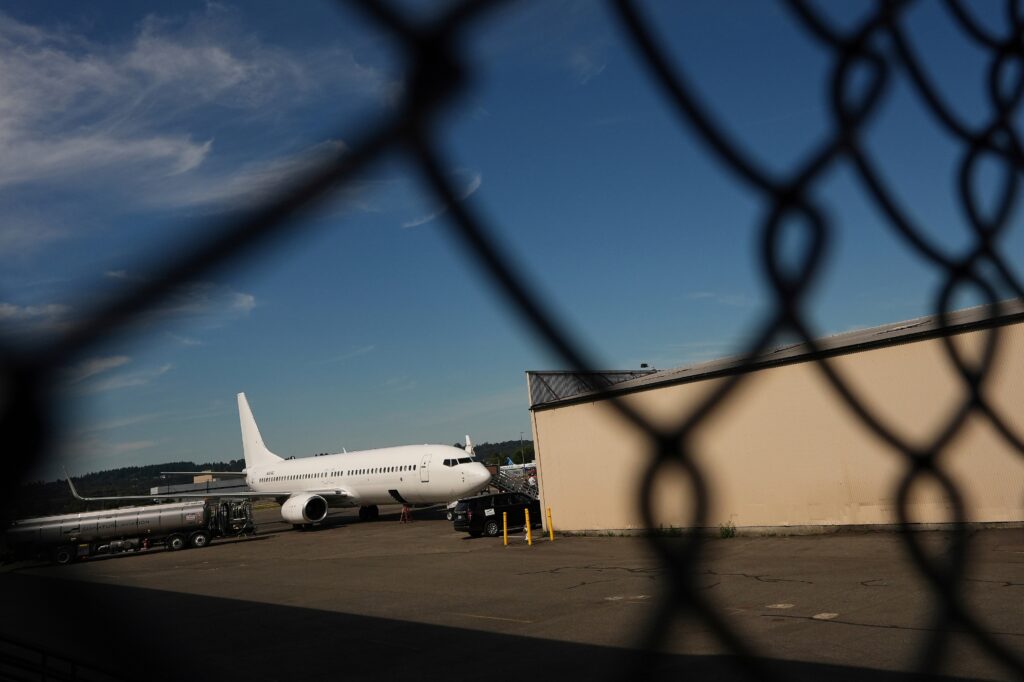
The 28-year-old began to panic when she learned where the military cargo plane, newly departed from a tarmac in Louisiana, was taking her.
The United States was deporting her and 13 other West Africans to Ghana, a country none of them called their own. From there, she feared, she would be sent on to neighboring Togo, the home she had fled to avoid genital mutilation.
A U.S. judge had ruled that the Trump administration could not send her back there. But Ghana was under no such obligation.
After two weeks last September in detention near Accra, the West Africa nation’s capital, armed guards dropped her and five others off at the Togo border, she said.
She has been in hiding in Togo ever since.
“I know God is with me but I’m tired,” she said in a tearful conversation. “I’m a human being. I have to live, like everybody.”
Over the past year, the Trump administration has sent hundreds of people to countries they are not from, in what are known as third-country deportations. Some of those people, like the woman who wound up back in Togo, had been granted protection against being sent back to the country they had fled by a U.S. immigration judge, only to be sent there by a third-country intermediary.
The woman, along with a man from Gambia deported on the same flight, spoke with The Washington Post by phone, on the condition of anonymity for fear of retribution. The Post also spoke with lawyers working with some of the deportees and reviewed court documents, including from their asylum proceeding and lawsuits filed in the United States and Ghana.
The story of the woman’s escape from Togo is recounted in her asylum declaration. An asylum officer had determined that she faced a credible fear of persecution or torture if deported to her country of birth, and an immigration judge ruled she could not be sent there. But under the Biden-era “Circumvention of Lawful Pathways” rule, the woman could not receive asylum, having crossed the U.S.-Mexico border without having sought protection in a country through which she passed en route. Had the restrictions not been in place, the judge would have granted her asylum, according to court documents.
U.S. Immigration and Customs Enforcement did not respond to a request for comment on the deportations to Ghana. In a statement to The Post, the White House defended its use of third-country deportations, adding that it doesn’t plan to stop anytime soon: “The Trump Administration will continue using all lawful methods to carry out President Trump’s promise to deport criminal illegal aliens.”
Togo’s embassy in Washington did not provide information requested about genital mutilation in the country. The office of Ghana’s president, the country’s Foreign Ministry and its embassy in Washington did not respond to requests for comment about the terms of Ghana’s deportation agreement with the Trump administration.
The woman left Togo in 2024 to escape genital cutting, she said. She had learned in school about health complications related to the custom — widely condemned as a severe human rights violation — which her mother and cousins had undergone. Practiced in dozens of countries, it often involves removing part of the clitoris and labia minora, and in some cases, sewing the vaginal opening shut.
In January 2024, her cousin was forced to undergo genital mutilation and died as a result, she said in interviews and her U.S. asylum declaration.
“The whole family hid the reason for her death except for my mother and her brother, who told me the truth,” she wrote in her asylum declaration. “Fear once again became a part of my daily life, knowing that I was bound to be the next to be cut under the circumciser’s sharp knife.”
“I clearly told my great-uncle that I was not going to give them the chance to expose my life to this murderous practice ‘in the name of tradition’ that took my cousin’s life, and that if my cousin succumbed, it was their fault, and they were the murderers,” she wrote.
Togo outlawed female genital mutilation in 1998. The practice has become uncommon there, but is not eradicated, according to a 2020 report, and remains somewhat prevalent in the Centrale Region, where she is from. When the woman asked the police for help, she said they told her be “a good African woman” and “respect my tradition,” she wrote.
“In this country, nobody can help me,” she told The Post. “If they do that practice on me and I die, nobody will help. Nobody will say anything.”
After family members held her captive, beating and starving her, she managed to escape, she said, and fled to the United States by way of Brazil and the perilous Darién Gap that separates Colombia and Panama. ICE detained her at the United States’ southern border in January 2025 and held her at the Eloy Detention Center in Arizona for eight months, she said.
A judge granted her a withholding of removal order on May 20, 2025, according to court documents, blocking deportation to Togo.
“Unfortunately for me, one day they just transferred me from Arizona to Louisiana and then from Louisiana to Ghana,” she said. Before long, she was back where she started.
Of the 14 people the U.S. deported to Ghana on the flight from Louisiana in September, at least 11 — including the woman from Togo and a man from Gambia — had been granted protections against removal by a U.S. immigration judge under the United Nations Convention Against Torture or other law, according to court documents.
Under CAT, to which the United States and Ghana are parties, the government cannot “expel or extradite” a person to a country where it is more likely than not that they will be tortured. The U.S. Immigration and Nationality Act prohibits deporting a noncitizen to a country where their “life or freedom would be threatened” because of their “race, religion, nationality, membership in a particular social group, or political opinion.”
In such cases, the administration has been deporting people to third countries. It sent a group of people from Latin America to the Democratic Republic of Congo last month, NPR reported. At least 25 countries have entered into deportation agreements, many of them opaque, with the U.S. government, or have received third-country nationals, according to a report released by Democratic members of the Senate Foreign Relations Committee in February. A federal-court decision blocked some of the deportations in February, but a higher court ruled that they could resume as a legal challenge proceeds, and third-country deportations continued apace in April.
According to the report, the Trump administration incentivized five countries — El Salvador, Equatorial Guinea, Rwanda, Eswatini and Palau — to agree to the deal by providing direct financial payments totaling $32 million.
As a part of those agreements, U.S. authorities sent about 250 Venezuelan migrants to a maximum-security prison in El Salvador last spring, while 29 migrants have been deported to Equatorial Guinea, 15 to Eswatini and seven to Rwanda, the report said.
Immigration advocates and attorneys have accused the Trump administration of using third-country deportations to circumvent CAT and INA protections through a process known as indirect or chain refoulement, which is prohibited under international refugee law. International law holds that states cannot avoid liability by merely outsourcing refugee protections, especially when exposing those individuals to foreseeable onward harm and removal, said Elora Mukherjee, a professor at Columbia Law School. But there is little recourse.
In March, the African Commission on Human and Peoples’ Rights agreed to hear a challenge to Eswatini’s third-country deportation agreement with the United States. The lawsuit, filed by the Global Strategic Litigation Council in December on behalf of three U.S. deportees originally from Cuba, Jamaica and Yemen, is the first of its kind outside of the Americas region.
At least 34 West Africans have been deported to Ghana since September as part of the third-country agreement between Washington and Accra, according to Meredyth Yoon, a lawyer working with some of them.
Ghana has defended its agreement with the United States. “We were approached by the U.S. to accept third-party nationals who were being removed from the U.S., and we agreed with them that West African nationals were acceptable,” Ghanaian President John Mahama said in September. “West Africa has a protocol of free movement. Any West African is welcome in Ghana.”
In February, Ghana’s Supreme Court ordered Mahama’s government to disclose the terms of the country’s deportation agreement to Ghanaian rights group Democracy Hub, which it has yet to do.
The 14 West African migrants sent to Ghana on the flight described in this story did not find out where they were headed until the plane stopped in the U.S. Virgin Islands to refuel, five of the deportees allege in a lawsuit filed in Washington by Asian Americans Advancing Justice, a legal advocacy group.
One of the five, a man from Gambia who had a judicial order against deportation there, was sent on by Ghana to Gambia. He has been in hiding ever since, he said. In the lawsuit, he said an ICE agent told him he would wind up back in his home country. ICE did not respond to a request for comment on the accusation.
“I think if the government was doing things aboveboard, they wouldn’t be forcing people into planes in the middle of the night without letting them talk to their attorneys and not telling them where they’re going until they’re on the plane,” said Bria Yazic, a lawyer working with some of the migrants.
The Togolese woman described being held in Ghana in poor conditions, without access to lawyers or family members. Detainees had limited access to running water and no access to bedding or feminine hygiene products, according to the Democracy Hub lawsuit.
“Despite repeated requests, they were not transported to any medical facility outside the camp,” the lawsuit alleges.
The woman was held at the camp for nearly two weeks until armed soldiers drove six of the migrants to Aflao, a border town in eastern Ghana, in late September. They were separated into two groups of three, given less than $150 each and ordered to cross the border into Togo on foot, the deportees say in the lawsuit filed in Ghanaian courts. Of the six people sent to Togo, only two were from there, the woman said. For the others, the country of fewer than 10 million residents was simply another incongruous stop in their deportation odyssey.
They walked for miles before hailing a taxi to Lomé, Togo’s capital city along the Atlantic coastline, the woman said. She parted ways with the group at a hotel and called her mother.
“I traveled from here to the U.S. to save my life,” the woman said. “I had a chance … but all these foolish people took my dreams.”
The post She fled genital mutilation in Togo. The U.S. deported her. appeared first on Washington Post.