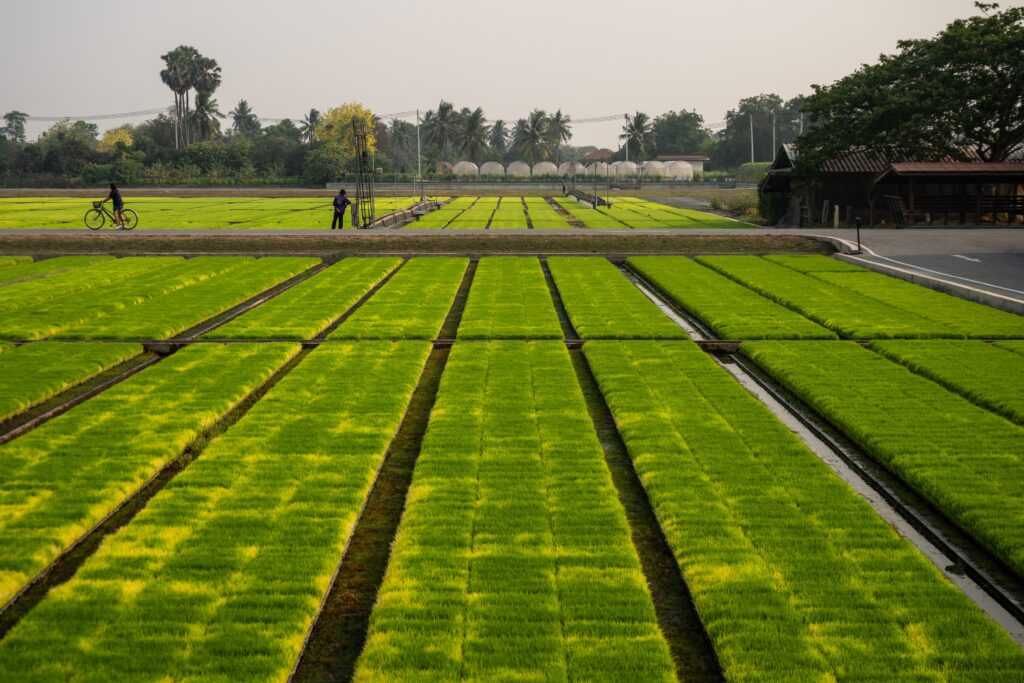
SUPHAN BURI, Thailand — Saithong Jamjai has just finished harvesting the rice on the 19 hectares of farmland she owns in central Thailand and now is the time to sow again. But she won’t, she said, because of the U.S.-Israeli war against Iran.
She has gone over the math for weeks. Because of surging prices, driven by the war, of fuel, fertilizer, plastics and other necessities, planting and harvesting will cost her at least $33,000, she said. The grain that she’ll produce, she estimates, will sell in August for only $22,000.
“A confirmed loss,” Saithong, 53, concluded. She’d rather let her land bake under the yellowing husks from last season. “We’re not going to sink the resources,” she said. “Not in this situation.”
The standoff between President Donald Trump and Iran that has brought shipping to a virtual halt in the Persian Gulf has set off supply chain shocks that are upending lives thousands of miles away in Asia, raising costs for farmers at the start of key planting seasons that will sharply reduce crop yields in the second half of the year and beyond, according to government officials, economists and farming groups.
Addressing world leaders in Rome on Thursday, Dongyu Qu, the director general of the U.N. Food and Agriculture Organization, said the war had created not only a geopolitical crisis but “a disruption at the core of the global agrifood system.”
Iran’s destruction of gas infrastructure in the Gulf and the dueling U.S.-Iran efforts to choke the Strait of Hormuz have prevented crucial supplies of fuel and its derivatives like urea — a potent source of nitrogen that enhances harvests — from leaving the Middle East. Because fuel infrastructure takes years to build, there is no ready replacement for these supplies.
In effect, 30 percent of the world’s urea has been “wiped out,” said Pranshi Goyal, senior analyst at the market intelligence firm CRU Group. China, a major fertilizer producer, has restricted exports to ensure its farmers have enough. Russia, another big manufacturer, is seeing demand soar, potentially boosting its economy and aiding its war in Ukraine. On what is known as the spot market, urea prices are up 40 percent since February.
On Monday, Trump said the United States would guide stranded ships through the Strait of Hormuz but then quickly reversed himself after reports that two U.S. destroyers had come under attack while transiting the strait. Even if ship traffic resumes, however, it would take at least a month or two for cargo to arrive at destinations and for markets to stabilize, Goyal said.
The longer the production plants in the Middle East stay closed, the longer they will take to restart. “This problem builds in a nonlinear fashion,” Goyal said.
So do its repercussions.
In Thailand, the Philippines, Bangladesh and Australia, which are the first since the war to enter key sowing periods, farmers are choosing to skip or reduce planting, or cut fertilizer use, which will lower yield.
As the war stretches deeper into the crop calendar, farmers from more countries will be forced to make similar choices, said Maximo Torero, chief economist for the FAO. “Right now, the impacts are more severe in Asia,” Torero said. “But clearly, this is moving east to west and south to north.”
In June, India and Brazil, two of the world’s biggest agricultural producers, will ramp up orders for urea. If, by then, vessels carrying urea are not sailing, there will be “significant yield loss” across many countries, Torero said. Commodity prices will climb, stoking inflation. The hit to economic growth, he said, will be “very close to what happened in covid-19.”
To make matters worse, scientists say the planet is likely to be hit with a super El Niñoclimate pattern this year, which could result in extreme heat and drought that will deal another blow to harvests.
Governments have tried to calm markets by asserting they have reserves. Thailand’s Commerce Ministry, for example, said in April the country still has 343,000 tons of urea fertilizer, sufficient to support the upcoming planting season. Driving through the vast flatlands surrounding Thailand’s Chao Phraya River basin, however, reveals a different picture.
Across Ayutthaya and Suphan Buri provinces, fertilizer shops large and small were completely out of urea — and said they had been for weeks. Distributors are offering only Russian compounds that farmers are wary to use, shop owners said. Seansdee Teerasattayaporn, 62, who runs a fertilizer wholesale business, sent a truck to a marketplace frequented by large dealers to try to procure urea but after waiting four days, he said, the truck returned empty.
Heading into planting season, many farmers said they are facing the worst conditions in their lifetimes. Not during the outbreak of the Russia-Ukraine war were shortages or costs this dire, they said. Nor during the pandemic.
Nam Aoi, 58, said she can only afford to plant on 19 of her 32 hectares. Until now, she never left farmland barren before.
Some of her neighbors blame the Thai government for not helping enough. Others accuse fertilizer companies of profiteering during an emergency. But standing at her paddy field under the 102-degree heat, sweat beading on her forehead, Nam Aoi said she faults only two men: Trump and Israeli Prime Minister Benjamin Netanyahu.
“Those two held hands and created war,” Nam Aoi said, her voice rising. “Nothing is normal because of them.”
In an interview, Foreign Minister Sihasak Phuangketkeow asserted that Thailand still has sufficient farming supplies and Thai leaders are jetting across the world to procure more. But he acknowledged the country is competing against bigger nations with deeper pockets, amid extraordinary logistical challenges. “We have not faced such a crisis before,” he said.
On Tuesday, two weeks after a trip to Moscow, Thailand’s agricultural minister said an attempt to secure urea from Russia is likely to fall through. Because of shipping disruptions, it would take at least two months for Russian urea to arrive in Thailand — far too late for the current planting season.
Agricultural experts say the Iran war has underlined the need for farmers to become more self-reliant, for example, weaning themselves of diesel by switching to solar power or swapping out chemical fertilizer for organic alternatives that can be produced locally. But to make these switches, farmers need government subsidies and time, both of which are in short supply, said Esther Penunia, secretary general of the Asian Farmers Association.
“Farmers can’t wait,” Penunia said. “On the day the sun shines, we have to plant.”
Thai farmers have been doubly hurt because the Middle East is also one of their biggest export markets. The region accounted for 17 percent of Thailand’s rice exports in 2025, according to customs data. Iraq was the single largest destination for Thai rice.
The day U.S. and Israeli forces bombed Iran, ship operators at a Bangkok port told sellers to lift containers of rice bound for Gulf countries off ships and back into warehouses, said Chookiat Ophaswongse, president of the Thai Rice Exporters Association. Since then, there have been no shipments of rice to the Gulf. Malaysia and the Philippines have absorbed some of Thailand’s excess supply but not all of it, leaving a glut that has kept rice prices low, Chookiat said.
Even before the war, many Thai farmers were in financially precarious situations, relying on loans to survive from one season to the next. Now, the squeeze of higher planting costs and lower projected rice sales could drive millions of farmers into spiraling debt that will take years to clear, said Pramote Charoensilp, 64, president of the Thai Farmers and Agriculturists Association.
Panida Srithong, 54, said even if she uses half as much fertilizer on her farmland, she sees no choice but to take out a line of credit from local loan sharks to afford the upcoming planting season.
Somchai Saelim, 51, said even though he will work every day from now until harvests in August, he expects to have virtually no profit at the end of it, so he’s sowing vegetables in his garden and rearing fish in his pond for sustenance.
Saichol Sudtoo, 52, said she is considering working as a day laborer to make up the $1,800 in losses that she anticipates from her next harvest. She has trouble sleeping these days because she is so anxious about money, she said.
“There’s a lot on farmers’ shoulders right now,” Pramote said. Research in Thailand also shows farmers have among the country’s highest suicide rates. Since the war began, farmers calling him from villages across the country have generally reported the same things, Pramote said. Debt. Depression. Desperation.
What does he tell them?
“I ask them to try to keep going. Just to keep going,” Pramote said, shrugging. “None of this is our fault. But we have to survive it.”
Huiyee Chiew in Taipei, Taiwan, contributed to this report.
The post Iran war is crushing Asia’s farmers, threatening global food supply appeared first on Washington Post.