President Trump really, really wants the war with Iran to end. He has declared victory many times, including about three weeks ago, when Iran briefly reopened the Strait of Hormuz. He has repeatedly extended his cease-fire deadlines instead of following through on his (sometimes-apocalyptic) threats to resume hostilities. This week, his administration abruptly abandoned an effort to escort ships through the strait in part because of a fear that it could provoke violent, escalating confrontations.
Trump is tired of the war, which has proved far more difficult and lasted far longer than he had expected. His party is warily watching rising gas prices and falling poll numbers. He doesn’t want to be bogged down in a Middle East conflict like some of his predecessors. He doesn’t want it to upend his high-stakes summit next week in China. He is ready to move on.
But Iran, it seems, does not want the war to come to a close. Or at least not with any sort of outcome that could be acceptable to American negotiators. Trump is now in a bind. The president, five aides and outside advisers told me, is convinced that he can sell any sort of agreement as a win. But at least for now, the man who wrote The Art of the Deal can’t even get Iran to the negotiating table. Today, Washington is still waiting for Iran to respond to the latest offering, a one-page memorandum of understanding that is far more of an extension of the cease-fire than a treaty to end the conflict.
Trump is left with a vexing question: How do you end a war when your opponent won’t budge? And while Trump grasps for an exit, the hard-liners in Tehran have used the war to tighten their grip on power. Iran seems hell-bent on pulling off something it’s historically done well: humiliating an American president.
Trump never thought it would turn out like this. After the impressive military operation to snatch Nicolás Maduro from Caracas, the president set his eyes on Iran, telling confidants that it would “be another Venezuela,” a pair of outside advisers told me. They, like others, spoke on the condition of anonymity to discuss internal strategy. Trump believed that the U.S. military was unstoppable, and that he had a chance to topple Tehran’s theocracy, a prize that had eluded his predecessors. He was redrawing the world’s maps and expected a victory to come in days, a week or two at most. The initial U.S.-Israel onslaught killed Iran’s supreme leader and included waves of bombings that reportedly obliterated much of the country’s missile capabilities. But Tehran did not capitulate, instead attacking its Gulf neighbors and seizing control of the Strait of Hormuz, through which 20 percent of the world’s oil passes. With a mix of mines, small attack boats, and drones, Iran effectively closed the waterway. Energy prices soared. The conflict settled into a stalemate and then a fragile cease-fire. One high-profile, official round of negotiations failed. No more are scheduled.
Outwardly Trump has expressed nothing but confidence. Sometimes, he downplays the war, calling it a “little excursion” or “detour” or “mini war.” He has proclaimed imminent victory nearly every day, a braggadocio that’s matched by Secretary of Defense Pete Hegseth at his Pentagon briefings. Behind closed doors, the volume is lower, but U.S. officials do believe a naval blockade of Iran’s ports, installed last month, is working and squeezing the country’s economy. Facing collapse, two officials predicted, Iran will be forced to negotiate.
But the real question is the timing: A number of experts have forecast that Iran can withstand pressure from the blockade for months, not weeks. A U.S. intelligence assessment delivered to policy makers this week agrees, suggesting that Iran could make it at least three or four more months. If so, and Iran continues to keep the strait closed, then prices will continue to rise in the West, including in the United States during a midterm-election year. It then becomes a matter of pain: Which side can withstand the most economic hardship?
[Read: Trump voters are over it]
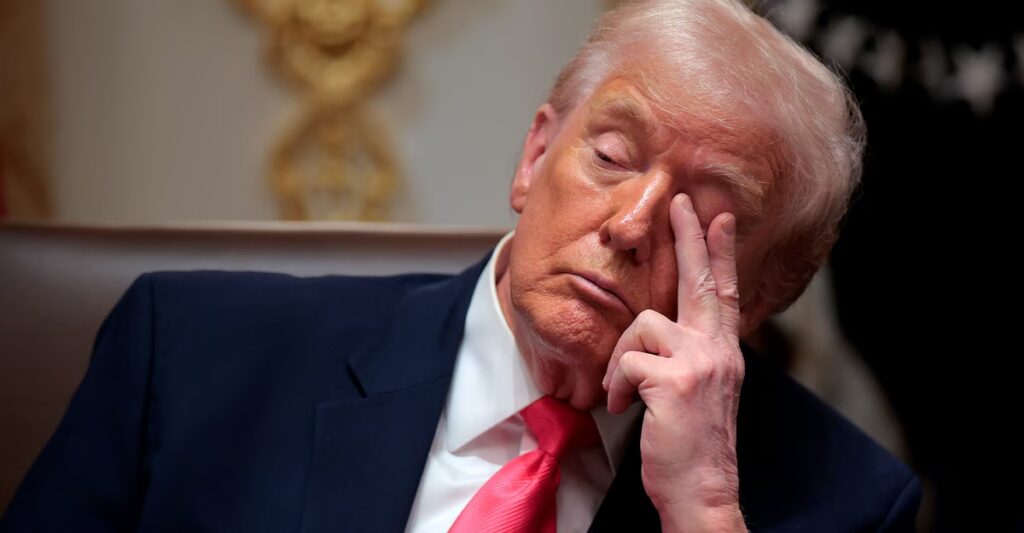
Patience is not Trump’s strength. One outside adviser, who speaks with him regularly, told me the president is “bored” with the war. Others believe he is frustrated at Iran’s intransigence. And while Trump at times feels detached from the political concerns of his party, Republicans have been inundated with complaints about rising prices, particularly at the gas pump. Many in the GOP were already preparing themselves to lose the House; the longer the war goes on, they believe, the more likely it is that the Senate could flip too.
Despite the negotiating impasse, Trump is reluctant to resume hostilities, aides and advisers have told me. There is concern about the dwindling supply of American munitions, and Trump this week expressed reluctance about killing more people. Some U.S. allies in the region (including, at times, Saudi Arabia and the United Arab Emirates) have voiced concern that the resumption of American attacks would make them, once more, targets of Iran’s retaliation. Yesterday, Iran opened fire on U.S. naval vessels in the Strait of Hormuz, and the U.S. retaliated by striking sites in Iran. But despite the spasm of violence, Trump insisted that the cease-fire was still in place and downplayed the strikes as “a love tap.” He also, advisers have indicated, wants to tamp down any military action ahead of his trip to Beijing next week to meet with Chinese President Xi Jinping. China has broadcast its unhappiness with the war and the closing of the strait; Trump wants to be able to claim that the fighting is ending as he pursues new trade and business deals with Xi.
As a further complication, the U.S. has largely exhausted its list of significant military targets, advisers have said. To continue to escalate, which is Trump’s signature move, he’s had to threaten civilian targets such as power plants, bridges, and even desalination plants. At one point, he threatened that “a whole civilization will die tonight,” an overt threat to commit war crimes. Trump also has options for a limited ground invasion—seizing highly enriched uranium or attacking Kharg Island, a hub of Iran’s energy sector—but he is leery about risking the lives of American troops.
[Read: The Pentagon may not be giving Trump the full picture of the war]
And so Trump keeps issuing deadlines to force Iran to cave, but Tehran keeps calling his bluff. For weeks now, Trump has blustered about resuming attacks but, each time, has found a way to back down. With the exception of a few hawkish voices, most in Trump’s orbit remain reluctant to restart the attack even as the stalemate continues. With the naval blockade in place to counter Iran’s closing of the strait, the administration on Monday unveiled Project Freedom, which deployed the U.S. Navy to help some ships escape the waterway. Although a few ships managed to cross the strait on the first day, Trump quickly abandoned the plan. Iranian forces fired on a South Korean cargo ship, there were clashes with U.S. warships, and the Pentagon said it destroyed seven small Iranian boats. But administration officials did not want to risk a major escalation of hostilities, particularly a possible attack on an American naval vessel. Some Gulf allies, fearing retaliation, moved to cut American access to their bases and airspace.
Trump also claimed that he was suspending the operation because a deal to end the war could be close. But he has been here before without success. American officials privately admit that, with Iran’s leadership fractured, they’re not sure with whom they are negotiating or who in Tehran is empowered to make a deal. Pakistani mediators have attempted to restart talks, but more moderate elements in Tehran have been largely bypassed by the hard-line Islamic Revolutionary Guard Corps. The formal negotiations, led by Vice President Vance, ended without a deal. Another round of talks slated for the end of last month never happened, as the Iranian delegation left Islamabad before American officials could arrive. It was an unmistakable rebuke.
Publicly, the White House continues to cast the war as going well, with spokesperson Olivia Wales telling me in a statement that “President Trump has all the cards, and he wisely keeps all options on the table to ensure that Iran can never possess a nuclear weapon. The highly successful blockade is strangling Iran’s economy, and the United States has proven that we maintain land, sea, and air superiority.”
Even without a formal agreement, Trump has considered declaring decisive victory and moving on. Secretary of State Marco Rubio went so far as to say earlier this week that the war was over. But doing so now would leave the conflict’s goals, as outlined at various times by the president and his aides, unfulfilled. Yes, the Iranian navy has been largely destroyed. But Iran still possesses, by some estimates, more than half of its ballistic-missile capabilities. Its proxy groups, such as Hezbollah, are still fighting. There has not been real regime change. Its nuclear stockpile remains a threat, and there is no deal to dilute it or ship it out of the country. Iran will almost certainly leave the war with more control, either implicitly or explicitly, over the Strait of Hormuz than it enjoyed before the conflict, including knowing that it could again shutter the waterway and inflict global economic pain.
Trump wants the war to end. He wants a deal. But deals take two parties, and there’s no evidence that Iran is interested in bailing Trump out of a dilemma of his own making.
The post Trump Is ‘Bored’ With the War He Started appeared first on The Atlantic.